How to Evaluate HOA Rules, Budgets, and Special Assessments on Portland Oregon Condos
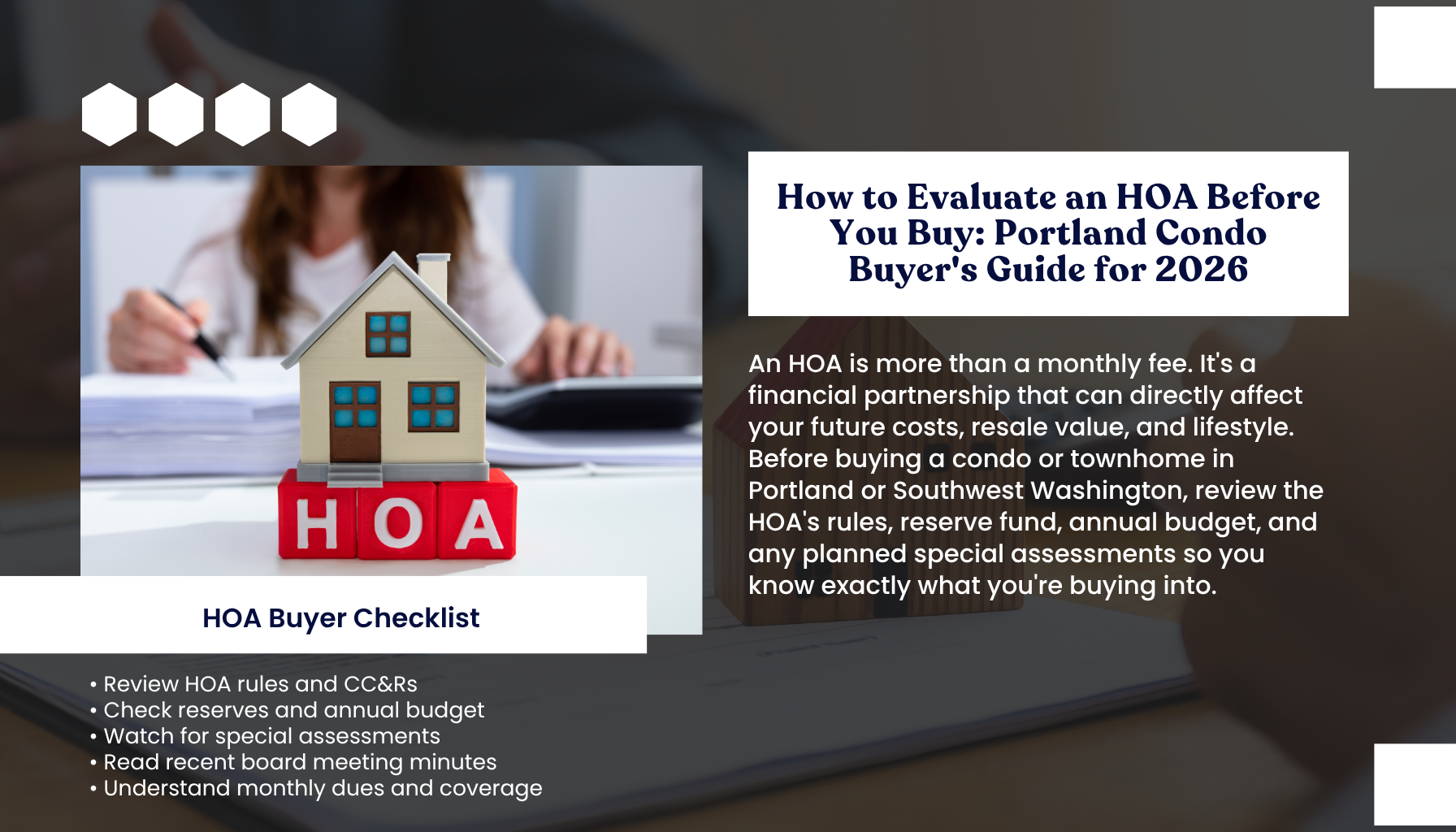
If you're buying a condo or townhome in Portland, Oregon or Southwest Washington, how do you evaluate the HOA's rules, financial health, and special assessment risk before making an offer?
You evaluate an HOA by reviewing its CC&Rs, analyzing the reserve study and annual budget, checking for pending or recent special assessments, and reading board meeting minutes for patterns of deferred maintenance or financial stress.
Why This Matters Right Now in Portland and Vancouver WA
Portland Oregon real estate presents a unique situation for condo and townhome buyers right now. Condo inventory in the urban core remains elevated compared to single-family homes, which means you have more leverage to negotiate, but it also means you need to be sharper about what you're buying into. An HOA isn't just a monthly bill. It's a financial partnership with every other owner in the building.
With over 20 years helping buyers and sellers navigate homes for sale in Portland Oregon and across Southwest Washington, I've seen firsthand how one overlooked HOA detail can turn a dream purchase into a financial headache. A buyer I worked with in the Pearl District nearly closed on a beautiful unit before we discovered a $35,000 special assessment that had been approved but not yet billed. That single finding changed the entire negotiation.
Whether you're inheriting a property with an existing HOA, buying your first condo near Irvington, or considering a townhome in Vancouver WA, here's exactly how to evaluate what you're walking into.
Understanding HOA Governing Documents Before You Buy in Portland Oregon
Your first step is requesting and reading the governing documents. Every HOA has a set of CC&Rs (Covenants, Conditions, and Restrictions), bylaws, and rules and regulations. In Oregon, sellers are required to provide these documents during the transaction, but you should request them during your due diligence period, not after you've already fallen in love with the unit.
Here's what to look for:
- Rental restrictions. Some Portland condo buildings limit the percentage of units that can be rented. If you're an investor or might need to rent the unit later, this is a dealbreaker you need to catch early.
- Pet policies. Breed restrictions, weight limits, and the number of pets allowed vary dramatically between buildings, even within the same Northeast Portland neighborhood.
- Alteration rules. Want to update the kitchen in your Sellwood townhome? Some HOAs require board approval for interior modifications, not just exterior changes.
- Use restrictions. Short-term rental bans, home business limitations, and parking rules all affect your lifestyle and financial flexibility.
What I tell my clients is this: read the CC&Rs like you're reading a lease, not a brochure. The tone and detail of these documents tell you a lot about how the association operates.
How to Analyze HOA Budgets and Financial Statements in the Portland Market
The HOA budget is where the real story lives. A beautifully maintained building in the Alberta Arts District or a newer townhome community in Battle Ground Washington can still be hiding financial problems beneath the surface.
What a Healthy HOA Budget Looks Like
- Operating expenses covered by dues. Monthly assessments should fully cover insurance, landscaping, utilities for common areas, management fees, and routine maintenance.
- Reserve fund contributions. A well-run HOA allocates at least 20-30% of its annual budget to reserves. If you see a budget where 95% goes to operations and almost nothing to reserves, that's a red flag.
- Year-over-year trends. Request three years of financial statements. Are dues increasing steadily by 3-5% annually? That's normal and healthy. A sudden 25% jump or, worse, years of flat dues followed by a massive special assessment tells a different story.
One couple looking at a townhome near Woodstock in Southeast Portland was initially excited by the low monthly HOA dues. When we pulled the financials, the reserve fund was nearly depleted, and the roof was 22 years old on a 25-year lifecycle. Low dues weren't a bargain; they were deferred maintenance waiting to become everyone's problem.
Key Numbers to Request
- Current reserve fund balance
- Most recent reserve study (ideally completed within the last 3-5 years)
- Annual budget with line-item detail
- Accounts receivable report (shows how many owners are behind on dues)
If more than 15% of owners are delinquent on dues, that's a serious concern. It means the association is likely deferring maintenance or borrowing from reserves to cover shortfalls.
Evaluating Special Assessments on Portland and Southwest Washington Condos
Special assessments are one-time charges levied on owners to cover major expenses the reserve fund can't handle. Think roof replacements, elevator upgrades, siding repairs, or seismic retrofitting. In the Portland Oregon real estate market, where many condo buildings date to the 1990s and 2000s, these are increasingly common.
How to Spot Special Assessment Risk
- Review the reserve study. This document projects future capital expenses over 20-30 years. If the current reserves fall below 50% of the recommended funding level, a special assessment is likely coming.
- Check board meeting minutes. The last 12-24 months of minutes often reveal discussions about upcoming major repairs. Boards don't surprise owners overnight; these conversations unfold over months.
- Ask about recent assessments. If the building passed a $20,000-per-unit assessment two years ago, find out what it covered and whether additional phases are planned.
- Building age and construction type. Portland's Pearl District high-rises, South Waterfront towers, and older condo conversions in inner Southeast Portland all carry different risk profiles.
For anyone inheriting a condo or townhome through probate, this is especially critical. You may inherit a unit with an existing special assessment balance owed, and that obligation transfers with the property. Having closed over 165 transactions across Portland and Southwest Washington, I've seen inherited properties where the heirs didn't discover an unpaid $8,000 assessment until they were already deep into the sale process.
What Portland and Vancouver WA Buyers Should Know About HOA Management
Not all HOA management is created equal. Self-managed associations (common in smaller townhome communities in neighborhoods like Foster-Powell, Lents, or newer developments in Brush Prairie Washington) operate very differently from professionally managed high-rise buildings downtown.
Self-Managed vs. Professionally Managed
- Self-managed HOAs rely on volunteer board members who may lack financial or property management experience. You'll want to scrutinize their bookkeeping, insurance coverage, and decision-making processes more closely.
- Professionally managed HOAs hire third-party companies that handle accounting, vendor contracts, and enforcement. This adds cost but typically improves consistency and record-keeping.
Questions to Ask the HOA or Property Manager
- What is the current reserve fund balance, and when was the last reserve study completed?
- Are there any pending or planned special assessments?
- What is the delinquency rate among current owners?
- Has the association been involved in any litigation in the past five years?
- What insurance does the HOA carry, and what does it cover versus what individual owners must insure?
That last question catches buyers off guard more than any other. In most Portland condo buildings, the HOA's master policy covers the building structure and common areas, but your interior finishes, personal property, and liability are your responsibility. You need an HO-6 policy, and you need it before closing.
HOA Considerations Specific to Inherited and Probate Properties in Portland
If you've inherited a condo or townhome in the Portland Oregon real estate market, HOA evaluation takes on additional urgency. Here's why.
- Unpaid dues and assessments. Any outstanding HOA balances typically become the responsibility of the estate or the new owner. Before accepting or selling inherited property, request a resale certificate or estoppel letter from the HOA that details the exact financial standing of the unit.
- Transfer fees. Many associations charge a transfer fee when ownership changes, including through inheritance. These range from a few hundred dollars to over $1,000.
- Compliance issues. If the previous owner made unauthorized modifications, kept pets in violation of rules, or let the unit fall into disrepair, the estate may face fines or required remediation before the unit can be sold.
- VA loan eligibility. If you're selling an inherited condo in Vancouver WA or Battle Ground Washington and the buyer is using a VA loan, the condo project must be on the VA's approved list. This is a non-negotiable requirement that can derail a sale if not verified early.
With 24 five-star reviews from past clients and a background in education, I approach these complex situations the same way I approach everything: with clear communication, thorough research, and honest guidance about what the numbers actually mean.
Frequently Asked Questions
What documents should I request from a Portland Oregon HOA before buying?
You should request the CC&Rs, bylaws, rules and regulations, most recent reserve study, annual budget, financial statements for the past two to three years, board meeting minutes, and a resale certificate. Oregon law requires sellers to provide many of these, but you should proactively request them during your inspection period to ensure nothing is missed.
How much should an HOA reserve fund have to be considered healthy?
A well-funded HOA typically maintains reserves at 70% or higher of the amount recommended by a professional reserve study. Below 50% is concerning and suggests special assessments may be needed. Below 30% is a serious red flag that indicates systemic underfunding.
What is a special assessment, and how does it affect my purchase in Portland?
A special assessment is a one-time charge to all unit owners to cover a major expense that exceeds the reserve fund's capacity. Common triggers include roof replacement, elevator repair, or building envelope work. If a special assessment is pending at the time of your purchase, you may be able to negotiate who pays it as part of your offer.
Can HOA rules change after I buy a condo in Northeast Portland?
Yes. HOA boards can amend rules and sometimes even CC&Rs through a vote of the membership. Review the amendment process in the bylaws to understand how much control the board has versus individual owners. Attending board meetings before you buy gives you insight into the direction the association is heading.
How do Portland condo HOA dues compare to townhome HOA dues?
Condo HOA dues in Portland, especially in high-rise buildings in the Pearl District or South Waterfront, tend to be significantly higher than townhome dues because they cover elevators, lobbies, parking structures, and shared amenities. Townhome HOAs in neighborhoods like Woodstock or Sellwood typically cover landscaping, exterior maintenance, and shared insurance.
What happens to HOA obligations when I inherit a property?
All existing HOA obligations transfer with the property, including any unpaid dues, special assessments, or compliance violations. Request a resale certificate from the HOA to get a complete accounting of what is owed before making decisions about keeping or selling the inherited property.
Are Vancouver WA condo HOAs different from Portland HOAs?
Washington and Oregon have different state laws governing HOAs. Washington's Condominium Act and Homeowners' Association Act have distinct requirements around reserve studies, disclosure, and owner rights. If you're comparing homes for sale in Vancouver WA with Portland options, make sure your Portland Oregon real estate agent understands the regulatory differences on both sides of the river.
How do I know if an HOA is well-managed?
Look for consistent financial reporting, a recently updated reserve study, low owner delinquency rates (under 10%), professional management, and board meeting minutes that show proactive decision-making rather than reactive crisis management. A well-managed HOA communicates regularly with owners and plans ahead for major expenses.
Can an HOA prevent me from renting out my inherited condo?
Yes. Many Portland and Southwest Washington HOAs have rental caps or restrictions. If you inherit a condo and plan to rent it rather than sell, verify the rental policy immediately. Some associations have waiting lists for rental permits, and others prohibit new rentals entirely if the building has reached its cap.
Should I attend an HOA board meeting before buying?
Absolutely. Board meetings reveal the tone, priorities, and conflicts within a community in ways that documents alone cannot. You'll hear about upcoming projects, budget concerns, neighbor disputes, and management quality. One meeting can tell you more about your future living experience than a hundred pages of CC&Rs.
The Bottom Line
Evaluating an HOA isn't just a checklist item. It's one of the most important financial decisions you'll make when buying a condo or townhome in Portland Oregon or Southwest Washington real estate markets. From Laurelhurst to Vancouver WA, from the Alberta Arts District to Battle Ground Washington, every association has its own financial health, management style, and culture.
Whether you're a first-time buyer drawn to the walkability and coffee shops of Northeast Portland, a remote worker weighing the tax advantages of living in Vancouver WA, or an heir navigating a probate sale on a property you never expected to own, the HOA details matter as much as the floor plan.
If you have questions about a specific property, need help interpreting HOA documents, or want straightforward guidance from a Portland Oregon real estate agent with over 20 years of experience and 165 closed transactions, reach out to Lisa Mehlhoff at 503-490-4888. Clear communication and confident decisions start with the right information.
Categories
Recent Posts









"My job is to find and attract mastery-based agents to the office, protect the culture, and make sure everyone is happy! "