Inspection Issues to Anticipate When Selling an Inherited Portland Home
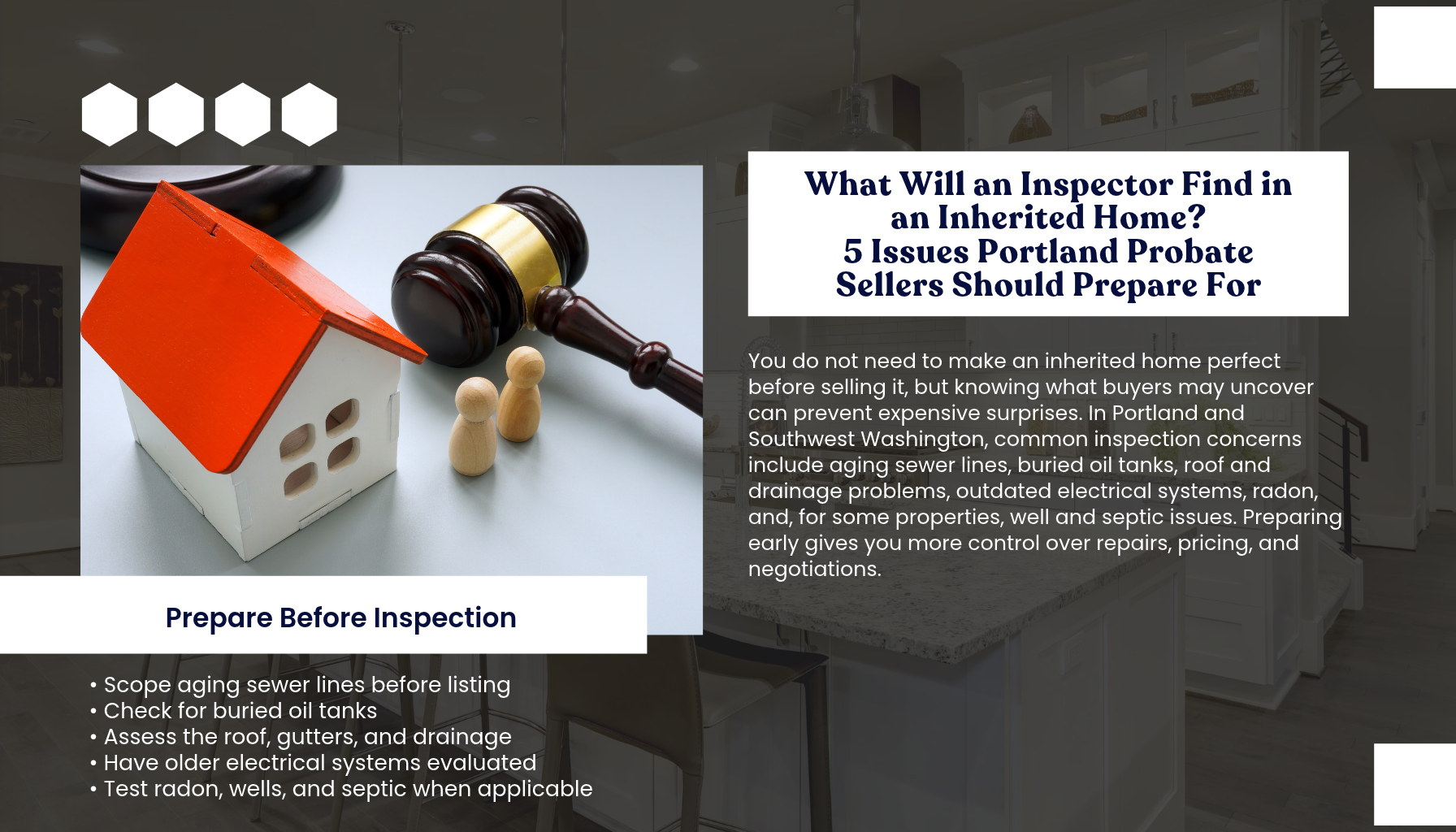
What inspection issues should you anticipate when selling an inherited property, and how can you prepare for them now?
Inherited homes in Portland and Southwest Washington commonly face inspection findings related to aging roofs, deteriorating sewer laterals, buried oil tanks, outdated electrical systems, and elevated radon levels. Preparing before you list reduces surprises and strengthens your negotiating position.
Why This Matters Right Now for Portland Oregon Probate Sellers
If you have recently inherited a home in Portland, Oregon or in Southwest Washington communities like Vancouver or Brush Prairie, the inspection phase of a sale can feel like the most nerve-wracking part of the process. You may not have lived in the home. You may not know when the roof was last replaced, what is buried in the yard, or whether the wiring behind the walls is original.
What I tell my clients is that preparation is the most powerful tool you have. Today's buyers in the Portland Oregon real estate market are intentional and almost always include inspection contingencies. That means any issue an inspector uncovers becomes a negotiation point, a potential price reduction, or worse, a reason for a buyer to walk away.
The good news? Most inspection findings are manageable when you know what to expect. With 20 years of experience and over 165 homes sold across Portland and Southwest Washington, I have seen these issues surface again and again. Preparing for them now is not about criticizing the previous owner's upkeep. It is about honoring the estate by positioning the home for a smooth, successful sale.
Sewer Laterals in Portland Oregon Neighborhoods: Your Top Inspection Priority
If the inherited home sits in Northeast Portland's Laurelhurst or Irvington neighborhoods, or in Southeast Portland communities like Foster-Powell, Lents, Woodstock, or Sellwood, the sewer lateral is likely one of your biggest inspection considerations. These neighborhoods were largely built with clay or Orangeburg sewer laterals that are now 60 to 100 years old.
What Buyers Will Find During a Sewer Scope
Buyers in these Portland neighborhoods routinely order a sewer scope as a separate, dedicated inspection. This is not optional in their minds; it is standard practice. The camera inspection frequently reveals:
- Root intrusion from mature trees that line these older streets
- Bellying, where sections of the pipe sag and collect standing water
- Cracks or collapse in aging clay pipes
- Offset joints where ground movement has shifted pipe connections
So what does this mean for your sale? A sewer line replacement can be a significant cost, and if the buyer's inspector finds problems, you will almost certainly face a repair request or a price concession.
How You Can Prepare Now
Before listing, consider ordering your own sewer scope inspection. If the results are clean, you have a selling point. If problems surface, you can get repair estimates and factor them into your pricing strategy, or handle repairs in advance. The City of Portland offers a Sewer Lateral Assistance Program through the Bureau of Environmental Services, though you should contact them directly to confirm current eligibility and terms, as program details can change.
Underground Oil Tanks: A Hidden Concern Across Portland and Brush Prairie
Here is something many out-of-area heirs do not realize. Many Portland homes built before 1970 were heated with fuel oil, and decommissioned tanks are frequently still buried in the yard. This is true not only in Portland's historic neighborhoods like the Alberta Arts District and North Portland, but also in some older properties in Southwest Washington.
Why This Can Derail Your Sale
An undisclosed or improperly abandoned underground storage tank is considered a material defect. Under Oregon DEQ regulations, abandoned tanks must be properly decommissioned, and any soil contamination must be assessed and remediated. If a buyer's inspector or a tank locator discovers a buried tank you did not know about, it can delay closing by weeks or months, and in some cases, kill the deal entirely.
Your Action Steps Before Listing
- Pull permits from the city or county to see if a tank was previously decommissioned
- Hire a tank locator if the tank status is unknown; this typically involves a scan of the yard with specialized equipment
- Contact Oregon DEQ's Underground Storage Tank Program for guidance on remediation requirements if a tank is found
What I consistently see in this market is that addressing the oil tank question upfront removes one of the biggest unknowns from your transaction. Buyers will ask about it, and having documentation ready builds confidence.
Roof, Gutter, and Drainage Issues in Portland's Wet Climate
Portland's climate is beautiful, but it is relentless on roofing materials. Moss growth, granule loss, and gutter failure are accelerated by the constant moisture, and inspectors know exactly where to look.
What Inspectors Flag First
The roof is typically the first item in any inspection report. For inherited homes, especially those where an aging owner may have deferred maintenance, inspectors will note:
- Age and remaining lifespan of the roof covering
- Condition of flashing at chimneys, skylights, and valleys
- Moss and debris accumulation on shingles and in gutters
- Whether gutters and downspouts drain away from the foundation, not toward it
- Evidence of interior water intrusion, which in Oregon is a material defect that must be disclosed
A roof that is functional but visibly aged will appear in the report and give the buyer leverage in negotiations. A roof with active leaks is a much larger problem.
Preparing the Roof Before Your Portland Home Hits the Market
You do not necessarily need to replace the entire roof before selling. But you should have a roofing professional assess its condition and provide a written estimate. Cleaning moss, clearing gutters, and addressing minor flashing issues can cost relatively little compared to the negotiation headaches they prevent. If the roof is near end-of-life, you and your Portland Oregon real estate agent can price the home accordingly and present the condition transparently.
Electrical Systems in Portland's Historic Neighborhoods
If the inherited property is in Irvington, Laurelhurst, the Alberta Arts District, or parts of North Portland, the home may predate 1950. That means there is a real possibility of original knob-and-tube wiring or an outdated fuse panel still in place.
Why This Goes Beyond the Inspection Report
Inspectors will flag knob-and-tube wiring as a safety concern, but the bigger issue is often insurability. Many insurance carriers will not write a homeowners policy on a property with active knob-and-tube wiring. That means your buyer may not be able to close, regardless of how much they love the home. Some lenders will also require electrical remediation as a condition of the loan.
What You Should Do Now
- Have a licensed electrician assess the panel and any visible wiring
- Determine whether knob-and-tube wiring is active or has been bypassed
- Get a written estimate for any necessary upgrades
- Budget for the possibility that a buyer's lender or insurer will require remediation
Having this information in hand before you list puts you in control of the conversation. With 24 five-star reviews from past clients, my approach has always been about transparent communication. When you know what you are working with, you make better decisions.
Radon Testing and Well Water Quality: Portland Metro and Southwest Washington Specifics
Radon is a colorless, odorless gas that enters homes through foundation cracks, and the Portland metro area and Clark County, Washington are both identified by Oregon OHA as areas where elevated indoor radon levels are common. Radon is the second leading cause of lung cancer in the U.S., so buyers increasingly request testing.
What the Numbers Mean
A radon test result at or above 4 pCi/L, which is the EPA action level, will typically trigger a buyer's request for mitigation. A pre-listing radon test costs relatively little and removes a significant unknown from negotiations. If levels are elevated, mitigation systems are straightforward and generally affordable to install.
Well Water and Septic: A Southwest Washington Distinction
If the inherited property is in Brush Prairie, Battle Ground, or the Cedars East area of Southwest Washington, you may be dealing with a private well and septic system rather than city utilities. This is a critical distinction from Portland's urban infrastructure. Buyers in these communities will order:
- Well water quality testing to check for bacteria, nitrates, and other contaminants
- Septic inspection to evaluate the condition and function of the system
These are separate from a standard home inspection and represent additional costs and potential findings. If you have not had the well tested or the septic inspected recently, doing so before listing gives you clarity on what to expect and how to price the home.
Disclosure Obligations for Inherited Properties in Oregon and Washington
Selling an inherited home does not eliminate your obligation to disclose known defects. This is a point where many probate sellers feel uncertain, and it is worth understanding clearly.
Oregon vs. Washington: Two States, Two Sets of Rules
Oregon's seller disclosure law, ORS 105.465, generally requires sellers, including personal representatives of an estate, to complete a Seller's Property Disclosure Statement covering known material defects. Washington's equivalent, RCW 64.06, applies to homes for sale in Vancouver WA, Brush Prairie, and Battle Ground. Both statutes have specific provisions and potential exemptions related to probate sales, but listing a property "as-is" does not remove the obligation to disclose defects you are aware of.
What I always recommend is that you consult a probate attorney and your listing agent before completing any disclosure forms. For current context on Oregon real estate market data and advocacy resources, Oregon Realtors provides market news and updates that can help inform your approach.
Frequently Asked Questions
Should I get a pre-listing inspection on an inherited Portland home?
A pre-listing inspection is one of the most strategic moves you can make. It gives you a clear picture of what buyers will find, lets you address issues proactively or price accordingly, and reduces the chance of a surprise that derails your sale. For inherited homes in Portland Oregon real estate, where deferred maintenance is common, this step is especially valuable.
What is a sewer scope, and do I need one in Southeast Portland?
A sewer scope is a camera inspection of the sewer lateral connecting your home to the city main. In Southeast Portland neighborhoods like Foster-Powell, Woodstock, Sellwood, and Lents, buyers order these routinely because the sewer pipes are often 60 to 100 years old. Getting your own scope done before listing helps you avoid unpleasant surprises.
How do I find out if there is a buried oil tank on the property?
You can start by pulling permits from the city or county to see if a tank was previously decommissioned. If records are inconclusive, hire a certified tank locator to scan the property. This is especially important for homes built before 1970 in Portland and some Southwest Washington properties. Oregon DEQ oversees proper tank decommissioning.
What happens if radon levels are high in the inherited home?
If a radon test returns results at or above the EPA action level of 4 pCi/L, buyers will typically request mitigation. Radon mitigation systems are straightforward to install and generally affordable. Getting a pre-listing test removes this unknown from negotiations and shows buyers you are proactive about the home's condition.
Do I have to disclose defects on an inherited property I never lived in?
In Oregon under ORS 105.465, and in Washington under RCW 64.06, you are generally required to disclose known material defects. If you never lived in the home, you may not know about many issues, but you still need to disclose anything you do know. Both states may have specific provisions for probate sales. Consult a probate attorney for guidance specific to your situation.
Is knob-and-tube wiring a deal breaker for selling in Irvington or Laurelhurst?
Knob-and-tube wiring is not automatically a deal breaker, but it creates hurdles. Many insurers will not write policies on homes with active knob-and-tube wiring, and some lenders may require remediation. Having an electrician assess the system before listing lets you understand the scope and cost, and address it on your terms rather than the buyer's.
What inspection issues are specific to homes for sale in Vancouver WA or Brush Prairie?
Homes in Vancouver WA, Brush Prairie, and Battle Ground may be on private well and septic systems rather than city utilities. Buyers will order well water quality tests and septic inspections in addition to a standard home inspection. These are distinct from the sewer scope concerns in Portland's urban neighborhoods and represent separate preparation steps.
Should I fix inspection issues before listing or sell as-is?
This depends on the issue, the cost, and your timeline. Some repairs, like clearing gutters or addressing minor electrical issues, are low cost and remove negotiation points. Larger issues, like a full roof replacement or sewer line repair, may be better addressed through pricing strategy. A Portland Oregon real estate agent with probate experience can help you weigh the options.
How does Portland's wet climate affect inspection findings?
Portland's moisture accelerates moss growth on roofs, causes gutter deterioration, and contributes to drainage and foundation concerns. Inspectors in this market are trained to look for water intrusion, and interior moisture damage is a material defect under Oregon law. Addressing drainage and roof condition before listing is one of the highest-impact preparation steps you can take.
What is the most common reason an inherited home sale falls apart during inspection?
In my experience across 165 transactions, the most common reason is an unexpected finding that the seller was not prepared for, often a failed sewer scope, a buried oil tank, or an uninsurable electrical system. Every one of these issues is manageable when you know about it ahead of time. The key is preparation, not perfection.
The Bottom Line for Inherited Home Sellers in Portland and Southwest Washington
Selling an inherited home is both a practical and emotional process. The inspection phase does not have to be the part that catches you off guard. By understanding the common issues in Portland's older neighborhoods, from sewer laterals in Sellwood to oil tanks in North Portland, to well and septic considerations in Brush Prairie and Battle Ground, you can approach the sale with clarity and confidence.
Your goal is not to make the home perfect. It is to know what you are working with, address what makes sense, and price the rest transparently. With 20 years of experience and a background in education, I believe in equipping you with the information you need to make confident decisions. If you are preparing to sell an inherited home in Portland, Oregon or Southwest Washington, I would welcome the chance to walk through the property with you and build a plan. You can reach me, Lisa Mehlhoff, at 503-490-4888 or through Lisa Mehlhof Homes at 2175 NW Raleigh St, Portland, OR 97210.
Categories
Recent Posts










"My job is to find and attract mastery-based agents to the office, protect the culture, and make sure everyone is happy! "