What price range should I really be looking in based on my monthly budget?
TLDR
- Start with a payment you can live with for five to seven years.
- Reverse-engineer price using current rates, taxes, insurance, and HOA estimates.
- Local MLS shows balanced conditions, so budget can dictate smart negotiations.
- Use lender options, assistance programs, and timing to expand safe affordability.
What does budget-based price range really mean?
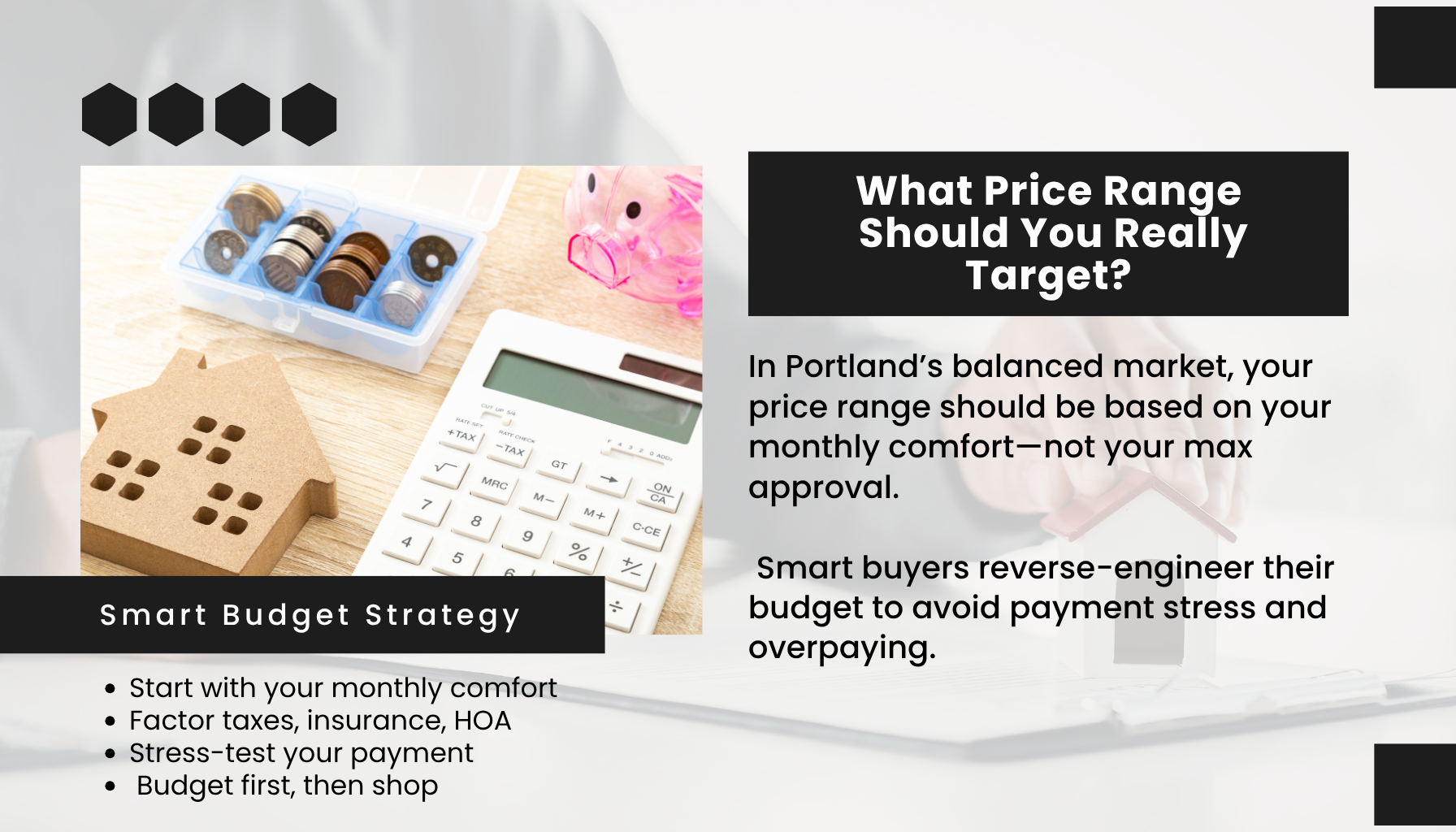
When clients ask what price range they should target, we always start with the monthly payment they can comfortably handle, not an arbitrary cap. In our region, the market is close to balanced, with roughly 4 to 5 months of supply and longer days on market in many pockets. That creates room for negotiation and strategic timing. But the riskiest mistake is letting the preapproval maximum define your purchase price without testing how that payment will actually feel in your life.
Your monthly housing cost has four main parts: principal, interest, property taxes, and homeowners insurance, commonly called PITI. Then we add HOA dues if applicable, plus a maintenance reserve for detached homes. In Portland and Vancouver, property tax rates and HOA dues vary widely by neighborhood, so two homes with the same price can deliver very different monthly payments. My rule of thumb is to model your budget in several neighborhoods before locking a target price.
Here is how I define it as Lisa Mehlhoff:
- Start with a comfort payment, then map to price using current rate scenarios.
- Add taxes, insurance, HOA, and a 1 percent annual maintenance reserve.
- Stress-test by modeling a slightly higher rate and a small tax increase.
How does this calculation work in Portland and Vancouver right now?
Local MLS trend data for early 2026 shows the Portland metro median around $538,000 in February and a modest month-over-month lift into March. Inventory sits near 4.5 months of supply, which signals a balanced market with rising buyer leverage in select segments as average days on market push 60 to 66 days in parts of the metro. Clark County shows a wider spectrum, with Vancouver’s city median closer to the high 400s and premium suburbs like Brush Prairie testing higher price brackets.
Nationally, the typical existing-home price has hovered near the low 400s, with affordability improving slightly as wage growth meets a slower pace of price gains. You can review national trend context at NAR Research and long-run price patterns through the FHFA House Price Index. For rate planning, I model around current conventional 30-year levels, then add a cushion. You can track the benchmark on FRED’s 30-year mortgage rate series.
In Clark County, MLS data indicates Vancouver’s median near $483,000 and Battle Ground near the low 500s. Brush Prairie frequently ranges well into the 800s and beyond for larger lots and newer construction. These splits matter when we translate your monthly budget into a price range, since taxes and HOAs differ between counties and even within neighborhoods.
What interest rate should I model?
I recommend modeling with a base rate aligned to today’s averages, then a version that is 0.5 percent higher to protect against volatility. Also model a buydown option if you want to improve the first two years of cash flow. Rate paths shift, but using a conservative assumption helps you avoid overcommitting. Track the benchmark at FRED and revisit with your lender weekly while you shop.
Which neighborhoods align with common monthly budgets?
If your comfort payment is about $3,000 per month for PITI, that often correlates to a price near $500,000 with 10 percent down, assuming a mid-6 rate, typical Portland-area taxes, and standard insurance. In SW Portland, that budget can unlock townhomes or smaller single-family homes near Multnomah Village or Hillsdale, while in East Vancouver you may find a newer home with a manageable HOA. If your comfort payment is closer to $4,500, you may be in range for larger homes in Lake Oswego or premium Clark County suburbs, depending on down payment.
For commuters to Intel, Beaverton and Southwest corridors offer good MAX access. For OHSU professionals, the SW Hills and Johns Landing shorten emergency routes. Tech buyers often prioritize fiber internet and transit, so I confirm broadband availability, MAX or C-TRAN routes, and commute windows. You can review regional planning context at the Portland Housing Needs Analysis, and transit schedules at TriMet MAX schedules and C-TRAN.
- Neighborhood 1: Multnomah Village and Hillsdale, SW Portland
- Neighborhood 2: Fishers Landing East and The Cedars, East Vancouver
Beyond these, Lake Oswego’s close-in pockets near Hallinan or Westlake suit higher budgets and the Lake Oswego Oregon Real Estate Market often pairs excellent schools with sophisticated amenities. Battle Ground offers value for space-seeking buyers, and Brush Prairie provides acreage and custom homes for buyers with premium budgets.
What are the pros and cons of stretching your budget vs staying conservative?
Pros:
- Stretching slightly can secure a better location or floor plan with less remodeling.
- Rate buydowns or temporary concessions can smooth cash flow while incomes grow.
- Buying now in a balanced market can reduce bidding pressure and inspection risk.
Cons:
- Overstretching raises risk if taxes adjust, HOA dues rise, or incomes change.
- Maintenance surprises hit harder when your payment leaves no monthly margin.
- If a refinance takes longer than expected, higher payments may persist.
How do I build a budget-based offer that still wins in a balanced market?
In a balanced market with around 4.5 months of supply, you can let your budget lead your strategy without sacrificing competitiveness. I start with a clear ceiling and craft terms that are attractive without exposing you to unnecessary risk. Preapproval, proof of funds for down payment, and a realistic close date matter more now than massive escalation clauses.
Inspections are typically buyer-paid in Oregon and Washington. Plan about $400 to $600 for a general home inspection, plus $250 to $500 for add-ons like sewer scope, radon, or pest. Appraisals often run $600 to $800. If you are leveraging FHA, VA, or down payment assistance, I front-load communication with the listing agent to avoid surprises and set realistic expectations.
One of my clients, a first-time buyer, targeted $2,900 per month. We used a 2-1 temporary buydown negotiated 1 percent under list after 45 days on market, and kept a 10-day inspection period. Another client, a physician relocating to the area, used a specialized doctor program with low down payment to secure a Lake Oswego home while maintaining liquidity for moving costs. A military family using a VA loan won in East Vancouver with a flexible close and capped inspection repairs.
For program research, explore VA Home Loans, Oregon’s homeownership resources through OHCS, and Washington assistance via the Washington State Housing Finance Commission.
FAQs
1) How do I translate my monthly payment into a purchase price? Work backward from your comfort payment. Estimate principal and interest using a current 30-year rate, then add local property taxes, insurance, and any HOA dues. I usually allocate 1 percent of home value annually for maintenance on detached homes. With $3,000 per month, 10 percent down, and a mid-6 rate, many buyers land near $475,000 to $525,000 depending on taxes and HOAs.
2) Should I wait for rates to drop before buying? Waiting can help, but it is not always the winning move. If inventory is rising and market conditions are balanced, today’s selection plus modest negotiation power can offset a slightly higher rate. You can monitor rates on FRED, buy now if the home works, then refinance later if rates improve. The key is ensuring the current payment fits your budget today.
3) How much should I budget for closing costs and prepaids? In Oregon and Washington, plan on 2 to 3 percent of the purchase price for lender fees, title, escrow, appraisal, and prepaids like taxes and insurance. If you choose points for a permanent buydown, that cost is separate. In a balanced market, we can sometimes negotiate a seller credit to offset some or all of your closing costs, especially if days on market are elevated.
4) How do property taxes differ across neighborhoods? Property taxes vary by county, city, and special districts. Multnomah, Washington, and Clackamas counties assess differently, and Clark County has its own structure. Two homes at the same price can have meaningful monthly differences. I always pull tax records during budgeting and include a conservative estimate in your PITI. Reassessments after significant improvements can change taxes later, so plan for a buffer.
5) Can I combine down payment assistance with FHA or VA financing? Yes, many programs layer with FHA, and VA already offers 0 percent down for eligible buyers. Oregon buyers can explore resources through OHCS. Washington buyers can review programs from the Washington State Housing Finance Commission. Each program has income, credit, and education requirements. I coordinate early with your lender to structure a clean, competitive offer.
6) What if I am relocating and do not know where to start? Start by defining your payment comfort and commute patterns. I will map neighborhoods that fit your budget, lifestyle, and school preferences, then layer in transit options like TriMet MAX and C-TRAN. For national-to-local context, review NAR Research and the FHFA House Price Index. Virtual tours, neighborhood previews, and a clear offer strategy make relocations smooth.
7) Is renting smarter than buying right now in Portland? It depends on your time horizon. If you plan to stay at least five to seven years, buying can outperform when principal paydown and potential appreciation are considered. Some local rents remain competitive versus ownership, but selection and stability are different. The Portland Housing Needs Analysis and national data from NAR offer helpful context. I will run a rent-versus-own side-by-side with your numbers.
Conclusion
The bottom line Your best price range starts with a monthly payment you can sustain for at least five to seven years, then gets refined by taxes, insurance, and HOA specifics in your target neighborhoods. Our Portland and Vancouver markets are balanced enough to let you shop deliberately and negotiate smartly. If you want SW Portland convenience, East Vancouver value, or the Lake Oswego Oregon Real Estate Market, I will tailor a budget-first plan that protects your cash flow and strengthens your offer. Let’s map payment to neighborhoods, test scenarios, and buy with confidence.
Lisa Mehlhof Homes | License #220603251 Call or text 503-490-4888 https://lisamehlhoffhomes-
Categories
Recent Posts






"My job is to find and attract mastery-based agents to the office, protect the culture, and make sure everyone is happy! "