When to Walk Away from a Negotiation on Portland Oregon Inherited Property
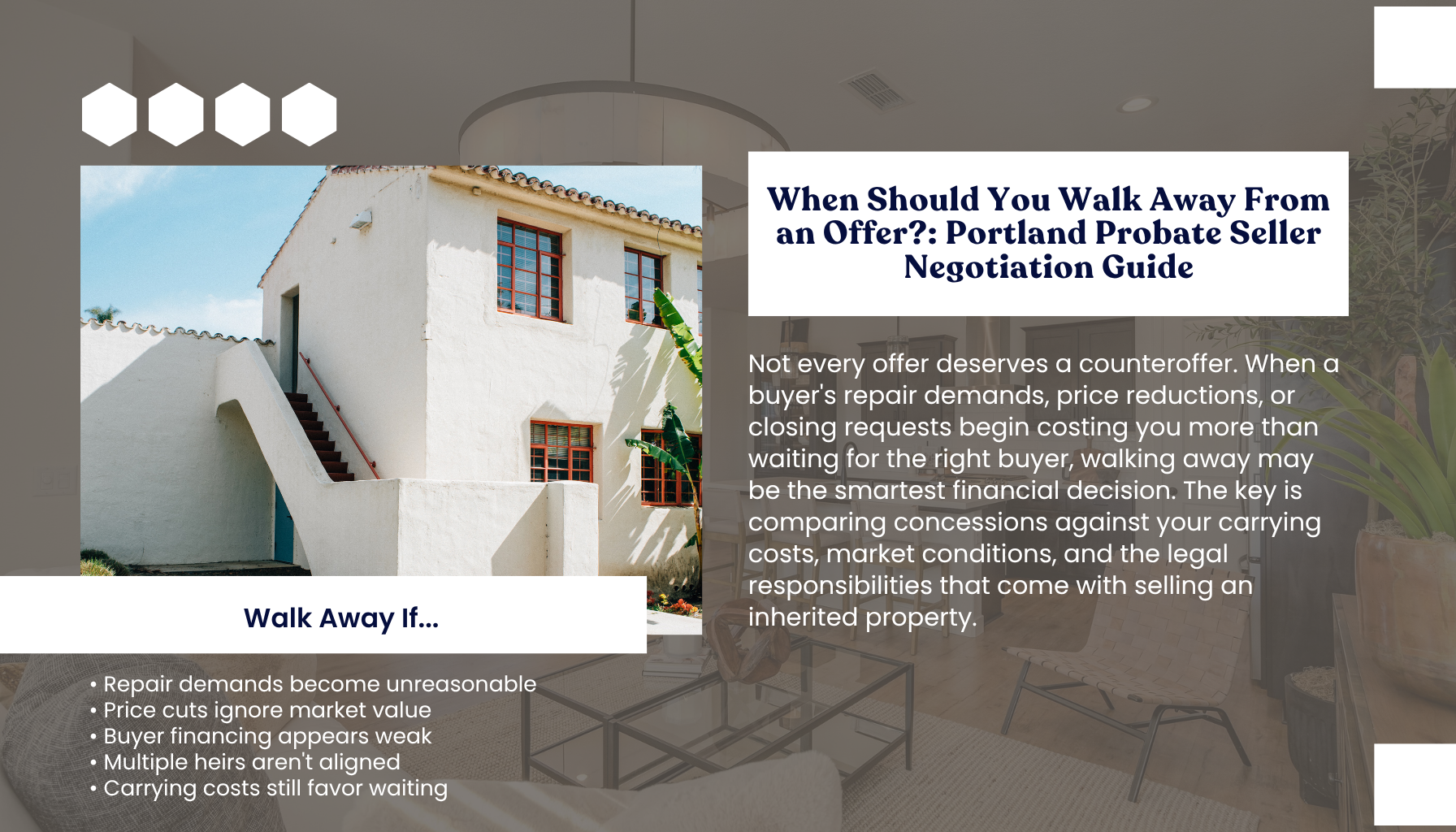
When you are selling an inherited or probate property in Portland, Oregon or Southwest Washington, how do you know when it is time to walk away from a buyer's negotiation demands?
You should walk away from a negotiation when a buyer's repair demands, price reductions, or timeline requests exceed your carrying costs, erode the stepped-up basis advantage, or create legal risk for the estate. Not every offer deserves a counteroffer.
Why Walking Away from a Portland Oregon Real Estate Negotiation Matters Right Now
If you have inherited a home in Northeast Portland, Southeast Portland, or across the river in Vancouver, WA, you are navigating one of the most emotionally loaded real estate transactions there is. You are grieving. You may be managing disagreements among siblings. And every month you hold that property, you are paying carrying costs that can easily reach $700 to $1,000 or more.
Here is the uncomfortable truth: some buyers will try to take advantage of that pressure. They see a probate listing and assume you will accept anything. With the Portland metro area currently sitting at roughly a 3.0-month housing supply, creating a balanced market, you do not have to. Well-priced inherited homes in neighborhoods like Irvington, Laurelhurst, and Woodstock still attract strong buyer interest, and you have more leverage than you might think.
With over 20 years of experience and 165 homes sold across Portland and Southwest Washington, I have guided dozens of families through probate sales. The hardest part is rarely the paperwork. It is knowing when to hold firm and when to let a bad deal go.
Red Flags That Tell You a Portland Buyer Is Not Negotiating in Good Faith
Not every lowball offer or repair request is a red flag. But certain patterns should put you on alert immediately.
Excessive Repair Demands on Older Portland Homes
Inherited homes in neighborhoods like the Alberta Arts District, Foster-Powell, and Irvington often feature Craftsman bungalows and Period Revival architecture that is 80 to 100 years old. Buyers who submit inspection responses demanding that every vintage quirk be modernized are not negotiating. They are trying to gut your price without saying so directly.
One family I worked with inherited a 1920s Craftsman near NE 17th Ave in Irvington. The buyer's inspection response included 47 line items, totaling an estimated $85,000 in demanded repairs. That included cosmetic requests like refinishing original hardwood floors and replacing period-appropriate doorknobs. We walked away, re-listed with stronger positioning, and accepted an offer from a buyer who understood what they were purchasing within three weeks.
What I tell my clients is this: if a buyer's repair list would cost more than 5% to 7% of the sale price and includes items that were visible during their initial walkthrough, that is not a negotiation. That is a renegotiation of the deal you already agreed to.
Price Reduction Requests That Ignore Market Data
The median home price in the Portland metro area currently sits around $545,000, with Northeast Portland commanding a median of approximately $655,000 and per-square-foot prices around $326. In Vancouver, WA, the median sale price has reached $486,749, up 3.6% year over year.
If a buyer submits an offer 15% to 20% below comparable sales for your neighborhood, that is not a serious starting point. It is a test to see whether grief or carrying costs will force your hand.
How Carrying Costs in Portland Should Shape Your Walk-Away Decision
Here is where probate sellers often miscalculate. You compare a low offer to your ideal number and feel insulted. But the real comparison should be against what keeping the property costs you every single month.
For a typical inherited home in the Portland metro, your monthly carrying costs look something like this:
- Property taxes: approximately $450 to $550 per month (based on the median effective rate of about 1.08%)
- Homeowner's insurance: roughly $100 to $200 per month
- Basic utilities: around $150 to $250 per month
- Maintenance and security: variable, especially for vacant properties
- Total monthly cost: $700 to $1,000 or more
So if a buyer is asking for a $15,000 price concession and you think you can find a better offer in 60 days, run the math. Two months of carrying costs at $900 per month is $1,800. That still leaves $13,200 in potential upside. Walking away likely makes sense. But if the concession is $5,000 and you are three months into carrying costs with no other interest? That is a different conversation entirely.
What separates good advice from generic advice is running these numbers for your specific property, your specific neighborhood, and your specific timeline.
Oregon vs. Washington: How Your Property's Location Changes the Walk-Away Calculus
This is something many probate sellers in the Portland-Vancouver metro do not realize, and it can dramatically affect your negotiation strategy.
Inherited Property on the Oregon Side
If the home you inherited sits in Laurelhurst, Sellwood, Lents, or anywhere in Portland, Oregon capital gains are taxed as ordinary income at rates up to 9.9%. Oregon also has a state estate tax with an exemption of just $1 million, which is far lower than the federal exemption. The silver lining is the stepped-up basis: if your parent bought that Irvington bungalow for $150,000 in 1995 and it is now worth $650,000, your cost basis resets to $650,000 at the date of death, potentially eliminating capital gains if you sell promptly.
But every month you wait, if the market shifts downward or carrying costs mount, you risk losing that advantage. This means walking away from a bad offer in Portland needs to be weighed against the tax clock.
Inherited Property on the Washington Side
If the home is in Vancouver, WA, Brush Prairie, or Battle Ground, Washington has no state income tax. That means no state capital gains tax on the sale. This is a significant financial advantage that gives you more room to be patient in negotiations. You can afford to walk away from a mediocre offer in Vancouver (where only 2.4 months of supply gives sellers stronger leverage) because the tax penalty for holding is lower.
One probate seller I worked with in Brush Prairie had inherited a property on a half-acre lot. The first buyer demanded $30,000 in concessions after the inspection, plus a 60-day closing extension. We walked away. Because Washington's no-income-tax structure reduced the seller's carrying cost pressure, we had room to wait. The next buyer offered $12,000 above the original asking price and closed in 28 days.
When Multiple Heirs Disagree About Walking Away in Portland
This is the situation I see most often, and it is the one that causes the most damage when handled poorly. Three siblings inherit a family home in the Woodstock neighborhood. One wants to sell immediately at any price. One wants to renovate and maximize value. And one is emotionally attached and does not want to sell at all.
When a buyer senses this kind of division, they will use it. They know that the sibling who wants fast cash may pressure the others to accept a low offer.
What I tell families in this situation: get aligned before you list. Agree on a minimum acceptable price, a maximum timeline, and who has authority to approve or reject offers. Having closed over 165 transactions and maintaining a perfect 5 out of 5 star rating across 24 client reviews, I have seen how a clear framework before listing prevents costly emotional decisions during negotiations.
If you cannot get alignment among heirs, that is actually a sign to walk away from the entire process temporarily, engage a probate attorney, and establish legal authority before putting the property on the market.
The Portland Neighborhoods Where You Have the Most Negotiation Power
Your ability to walk away confidently depends heavily on where the property sits.
- Laurelhurst and Irvington: Homes in these Northeast Portland neighborhoods receive an average of 3 offers and sell in around 21 days. Walking away from a problematic buyer here is low risk because demand is strong.
- Alberta Arts District: Homes along NE Alberta St between NE 15th and NE 30th still command a walkability premium, with solid Craftsman homes listing in the $520,000 to $720,000 range. Buyers compete for the neighborhood's energy and character.
- Vancouver, WA and Cedars East: With homes selling at 100.07% of asking price and only 2.4 months of supply, you have genuine leverage. Walking away is a position of strength here.
- Battle Ground and Brush Prairie: These markets are still active in the $500,000 to $580,000 range, though with 61 average days on market in Battle Ground, you should factor in a longer timeline when deciding to reject an offer.
- Foster-Powell and Lents in Southeast Portland: These neighborhoods offer more affordable price points and attract first-time buyers who may have tighter financing. Walking away from a buyer with shaky loan approval is especially wise here.
Frequently Asked Questions
Can you walk away from a negotiation after accepting an offer in Portland Oregon?
Yes, but timing matters. Before both parties sign the final purchase agreement, either side can walk away. Once the contract is executed, walking away has legal and financial consequences, including potential forfeiture of earnest money. Your Portland Oregon real estate agent should advise you on specific contractual exit points, such as inspection contingency deadlines.
What is the stepped-up basis and why does it matter for negotiation timing?
The stepped-up basis resets your inherited property's cost basis to its fair market value at the date of death. This can eliminate capital gains tax if you sell promptly. The longer you hold the property and the more it appreciates, the more potential capital gains tax exposure you create, which is why walking away from an offer requires careful timing analysis.
Should probate sellers in Vancouver WA negotiate differently than Portland sellers?
Yes. Washington has no state income tax, which means no state capital gains tax on the sale of inherited property. This gives Vancouver, WA probate sellers more financial flexibility to walk away from low offers and wait for better terms compared to sellers on the Oregon side.
How long does probate take in Oregon before you can sell?
Oregon probate typically takes 4 to 12 months. A personal representative must be appointed by the court before any property can be sold. Oregon also allows a simplified small estate affidavit process for estates valued under $75,000 in real property and $200,000 in personal property.
What if the buyer demands repairs on an inherited home sold as-is in Portland?
Even when you list as-is, buyers can still request repairs during the inspection period. You are not obligated to agree. If the requests are excessive or go beyond legitimate safety concerns, walking away protects your financial position, especially in competitive neighborhoods like Irvington or Sellwood where another buyer is likely waiting.
How do carrying costs affect the decision to walk away from an offer?
Monthly carrying costs on a Portland metro inherited property typically run $700 to $1,000 or more, including property taxes, insurance, and utilities. Every month you hold the property waiting for a better offer, those costs reduce your net proceeds. Always compare a buyer's concession request against projected carrying costs over the time it would take to find an alternative buyer.
Is it smarter to accept a lower offer quickly or wait for a higher one in Portland?
It depends on your neighborhood, market conditions, and carrying costs. In Northeast Portland, where homes sell in around 21 days, waiting for a better offer is often worth it. In areas with 60-plus days on market, the math may favor accepting a reasonable offer sooner.
What role do multiple heirs play in the decision to walk away?
Multiple heirs create complexity because conflicting priorities can lead to emotional, rather than strategic, decisions. Establishing a minimum acceptable price and a decision-making framework before listing prevents the kind of internal disagreement that buyers exploit during negotiations.
Can a Portland Oregon real estate agent help with probate-specific negotiations?
Absolutely. An experienced agent understands court timelines, disclosure requirements, multi-heir dynamics, and the specific negotiation patterns that probate listings attract. With 20 years of experience navigating these exact situations in Portland and Southwest Washington, the right agent can protect you from accepting a deal you should not have to take.
When is it better to counteroffer than walk away entirely?
Counteroffer when the gap between your position and the buyer's is bridgeable, typically within 3% to 5% of your asking price, and when the buyer has shown good faith throughout the process. Walk away when the buyer has been consistently difficult, when their financing looks uncertain, or when their demands suggest they are trying to renegotiate the entire deal after inspection.
The Bottom Line
Walking away from a negotiation on an inherited property in Portland, Oregon or Southwest Washington is not failure. It is strategy. You walk away when a buyer's demands exceed the cost of waiting, when the math does not support concessions, or when the emotional pressure of probate is being used as leverage against you.
Your neighborhood matters. Your tax situation matters. Your family dynamics matter. And the right guidance makes all the difference. If you are navigating a probate or inherited-property sale in Northeast Portland, Southeast Portland, Vancouver, WA, Brush Prairie, or Battle Ground, you deserve someone who has done this before, more than 165 times, in fact. Reach out to Lisa Mehlhoff at 503-490-4888 to talk through your specific situation. No pressure, just practical advice grounded in 20 years of local experience.
Categories
Recent Posts











"My job is to find and attract mastery-based agents to the office, protect the culture, and make sure everyone is happy! "