Is It Smarter to Rent or Buy in Portland Oregon in 2026?
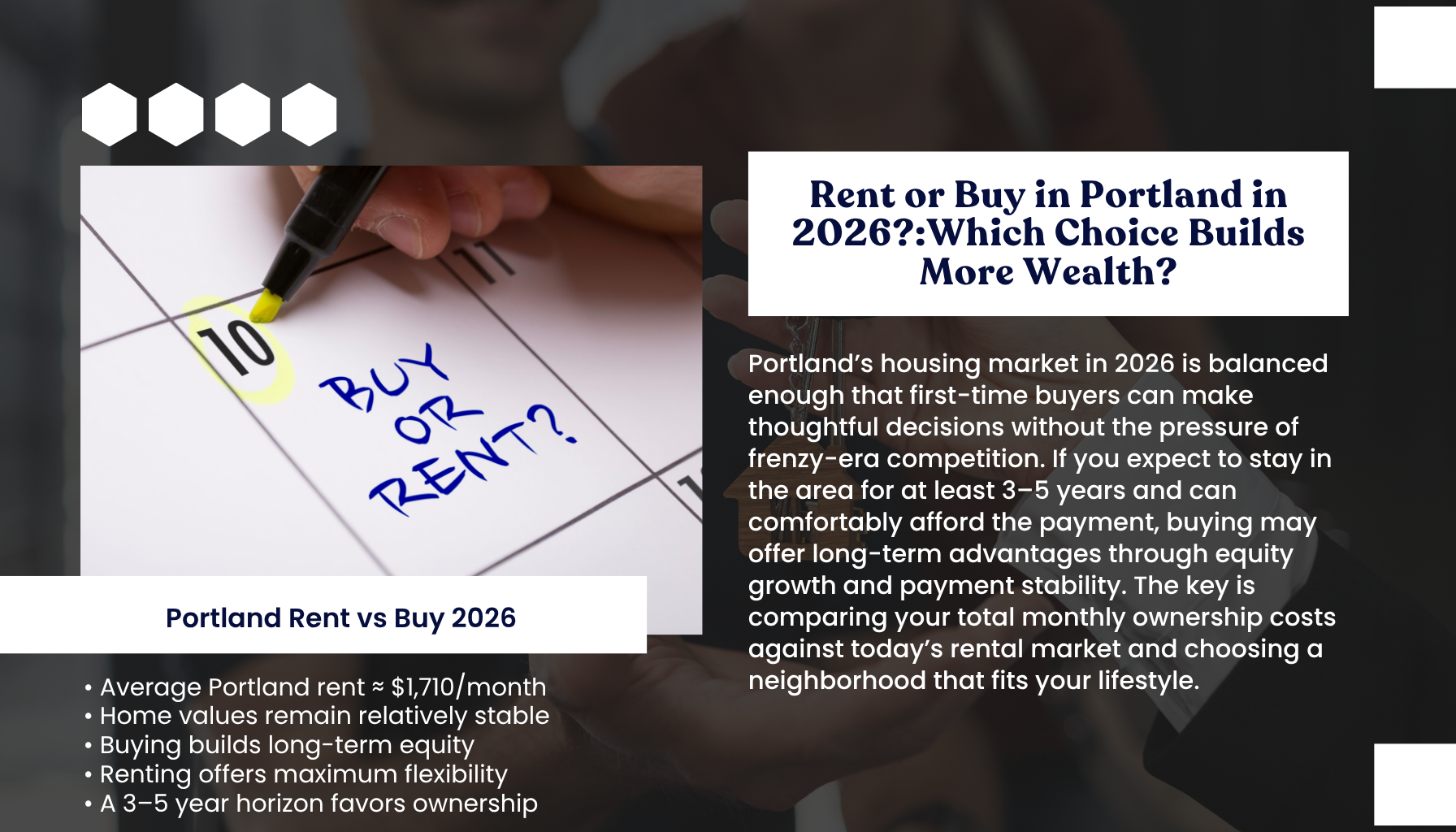
Is it smarter to keep renting in Portland Oregon or buy a starter home in 2026 if you’re planning to stay at your tech job for at least 3–5 years?
If you’ll stay 3–5 years and the monthly payment fits, buying a starter home in Portland Oregon in 2026 typically beats renting, thanks to stable prices, $1,710 average rent, and homes selling near list in 22–33 days.
Why This Matters Right Now for Portland Oregon Buyers
You’re weighing one of the biggest decisions you’ll make in Portland’s housing market, and your timing could shape your next five years. Local data shows typical Portland home values around $524,251 with homes going pending in about 22–33 days. Sale-to-list prices hover near 0.994, and about 27% of closings still land over asking, which means well-priced homes move but you still have room to negotiate. Meanwhile, the average Portland rent is about $1,710, which is a real benchmark when you compare against a starter-home payment.
Why this matters to you: if you plan to stay put in your tech role for 3–5 years, the question isn’t whether the market is “hot,” it’s whether your monthly payment, commute, and lifestyle balance out across a neighborhood specific plan. With inventory hovering close to two thousand active listings and prices showing stability rather than steep declines, you can make a confident decision if you run the numbers clearly and move with a simple C3 approach, centered on care, confidence, and communication.
What You Need to Know Before Choosing to Rent or Buy in Portland Oregon
You should start with the numbers that affect your wallet today and your flexibility tomorrow. Portland’s median sale price is about $512K, homes often see three offers, and days to pending average 22–33. This tells you that choice exists, but you’ll want your financing dialed in before you start touring.
Key takeaways:
- Your time horizon matters most. Buying typically makes more sense if you’ll stay at least 3–5 years, since transaction costs on purchase and sale can run around 7–10% combined.
- Payment vs rent. With average rent around $1,710, your buy math should compare principal, interest, taxes, insurance, HOA if any, and 1% of home value per year for maintenance. If your after-tax payment and maintenance plan fit, buying can win on equity build.
- Portland pace. With homes moving in 22–33 days and a sale-to-list ratio near 0.994, you should expect to write a strong, clean offer on the right home rather than waiting weeks to decide.
- Down payment options. You can consider low-down-payment loans, VA loans if you’re eligible, or 5% to 10% down conventional options. You don’t need 20% to get in, but you should understand PMI and your monthly impact.
- Resale positioning. If you choose a neighborhood specific location near job centers, transit, or strong schools, you improve your resale odds if you move within 3–5 years.
Bottom line, you should compare total monthly housing cost against your rent today, then weigh equity gain and tax treatment with your CPA. If the payment is sustainable and you’ll stay long enough to amortize costs, buying a starter home in Portland Oregon often puts you ahead.
A quick Portland baseline
For a rough baseline, use $500K–$525K as a typical starter-home range. At this price, your focus is less on timing the market and more on securing the right fit near your commute with a payment you can hold through market cycles.
How to Compare Renting vs Buying in Portland Oregon for a 3–5 Year Plan
You want a side-by-side that is easy to act on. The market has stabilized, so your decision comes down to affordability, risk tolerance, and lifestyle fit.
Pros of renting in Portland Oregon:
- Flexibility. If job mobility or relocation is possible within two years, renting keeps you light and nimble.
- Lower upfront costs. Security deposit and routine maintenance are typically lower than a down payment plus closing costs.
- Predictable move-outs. If you need to pivot quickly, you won’t face a sale timeline.
Pros of buying a starter home in Portland Oregon:
- Equity build. Each payment reduces principal over time, turning housing cost into an asset that can help your next move.
- Payment stability. A fixed-rate mortgage offers predictability compared with rent growth.
- Resale support. Homes are selling near list, with 22–33 day market times, which supports a confident exit if you choose wisely.
Key factors to evaluate:
- Payment comfort vs $1,710 rent. Your PITI, HOA, and maintenance should align with your budget at today’s income.
- Holding period. A 3–5 year stay often clears the breakeven point when you account for transaction costs and principal paydown.
- Neighborhood specific fit. Proximity to work hubs like downtown, the westside tech corridor, or hospital systems can drive stronger resale and daily convenience.
Data signals you can use: Portland’s typical value is around $524,251, the sale-to-list ratio is close to 0.994, inventory sits near 1,968, and new listings register around 482 in a recent snapshot. That’s not a frenzy, and it’s not a slowdown. It’s a “prepare, decide, and move” market, where strong preparation beats aggressive timing.
Your Step-by-Step Guide to Deciding in Portland Oregon
You can simplify this by following a clear sequence that respects your time and your budget. Think of it as your C3 approach checklist.
1) Clarify your 3–5 year plan. Confirm job stability, likely commute, and lifestyle needs, including home office, yard, or condo amenities. 2) Build your payment guardrails. Compare your current rent around $1,710 to a realistic buy scenario, including mortgage, taxes, insurance, HOA if applicable, and a maintenance reserve of 1% per year of home value. 3) Get pre-approved. Secure a lender letter that reflects your payment comfort, not just your max approval. This frames your search and your offer strength. 4) Shortlist neighborhoods. Choose 2–3 areas based on commute and daily life. In Portland, explore options like Laurelhurst, Irvington, Alameda, Sellwood, or Foster Powell for entry points and amenities that match your priorities. 5) Create a neighborhood specific tour plan. Start with must-haves and nice-to-haves. Visit at different times of day to assess traffic, noise, and parking. 6) Track market pulse weekly. Monitor days to pending, list-to-sale trends, and price reductions so you’re ready when a well-priced home appears. 7) Draft your offer playbook. Decide in advance how you’ll handle inspection repairs, appraisal gaps, and closing timelines. In a market averaging about three offers per listing, clarity beats chaos. 8) Inspect for longevity. Portland’s older homes can carry sewer, roof, or foundation concerns. Plan for a thorough inspection and budget for near-term fixes. 9) Revisit breakeven math before you sign. If you expect to move in three years, confirm that expected equity and tax benefits offset transaction costs and maintenance. 10) Close with confidence. Align your choice with your 3–5 year goals, not just the list price, and lock in a home you can comfortably hold.
What This Looks Like in Portland Oregon, Cedars East, Vancouver WA, Brush Prairie Washington, Battle Ground Washington
Your options vary by side of the river and lifestyle. In Portland Oregon, you’ll find a wide range of neighborhoods that pair walkability with access to job centers and transit. With median sale prices around the low to mid $500Ks and homes going pending in 22–33 days, you can target areas like Northeast Portland for classic homes, Southeast Portland for creative energy and food scenes, or Westside pockets near the tech corridor for commute efficiency.
In Vancouver WA, you may see newer construction and different tax treatment compared with Oregon. Neighborhoods to explore include Cedars East and nearby Brush Prairie Washington for larger lots and a quieter pace. Battle Ground Washington offers a community feel with more space and often newer homes than many in-city Portland options. These Southwest Washington areas can be compelling if you prioritize square footage, a suburban rhythm, and Washington’s overall tax landscape. Since neighborhood level data for Cedars East, Brush Prairie, and Battle Ground was not included in the current dataset, you should verify recent pricing, inventory, and days on market with MLS and county sources before you finalize your short list.
Why this matters to you: if your 3–5 year plan is all about easy commuting to downtown Portland or the westside tech hub, an in-city condo or small house may beat a longer cross-river drive. If you want more space and a quieter street rhythm, Southwest Washington homes for sale in Vancouver WA, Brush Prairie homes for sale, or Battle Ground options could be the better fit. Keep your search neighborhood specific so your daily life, not just your budget, drives the decision.
What Most People Get Wrong About the Portland Oregon Rent vs Buy Decision
You’ll hear plenty of myths. The first is that you need 20% down to buy in Portland Oregon. You don’t. You can explore 3% down conventional, 3.5% down FHA, or VA with zero down if eligible, as long as the payment works and the home qualifies. The second myth is that waiting will automatically save you money. Portland’s market is balanced to mildly competitive, with homes selling near list and moving in 22–33 days. That means waiting can just as easily cost you the right home as it can deliver a discount.
Another misconception is that Portland bidding wars are everywhere. About 27% of sales exceed list, which tells you selective competition exists, especially for well-priced homes. With a smart offer plan and realistic expectations, you can still negotiate inspection items or secure seller credits in the right situations. Focus on what you control: pre-approval, payment comfort, and choosing a neighborhood specific target that will hold value for your 3–5 year horizon.
Frequently Asked Questions
Is buying still worth it if you’ll only stay three years in Portland Oregon?
Yes, if the monthly payment fits and you choose a strong resale location, buying can pencil out in three years. Your breakeven depends on closing costs, maintenance, and principal paydown. Use a realistic maintenance reserve and confirm with your lender and CPA.
How much down payment do you need for a Portland starter home?
You don’t need 20%. Many buyers use 3% to 5% down options, FHA at 3.5%, or VA with zero down if eligible. Understand PMI, total monthly cost, and reserves. What matters most is a sustainable payment, not the biggest down possible.
Are Portland Oregon home prices expected to drop in 2026?
Current data shows stability, not sharp declines. Typical values are near $524K, homes sell close to list, and days to pending average 22–33. Plan your decision around affordability and timeline rather than betting on a price swing.
Is Vancouver WA better than Portland Oregon for a 3–5 year buy?
It depends on your commute, taxes, and home preferences. Vancouver WA, including Cedars East and nearby Brush Prairie, can offer newer homes and more space. Portland can offer walkability and shorter commutes. Run a neighborhood specific comparison with your actual drive times.
How does a VA loan change the rent vs buy math in Portland or Vancouver?
If you’re VA-eligible, lower or zero down payment and no monthly PMI can improve affordability. You should still budget for taxes, insurance, and maintenance. A VA-preapproval also strengthens your offer in a market that sees multiple bids.
What monthly payment target should you compare to Portland’s $1,710 average rent?
Aim for a total monthly housing cost that you can hold through job and life changes. Compare PITI, HOA if any, and maintenance to your $1,710 rent. If your total buy cost is modestly higher but you’re building equity, the trade-off can still make sense.
Are condos or houses smarter for first-time buyers in Portland Oregon?
Condos often offer lower entry prices and easy maintenance, but HOA dues add to the payment. Houses can require more upkeep but give you yard space and control. Choose based on lifestyle, budget, and resale potential within your 3–5 year window.
How fast do you need to decide once you find a Portland home you like?
With homes going pending in about 22–33 days and an average of three offers, you should be ready to write within 24–48 hours on the right fit. Preparation is everything: pre-approval, proof of funds, and a clear offer strategy.
What inspection issues should you watch for on older Portland homes?
Focus on roof age, sewer lines, foundation, electrical panels, and drainage. Budget for near-term fixes and use inspections as a tool, not a deal breaker. Older homes can be great investments if you plan for sensible upkeep.
What if you might relocate in under three years?
If relocation is likely under three years, renting may be safer. You’ll avoid selling costs and market timing risk. If you still want to buy, prioritize highly liquid, neighborhood specific locations near transit and job centers to protect your exit.
The Bottom Line
If you’re planning to stay at your tech job in Portland Oregon for at least 3–5 years and your monthly payment fits, buying a starter home often wins over renting. Portland’s market shows stable prices near $524K, homes going pending in 22–33 days, and rents around $1,710. That mix supports a buy decision when your holding period clears the breakeven and your neighborhood specific choice aligns with commute, lifestyle, and resale. Use a clear C3 approach, compare total monthly cost to your rent, and pick a location you can confidently hold through your timeline.
If you’re ready to explore your options for renting vs buying in Portland Oregon, Cedars East, Vancouver WA, Brush Prairie Washington, and Battle Ground Washington, Lisa Mehlhoff at Lisa Mehlhof Homes can walk you through the specifics for your situation. You’ll get a straightforward plan built around care, confidence, and communication, backed by 20 years of experience, 200 closed transactions, and expert guidance shaped by top national coaching. Clients consistently describe the experience as comprehensive and supportive from first tour to keys in hand.
Compliance note: Information is deemed reliable but not guaranteed and is subject to change without notice. This content is for educational purposes and is not financial, legal, or tax advice. You should consult your lender, CPA, and attorney for advice specific to your situation. Equal Housing Opportunity.
Lisa Mehlhoff, Real Estate Agent, Real Broker, License #200603251 Phone: 503.490.4888 Email: lisapdxhomes@gmail.com Office: 2175 NW Raleigh St, Portland, OR 97210
According to local MLS and public housing data for 2026, Portland’s typical home value is about $524,251, median sale price measures around $507K to $512K, inventory sits near 1,968 with 482 new listings, median days to pending average 33, average days on market are about 22, homes receive roughly three offers, and average rent is approximately $1,710. Homes sold in April 2026 totaled about 1,924, up from 1,773 the prior year. These signals reflect a balanced to mildly competitive market, which is why this matters to you as you decide whether to rent or buy now.
Categories
Recent Posts








"My job is to find and attract mastery-based agents to the office, protect the culture, and make sure everyone is happy! "