Portland Summer 2026 Market Update for Buyers and Sellers
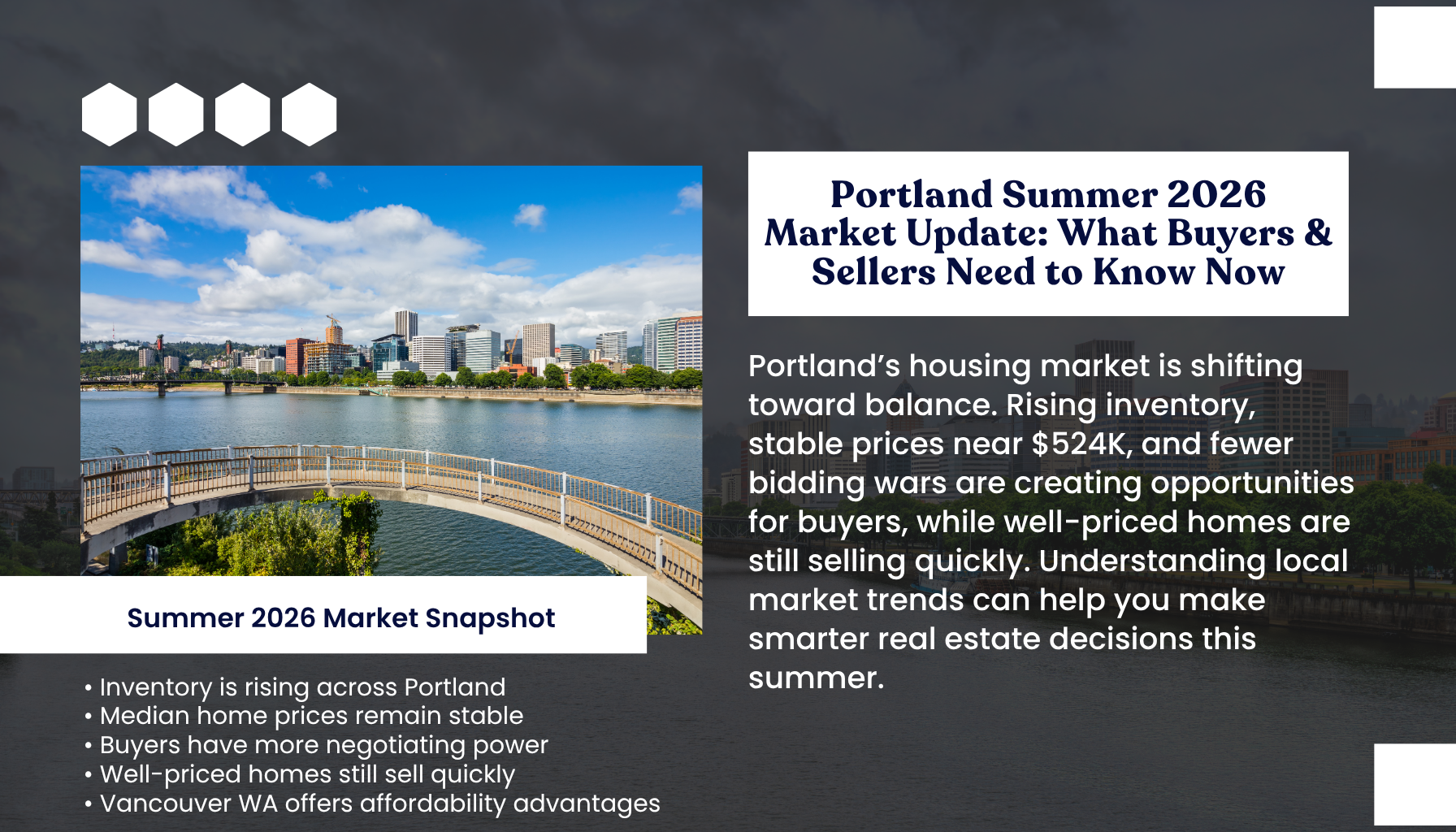 What should buyers and sellers know about the Portland Oregon real estate market heading into summer 2026?
[SNIPPET ANSWER: Portland's summer 2026 market favors buyers with rising inventory, stable prices near $524K, and rates between 6.5% and 7.0%. Sellers still benefit from homes moving in under 19 days when priced strategically.]
Why the Portland Oregon Real Estate Market Matters Right Now
If you have been watching from the sidelines, summer 2026 is the moment to pay attention. The Portland Oregon real estate market has shifted into a more balanced territory, and that changes the playbook for everyone involved.
Median home prices in Portland sit around $523,862, essentially flat compared to last year. Meanwhile, inventory is climbing. If trends hold, Portland could see close to 9,000 active listings in a single summer month, which would exceed pandemic-era levels when rates were in the 3% range. That is a dramatic shift.
What does this actually mean for you? It means you have more options, more negotiating power, and less pressure to make snap decisions. With 20 years of experience helping buyers and sellers across Portland and Southwest Washington, I can tell you that this type of market rewards preparation over panic. The families and professionals who take time to understand the numbers, rather than react emotionally, are the ones who come out ahead.
Whether you are searching for homes for sale in Portland Oregon or considering Southwest Washington real estate across the river, right now is about strategy. Understanding current homebuying costs and financing options can help you make more informed decisions during this balanced market period.
Portland Home Prices and Inventory Through Summer 2026
Here is where the numbers tell the real story. Portland's median sale price hovers near $500,000 to $524,000, depending on the data source, with year-over-year gains barely registering. Condos in the urban core sit around $365,000, while single-family homes average closer to $570,000.
The inventory picture is what matters most for your summer decision. In March 2026, just 1,626 homes were available with 2.5 months of supply. But the trajectory is what catches my eye. Active listings are climbing, and by midsummer, you could be looking at the most available inventory Portland has seen in years.
So what does this look like in real life? One tech professional I recently worked with had been watching Northeast Portland's Laurelhurst neighborhood for months. When a well-maintained Craftsman hit the market in late spring and sat for 12 days without competing offers, they were able to negotiate a $15,000 price reduction and a closing cost credit. That would not have happened 18 months ago.
Homes are still selling in about 19 days on average, and properties are closing at 100.56% of asking price. But those averages mask a split: well-priced homes in popular neighborhoods like Irvington, Woodstock, and Sellwood still move fast. Overpriced listings in any neighborhood are sitting.
What Sellers Need to Know About Portland Pricing Strategy
If you are selling, here is the honest truth. The window of strongest seller advantage in Portland runs from March through May. By summer, the market shifts in favor of buyers. That does not mean you cannot sell well in July or August, but it means your pricing strategy has to be sharper.
What I tell my clients is this: the days of listing 5% above comparable sales and expecting multiple offers are behind us. Today's Portland buyers are more intentional, and they are doing their homework. Strategic marketing, professional home presentation, and accurate pricing are the difference between selling in two weeks and sitting for two months.
Vancouver WA and Southwest Washington Real Estate Advantages
If you are relocating to the Portland metro and have not looked across the river, you are potentially leaving significant money on the table. The homes for sale in Vancouver WA market offers a compelling combination of affordability, stability, and one major financial advantage: Washington State has no state income tax.
Vancouver's median sale price sits at $489,000, with single-family homes averaging around $508,000. That is already lower than Portland proper. But the real savings come on your annual tax bill. Oregon's state income tax reaches up to approximately 9.9%. For a tech professional or doctor earning $200,000 or more, that difference alone can represent $15,000 to $20,000 annually.
Vancouver was recently ranked the seventh healthiest real estate market in the nation by a leading financial analysis firm, with home prices forecast to rise 2% to 4% in 2026. Homes priced between $425,000 and $500,000 continue to sell fastest.
Battle Ground and Brush Prairie Washington for Growing Families
Further north in Clark County, Battle Ground and Brush Prairie offer something Portland simply cannot: space, newer construction, and genuine small-town character at a lower price point.
Battle Ground's median home prices cluster in the mid-$500,000s to low-$600,000s, with a population that has grown 15% since 2020 to approximately 24,000 residents. The Battle Ground School District serves over 12,700 students across multiple schools, including Battle Ground High School, Prairie High School, and CAM Academy.
A military family I worked with last year was relocating from Joint Base Lewis-McChord and initially focused exclusively on Portland. After we toured Brush Prairie and the Cedars East area near Battle Ground, they realized they could get a four-bedroom home with a half-acre lot for what a three-bedroom on a 5,000 square-foot lot would cost in Southeast Portland's Foster-Powell neighborhood. They closed on a home in Brush Prairie and now have a 30 to 35 minute commute into Portland when needed.
Battle Ground's price-to-income ratio of 4.6x makes it one of the more affordable options in the metro area, and the Dollars Corner growth corridor continues to bring new construction inventory to market.
What First-Time Buyers in Portland Oregon Should Do This Summer
Summer 2026 is shaping up to be one of the better windows for first-time buyers in recent memory. Research indicates that August through December is typically the best time to buy a house in Portland, when supply is high and demand is low. That means your preparation should start now.
Here is what you need to have in place:
- Loan pre-approval with current limits: Portland's conforming loan limit is $832,750 and the FHA limit is $701,500. These numbers give you significant purchasing power.
- Down payment strategy: In Battle Ground, a 3% down payment on the median listing price of $576,497 is about $17,295. Washington State's Home Advantage program offers 0% deferred DPA covering 3% to 5% of the loan amount, with income caps up to $180,000.
- Neighborhood priorities: Know whether walkability, school quality, commute time, or lot size matters most. That single decision narrows your search dramatically.
One thing that surprises many first-time buyers is Oregon's unique property tax system. Your assessed value can only increase by 3% annually regardless of market appreciation, thanks to Measure 50. Multnomah County's median effective rate is approximately 1.08%. This is actually a benefit over time, but it confuses a lot of people coming from other states.
Relocating to Portland Oregon: Where to Start in Summer 2026
Having closed over 165 transactions across Portland and Southwest Washington, I can tell you that relocation clients face a unique challenge. You are making neighborhood decisions without the local context that longtime residents take for granted.
Here is how I typically guide relocating professionals. If you are a tech worker commuting to the Silicon Forest in Hillsboro or Beaverton, living in Northeast Portland's Irvington or Grant Park neighborhoods puts you on a manageable commute westward. If you work remotely two to three days per week, Battle Ground and Brush Prairie become realistic options with significantly lower housing costs.
For doctors relocating to work at OHSU, Legacy, or Providence, Southwest Portland and the Sellwood neighborhood offer shorter commutes, while Vancouver provides the tax savings that make a real difference on a physician's income.
The Portland condo market, particularly in the Pearl District and downtown, tells a different story entirely. Inventory remains elevated, days on market are longer, and buyers have meaningful leverage to negotiate price reductions or closing cost credits. If urban living appeals to you and you are comfortable with the condo lifestyle, this is a buyer's market within the broader market.
There is real pent-up demand from residents who pressed pause during the rate shock of recent years. That demand is starting to move, which means the best selection may be available right now, before fall activity picks up.
Frequently Asked Questions
Is Portland Oregon a buyer's or seller's market in summer 2026?
Summer 2026 leans toward buyers in Portland. Inventory is rising significantly, prices are essentially flat year over year, and interest rates between 6.5% and 7.0% are keeping bidding wars in check. The strongest seller window is March through May, while July through December increasingly favors buyers with more negotiating power.What is the median home price in Portland Oregon right now?
The median home price in Portland sits at approximately $523,862 as of spring 2026, up just 0.05% compared to last year. Single-family homes average around $570,000, while condos average $365,000. Recent U.S. house price data shows that prices continue to remain relatively stable across major markets. Prices are expected to remain flat or slightly soft through the summer months.Are homes for sale in Vancouver WA more affordable than Portland?
Yes. Vancouver's median sale price is approximately $489,000, with single-family homes averaging $508,000. Combined with Washington State's lack of state income tax, the total cost of living advantage over Portland can be substantial, especially for higher-income professionals.What are interest rates expected to be in Portland for summer 2026?
Mortgage rates in the Portland metro area are expected to hover between 6.5% and 7.0% through summer 2026. These rates are keeping the market balanced without triggering aggressive competition or dramatic price drops, which creates steady conditions for both buyers and sellers.How long are homes taking to sell in Portland Oregon?
On average, Portland homes are selling in about 19 days, and properties are closing at 100.56% of asking price. However, that average varies significantly by neighborhood and pricing accuracy. Well-priced homes in desirable areas like Woodstock and Sellwood still move quickly, while overpriced listings can sit for weeks.Is Battle Ground Washington a good place to buy a home in 2026?
Battle Ground offers strong value with median prices in the mid-$500,000s, a price-to-income ratio of 4.6x, active new construction, and growing community amenities. The Battle Ground School District serves over 12,700 students, and the commute to Portland runs about 30 to 35 minutes.What down payment assistance is available for Portland area first-time buyers?
Washington State's Home Advantage program offers 0% deferred down payment assistance covering 3% to 5% of your loan amount, with income caps up to $180,000. Oregon also has state-level programs. FHA loans require as little as 3.5% down, and the Portland FHA limit is $701,500. For more information about homeownership assistance programs, contact your local housing authority.Should I buy in Portland Oregon or Vancouver WA?
It depends on your income, commute, and lifestyle priorities. Portland offers walkable urban neighborhoods, cultural amenities, and shorter commutes to many employers. Vancouver offers lower home prices, no state income tax, and strong community stability. High-income earners often save tens of thousands annually by living in Washington.How does Oregon's property tax system work for new buyers?
Oregon distinguishes between Real Market Value and Assessed Value. Thanks to Measure 50, your assessed value can only increase by 3% per year regardless of actual appreciation. Multnomah County's effective tax rate is approximately 1.08%. This system benefits long-term homeowners as their tax burden grows slowly.What Portland neighborhoods are best for relocating professionals?
Laurelhurst and Irvington in Northeast Portland offer historic homes, walkability, and tree-lined streets. Southeast neighborhoods like Sellwood and Woodstock provide a community feel with local businesses and green spaces. The Alberta Arts District appeals to young professionals, while Brush Prairie and Battle Ground attract families wanting space and newer construction.The Bottom Line on Portland's Summer 2026 Market
You are entering one of the most balanced Portland Oregon real estate markets in years. Prices are stable, inventory is growing, and neither buyers nor sellers hold all the cards. That makes this a strategy market, not a speed market.
If you are buying, take advantage of rising inventory and improved negotiating conditions, especially as summer progresses into fall. If you are selling, pricing accuracy and professional presentation have never mattered more.
With 20 years of experience, 165 closed transactions, and strong client reviews across Portland and Southwest Washington, I have guided first-time buyers, relocating families, and seasoned investors through every type of market. Whether you are exploring homes for sale in Portland Oregon, considering Southwest Washington real estate in Vancouver or Battle Ground, or just trying to figure out where to start, the best next step is a real conversation about your specific situation. Reach out to Lisa Mehlhoff at 503-490-4888 to talk through what summer 2026 looks like for your goals.
Categories
Recent Posts






"My job is to find and attract mastery-based agents to the office, protect the culture, and make sure everyone is happy! "