Keeping Your Portland Oregon Real Estate Sale on Track After Going Under Contract
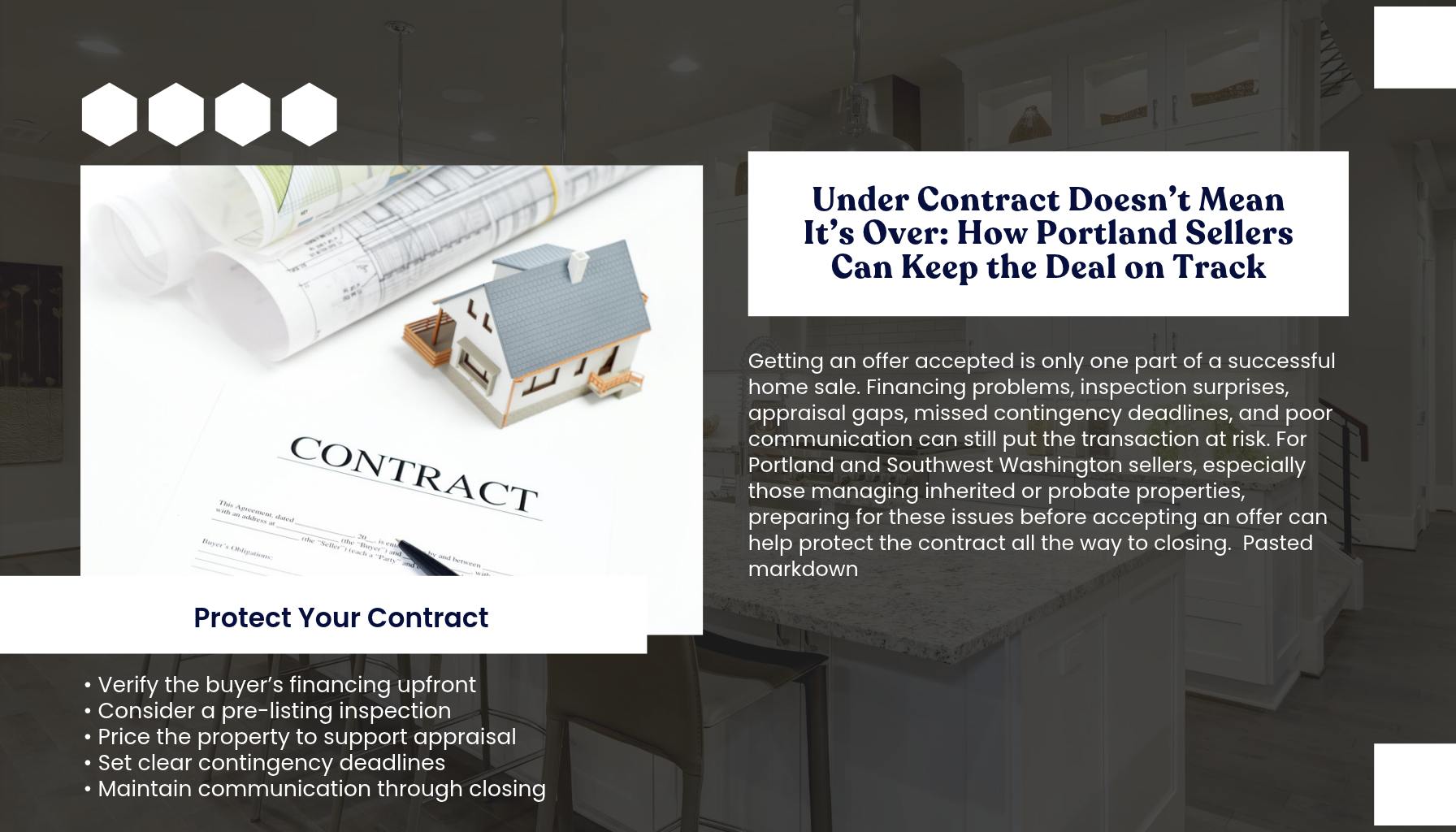
How can you minimize the chance of a sale falling through once you're under contract on a Portland or Southwest Washington property?
You protect a signed contract by vetting the buyer's financing upfront, ordering a pre-listing inspection, pricing to appraise, setting tight contingency deadlines, and maintaining clear communication through closing day.
Why This Matters Right Now for Portland and Southwest Washington Sellers
If you are selling an inherited or probate property in Portland, Oregon or in nearby Southwest Washington communities like Vancouver or Brush Prairie, a deal falling apart after you have already signed a contract is more than an inconvenience. It resets the clock on estate carrying costs, invites lower offers when the home comes back on market, and can create friction among co-heirs who are ready to move on.
Nationally, 6% of purchase contracts were terminated in the three months ending July 2026, and 13% experienced delayed settlements during the same period, according to the NAR REALTORS Confidence Index for July 2026. Those numbers might sound small, but when your property is the one that falls through, the impact is significant.
With 20 years of experience and over 165 homes sold across Portland and Southwest Washington, what I consistently see is that most failed contracts share a few preventable causes. The good news? Nearly every one of them is something you can address before your property even hits the market.
Screen the Buyer's Financing Before You Accept an Offer in Portland Oregon
Financing failure is one of the most common reasons contracts collapse. A buyer might look great on paper, but between the time they write an offer and the day of closing, rate changes, job losses, or new debt can push them out of qualification. With the 30-year fixed mortgage rate averaging 6.54% in July 2026 according to NAR, even a small rate fluctuation can tip a borderline buyer over the edge.
So what should you require?
- A pre-approval letter, not a pre-qualification letter. Pre-qualification is a rough estimate. Pre-approval means the lender has already verified income, assets, and credit. In my experience working with sellers across Northeast Portland, Southeast Portland, and Vancouver WA, this is the first thing I recommend before accepting any offer.
- Contact information for the buyer's loan officer. Your agent should be able to confirm where the buyer stands in underwriting and whether conditions have been met.
- A realistic financing contingency deadline. A tighter deadline, typically 21 days or fewer, surfaces problems early enough for you to pivot if needed rather than waiting until the week before closing.
What does this actually mean for your situation? It means you have the right to be selective about which offer you accept. A slightly lower offer from a buyer with rock-solid financing can be a better deal than a higher offer from someone whose approval is shaky.
Order a Pre-Listing Inspection on Your Portland or Vancouver WA Property
For probate and inherited-property sellers, the inspection contingency is one of the most consequential points where deals can unravel. Why? Because you often have limited firsthand knowledge of the home's condition. Maybe you grew up in a Laurelhurst bungalow but moved away decades ago. Maybe you inherited a home in Lents or Foster-Powell from a relative and have never even turned on the furnace.
A pre-listing inspection, which you commission before going to market, is one of the most powerful tools available to protect a contract once it is signed. Here is why:
- It removes the element of surprise. When you already know about the aging roof or the outdated electrical panel, you can price accordingly and disclose upfront.
- It reduces renegotiation. Buyers who discover issues during their own inspection frequently ask for credits or repairs, and if the numbers are big enough, they walk. When you have already disclosed known conditions, the buyer's inspection becomes a confirmation rather than a revelation.
- It shortens the timeline. A typical contract-to-close timeline runs about 30 days nationally, per NAR data from July 2026. When inspection surprises are off the table, you are far less likely to see delays that stretch that window.
What I tell my clients is this: spending a few hundred dollars on a pre-listing inspection can save you thousands in renegotiated credits and weeks of lost time if a deal falls apart.
Price Your Portland Home to Appraise, Not Just to Attract Offers
Appraisal gaps are a significant cause of delayed settlements. According to the NAR REALTORS Confidence Index for July 2026, 7% of contracts nationally were delayed specifically due to appraisal issues. For inherited properties in neighborhoods like Irvington, Woodstock, or Sellwood, where home styles and conditions vary widely, the appraisal risk can be elevated.
Why Inherited Properties Are Especially Vulnerable to Appraisal Problems
Appraisers rely on recent comparable sales of similar homes. If your inherited property has deferred maintenance, dated finishes, or unusual features that set it apart from recently sold neighbors, the appraiser may not be able to support the contract price. That gap between the appraised value and the agreed-upon price can kill the deal if the buyer's lender will not fund the difference and the buyer cannot or will not cover it out of pocket.
What You Can Do Before Listing
- Work with your agent to pull current comparables in the specific neighborhood. Comparables from one neighborhood are not interchangeable with those from another, even within the same metro area. Pricing has to reflect the micro-market, not the metro average.
- Make targeted cosmetic improvements. Fresh paint, updated lighting, and professional cleaning can help present the property favorably, which may support the asking price.
- Provide the appraiser with documentation. Your agent can prepare a packet of comparable sales, recent improvements, and neighborhood context that helps the appraiser understand the property's value.
With 24 five-star reviews from past clients, one thing I take seriously is making sure properties are priced to close, not just priced to generate interest. A flashy list price that cannot survive an appraisal does nobody any favors, especially when you are managing estate timelines and co-heir expectations.
Set Tight Contingency Deadlines and Get Everything in Writing
Every contingency in your contract, whether for financing, inspection, appraisal, or title, should come with a clear, written deadline. This is not a formality. According to NAR guidance on contract contingencies, a contingency is a condition that must be met before the purchase can be completed. If it is not met within the specified timeline, either party may generally have the right to cancel — though the specific terms of your contract and applicable state law govern what remedies or penalties apply, and an estate attorney can confirm how this works in your situation.
Here is where probate sellers, particularly those managing estates remotely from outside Portland or Southwest Washington, often get tripped up:
- Vague deadlines invite delay. If your inspection contingency says "within a reasonable time" instead of "within 10 business days," you have given the buyer an open-ended exit ramp.
- Verbal agreements are not enforceable. NAR guidance strongly recommends that all amendments be in writing and signed by all parties — and in practice, undocumented verbal agreements are very difficult to enforce, so treat every change to the contract as a formal written amendment. If the buyer's agent calls to request a three-day extension, that extension must be documented formally before you agree.
- Earnest money should be meaningful. A larger earnest money deposit gives the buyer skin in the game. If the buyer walks without a valid contingency basis, the contract should specify your remedies, whether that is retaining the earnest money as liquidated damages or pursuing other remedies. An estate attorney can advise you on what structure best protects your interests under Oregon or Washington law, depending on where the property is located.
What I always recommend is that you treat the contract timeline like a project plan. Every milestone has a deadline, and every change gets documented. That kind of structure is what keeps a transaction moving toward closing instead of drifting toward cancellation.
Maintain Communication and Property Access Through Closing Day
Once you are under contract on a property in North Portland, Battle Ground, or anywhere else in the Portland metro and Southwest Washington market, the work is not over. Variations in the time from pending contract to closed sale are commonly caused by financing delays, inspection disputes, and appraisal problems, and nearly all of these are made worse by poor communication.
If you are managing a probate property from out of state, designate a single point of contact who can provide access for inspections, appraisals, and lender-required walkthroughs. This is one of the areas where having a local Portland Oregon real estate agent who knows the neighborhoods and can be physically present makes an enormous difference.
A few practical rules:
- Do not make changes to the property after going under contract without written buyer consent. Removing furniture, starting repairs, or altering landscaping can trigger disputes.
- Respond promptly to lender requests. Underwriters frequently need additional documentation or property access, and delays on your end can push the closing past the contract deadline.
- Stay in regular contact with your agent. A quick weekly check-in can surface small problems before they become deal-breakers.
Real estate is personal, and every move comes with both practical and emotional decisions. My approach combines local market expertise, honest communication, and a deep understanding of what makes Portland and nearby communities in Southwest Washington unique places to call home. That combination is what keeps transactions on track.
Frequently Asked Questions
What is the most common reason a home sale falls through after going under contract?
Financing failure is a primary cause of contracts collapsing. The buyer may lose their job, take on new debt, or see their rate lock expire. Nationally, the 30-year fixed rate averaged 6.54% in July 2026 per NAR, and even small rate changes can disqualify a buyer. You can reduce this risk by requiring a genuine pre-approval letter and confirming the buyer's financing status with their lender throughout the process.
Should I get a pre-listing inspection on an inherited Portland property?
Yes, in most cases this is one of the smartest investments you can make. A pre-listing inspection surfaces issues before the buyer discovers them, reduces the chance of renegotiation or cancellation, and allows you to price the property based on its actual condition. This is especially valuable for inherited homes in neighborhoods like Sellwood, Irvington, or Foster-Powell where you may not know the home's full history.
How much earnest money should I expect from a buyer in Portland Oregon real estate?
Earnest money amounts vary by market and property price. What matters most is that the deposit is meaningful enough to discourage a buyer from walking away casually. Your agent and, if applicable, your estate attorney can advise on what amount is customary and appropriate for your specific transaction and property type.
Can a buyer cancel the contract during the inspection contingency period?
Generally, yes. The inspection contingency gives the buyer a defined window to review the property's condition and negotiate repairs or credits. If you and the buyer cannot reach agreement within that window, the buyer can typically cancel and receive their earnest money back. A pre-listing inspection helps you avoid surprises during this phase.
What happens if the appraisal comes in lower than the contract price?
An appraisal gap means the lender will generally only fund a loan based on the appraised value, not the contract price. The buyer must then cover the difference out of pocket, you and the buyer renegotiate the price, or the deal may fall apart. According to the NAR REALTORS Confidence Index for July 2026, 7% of contracts nationally were delayed due to appraisal issues.
How long does it typically take to close after going under contract?
The typical contract-to-close timeline is about 30 days nationally, according to NAR data from July 2026. However, this can stretch longer if financing, inspection, or appraisal issues arise. Setting firm contingency deadlines and responding promptly to requests helps keep your timeline on track.
Do I need a real estate attorney for a probate sale in Portland or Vancouver WA?
Oregon and Washington each have their own rules regarding probate transactions, and the level of attorney involvement required can vary by situation. In many cases, working with both a real estate agent experienced in probate sales and an estate attorney ensures that court requirements, title issues, and contract terms are handled correctly. Your situation and the complexity of the estate will determine what level of legal support you need.
What if I am managing the sale of an inherited property from out of state?
This is common among probate sellers with Portland or Southwest Washington properties. Having a local Portland Oregon real estate agent who can coordinate inspections, appraisals, and walkthroughs on your behalf is essential. Designating a single point of contact and staying in regular communication with your agent helps prevent access delays that can jeopardize the contract.
Should I accept a cash offer to avoid the risk of financing falling through?
Cash offers eliminate financing contingency risk, but they are not automatically the best deal. A cash offer may come in lower than a financed offer, and you should evaluate each offer based on the full picture: price, contingencies, timeline, and buyer reliability. Your agent can help you compare offers and assess which one is most likely to close.
Can the buyer back out after all contingencies have been removed?
Once contingencies are removed, the buyer has far fewer contractual grounds to cancel. However, life events like job loss or medical emergencies do occur. Meaningful earnest money and clear contract language about remedies, such as liquidated damages, give you protection if a buyer cancels without a valid contractual basis. Your agent and attorney can help ensure these protections are in your contract.
The Bottom Line
Selling a probate or inherited property in Portland, Northeast Portland, Southeast Portland, Vancouver WA, Brush Prairie, Battle Ground, or any of the surrounding communities requires more than just finding a buyer. It requires making sure that buyer actually makes it to the closing table. By screening financing carefully, ordering a pre-listing inspection, pricing to appraise, setting firm contingency deadlines, and maintaining clear communication throughout the process, you dramatically reduce the chance of a deal falling through.
With 20 years of experience, over 165 homes sold, and a background in education that shapes everything about how I communicate with clients, I bring a teaching-focused, straightforward approach to every transaction. If you are navigating a probate sale or considering selling an inherited home anywhere in the Portland Oregon real estate market or Southwest Washington, reach out to me, Lisa Mehlhoff, at 503-490-4888. Let's build a plan that gets your property from contract to closing with confidence.
Categories
Recent Posts






"My job is to find and attract mastery-based agents to the office, protect the culture, and make sure everyone is happy! "