“Date the Rate, Marry the House”: What That Really Means in Today’s Portland Market
TLDR
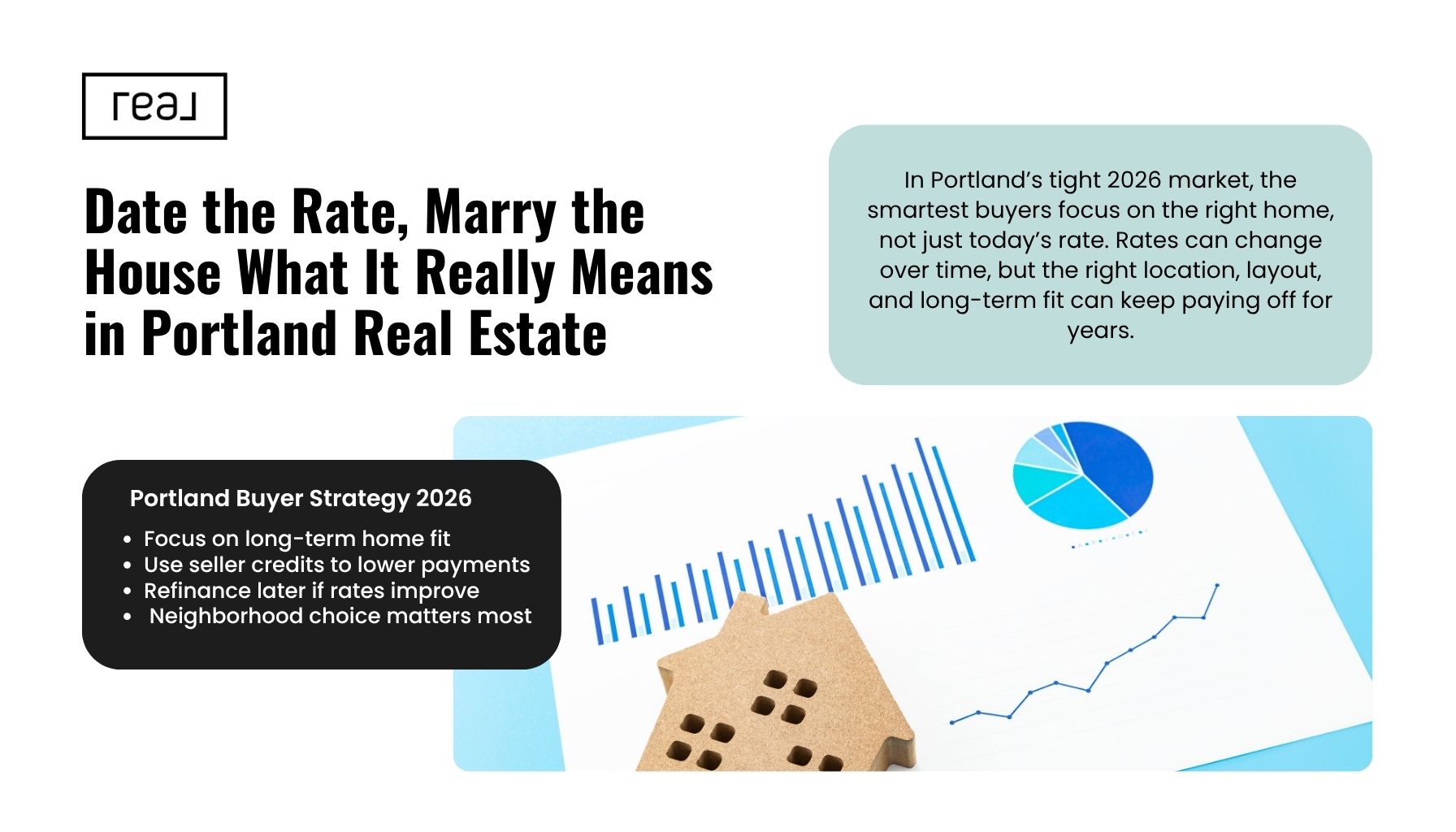
- Portland inventory is tight with quick pendings, so focus on long-term home fit.
- Rates are likely to change over time, but location and layout benefits persist.
- Use concessions, buydowns, and future refi plans to manage short-term payments.
- Neighborhood choice drives value and lifestyle more than short-term rate moves.
What does “date the rate, marry the house” really mean?
At its core, this phrase means you make a long-term commitment to the home that meets your needs, while treating the interest rate as temporary. Rates are cyclical and may be refinanced when conditions improve. The home’s location, floor plan, school zone, and neighborhood trajectory tend to matter far more for your happiness and long-term equity.
In Portland right now, this mindset fits the data. Recent MLS reporting shows median sale prices around the 500 thousand dollar mark in the metro, with typical pendings happening in about 38 days. Southwest Portland submarkets remain higher, near the mid 600 thousands, and East Vancouver is moving briskly with around 25 days on market. Inventory across the metro often tracks close to one and a half months of supply, which favors sellers and rewards buyers who move decisively when the right home appears.
Here is how I define it as Lisa Mehlhoff:
- Focus on a home you would happily keep beyond five to seven years.
- Structure the mortgage to be comfortable today, with a clear refinance path.
- Buy in a location with strong fundamentals that support future resale.
How does this strategy work in Portland and SW Washington today?
In Q1 2026, 30‑year mortgage rates have hovered in the mid fives to six percent range. The Federal Reserve’s path influences these rates, but consumer mortgage pricing also reflects broader bond market dynamics. Historical data from the FRED 30‑Year Mortgage Rate shows long periods above and below today’s levels. That is why “dating” today’s rate with the expectation to refinance during a future window can be prudent.
Portland’s supply side keeps competition alive. The Regional Multiple Listing Service shows low months of inventory, fast pendings, and steady seasonal swings that typically peak in spring. When supply is lean, buyers who wait for a perfect rate often miss the right house. I advise locking a competitive rate, leveraging seller credits when possible, and planning for a rate update later if the market allows. City planning forecasts in the Portland Housing Needs Analysis also anticipate continued demand pressures tied to job growth and limited buildable land.
What about comparing to national trends?
Nationally, inventory has often hovered near three months of supply, per the NAR housing statistics. Portland’s roughly one and a half months means our market typically moves faster. That favors buyers who evaluate homes quickly, use strong preapprovals, and consider temporary buydowns to smooth payments during the first years.
Which neighborhoods fit different buyers who plan to refinance later?
Neighborhood choice determines how well this strategy performs. Here are examples I guide clients through as a Portland Oregon Real Estate Agent with deep neighborhood knowledge.
- Hillsdale and Multnomah Village, SW Portland
- Lake Oswego
- East Vancouver, including Cascade Park East and Parkway East
- The Cedars, East Vancouver, WA
- Battle Ground and Brush Prairie
For buyers relocating to Portland, I also point to Sellwood‑Moreland, Alameda, and West Slope for commute balance, and to the Pearl District for condo living that supports walkability. If you plan to refinance later, prioritize the home and neighborhood that best supports your daily life first.
What are the pros and cons of buying now and planning to refinance later?
Pros:
- You secure the right home in a tight market with limited months of inventory.
- You can use seller concessions for rate buydowns or closing costs to control payments.
- You participate in potential appreciation sooner, supported by long‑term trends in the FHFA House Price Index.
Cons:
- If rates fall slower than expected, carrying costs may stay higher longer.
- Refinancing involves closing costs that must be recouped through lower payments.
How do I structure numbers and timelines to protect my budget?
Start with a rock‑solid preapproval and a clear payment target. If your comfort level caps at a certain monthly number, I build offers around that target using seller credits and lender options. The Regional MLS shows sellers often granting one to two percent in concessions during negotiation phases, which can fund buydowns or closing costs. Total buyer closing costs usually run about three to five percent of the purchase price, which we model upfront.
I like using temporary buydowns when a listing is sitting longer than average. A 1‑0 or 2‑1 buydown lowers the initial monthly payment, giving you time to refinance later if conditions improve. We also consider permanent buydowns if you plan to hold the loan for a long period. I coordinate with your lender to compare breakeven timelines.
One of my clients, a tech professional moving to Multnomah Village, targeted a payment under a set threshold. We negotiated a two percent seller credit, applied a 1‑0 buydown, and set calendar reminders to review refinance options at 6 and 12 months. Another client, a physician joining OHSU, chose Hillsdale for a short on‑call commute. We used a physician loan with minimal down, then arranged for a future refinance review once bonus eligibility kicked in.
To keep everything smooth:
- Lock a rate with a float‑down option if available.
- Schedule inspection and sewer scope early to preserve negotiation leverage.
- Confirm HOA rules and fees before appraisal to avoid delays.
- Use calendar check‑ins at 6, 9, and 12 months to reassess refinance math.
FAQs
1) Should I wait for lower rates before buying in Portland? Waiting can work if your timeline is flexible, but supply remains tight with roughly one and a half months of inventory in many submarkets. When the right home appears, moving forward and planning to refinance can outperform waiting. I watch the FRED 30‑Year Mortgage Rate and local MLS data with clients to time opportunities.
2) What if I buy and rates never drop enough to refinance? We plan for that scenario from day one. I build your offer to be affordable at today’s rate by leveraging seller concessions and buydown options. If rates do not drop, your payment still fits the budget you approved. If they do, refinancing can reduce your payment or term, depending on your goals and breakeven analysis.
3) How much should I budget for closing costs and prepaids? Typical buyer closing costs in our region run about three to five percent of the purchase price, which includes lender fees, title, escrow, and prepaid taxes and insurance. I often negotiate one to two percent in seller credits to offset part of that. We will review a detailed loan estimate so you have exact figures before you commit to the offer.
4) Are certain neighborhoods better for this strategy than others? Yes. Neighborhoods with strong fundamentals and consistent demand reduce risk. Hillsdale, Multnomah Village, and parts of Lake Oswego hold value due to schools and amenities. East Vancouver submarkets like Cascade Park East and The Cedars attract relocators who value commute options and newer homes. Strong fundamentals support your long‑term “marry the house” objective.
5) How soon after I buy can I refinance? You can usually refinance once you meet lender requirements, often after six months, although some programs allow sooner. Your future interest rate will depend on market conditions and your updated profile. I set reminders to reassess at six and twelve months, and I coordinate with your lender to compare permanent buydowns against refinance scenarios.
6) What if I am a first‑time buyer with limited cash? We can combine down payment assistance with seller credits, target homes that qualify for grants, and use temporary buydowns to lower initial payments. Oregon Housing and Community Services programs are a strong resource for eligible buyers. Explore options at Oregon Housing and Community Services, then I will align the right neighborhood and property type with your assistance program.
7) Do national trends matter for a local decision? They help with rate timing and big‑picture pricing. NAR’s national data shows months of supply around three, while our local MLS often runs lower. That difference explains why Portland and SW Washington move quickly. Your decision should prioritize neighborhood fit, inspection risk, and total monthly cost, then consider national rate trends for refinance planning.
Conclusion
The bottom line “Date the rate, marry the house” is not a slogan. It is a disciplined way to buy in a market where homes still move quickly and where interest rates shift over time. Focus on the property you can see yourself in for years, the neighborhood that fits your life, and a payment strategy that is comfortable today with a path to improve later. As your Portland Oregon Real Estate Agent, I bring grounded market data, strong negotiation strategies, and local insight to help you secure the right home in SW Portland, Lake Oswego, East Vancouver, and beyond. When the right house appears, we line up the financing tools so you can act with confidence.
Lisa Mehlhof Homes | License #220603251 Call or text 503-490-4888 https://lisamehlhoffhomes-
Categories
Recent Posts








"My job is to find and attract mastery-based agents to the office, protect the culture, and make sure everyone is happy! "