Concessions, Credits, and Closing Costs: What Portland Sellers Are Actually Paying for in 2026
TLDR
- Most Portland sellers cover title, escrow, commissions, and 1–2% buyer concessions.
- Days on market hover near five to six weeks, so smart incentives matter.
- Rate buydowns, closing-cost credits, and repairs beat simple price cuts in impact.
- Costs differ across Portland, Lake Oswego, and Vancouver because of taxes and demand.
What do concessions, credits, and closing costs really mean for Portland sellers?
When you sell in 2026, your net proceeds depend on three cost buckets: concessions, credits, and closing costs. Concessions are incentives you agree to pay that make the buyer’s financing easier. Credits are specific dollar amounts applied to the buyer’s closing costs or repairs. Closing costs are the unavoidable items tied to title, escrow, and government fees. As a Portland Oregon Real Estate Agent, I walk every seller through a clear estimate before we list.
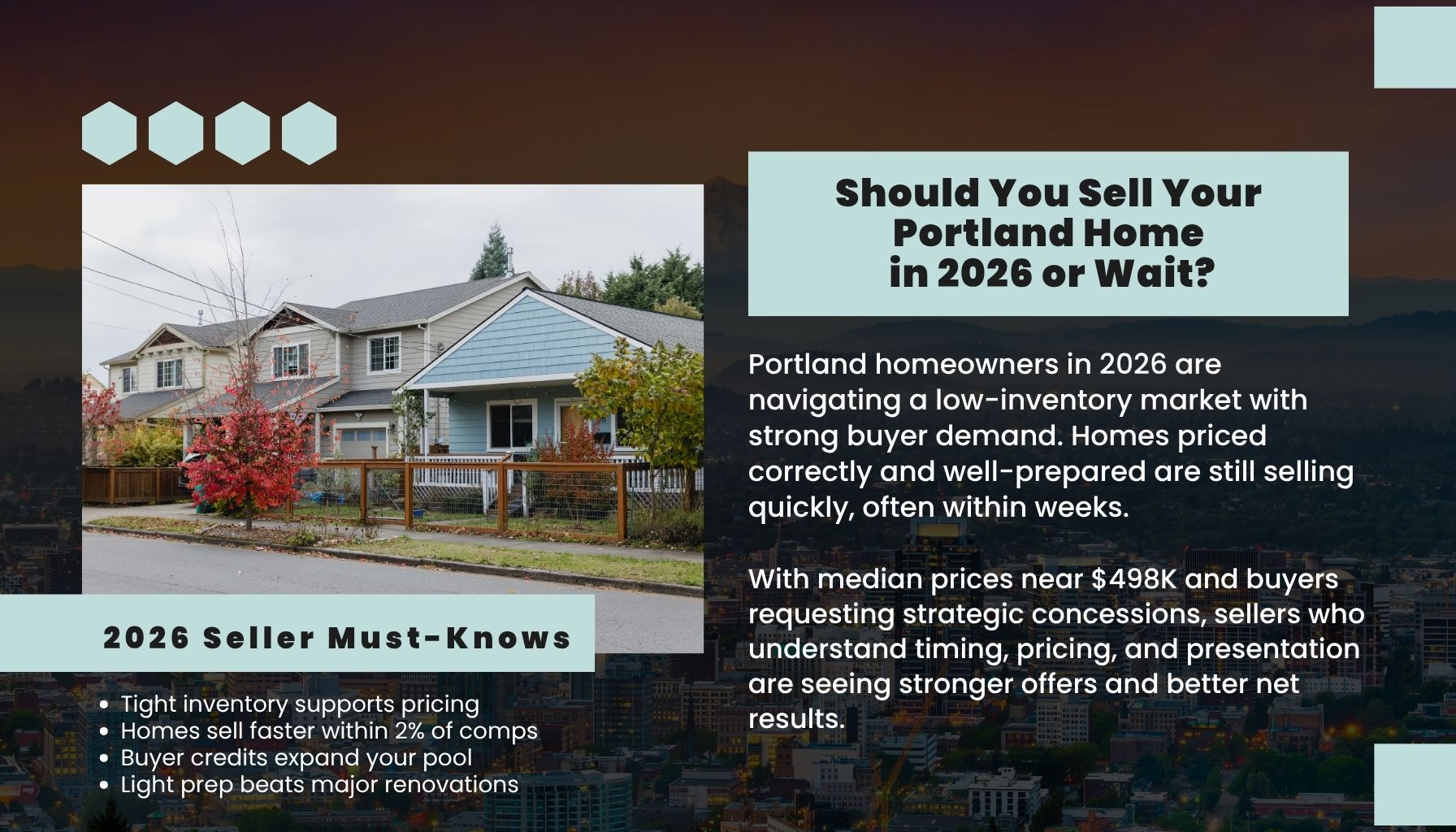
Local market conditions matter. In early 2026, Portland remains a tight-inventory market with roughly a month and a half of supply, and typical homes going pending around five to six weeks. That pace keeps leverage balanced. Many sellers still receive strong offers but increasingly negotiate 1–2% in concessions to secure the best terms. Layer in traditional seller costs like brokerage fees, title and escrow, and you get the true picture of your bottom line.
Concessions and credits are tools, not giveaways. Used correctly, they shorten time on market, widen the buyer pool, and can protect your sales price. Used poorly, they feel like death by a thousand cuts. My role is to align the right incentive to the right buyer profile, neighborhood, and season.
Here is how I define it as Lisa Mehlhoff:
- Concessions: seller-paid items that offset buyer costs, like closing-cost credits or rate buydowns.
- Credits: targeted amounts for repairs or closing fees, agreed during offer or inspection.
- Closing costs: title, escrow, recording, plus brokerage fees, paid at closing regardless of concessions.
How do these costs show up in today’s Portland market data?
Portland’s median sale price has hovered near the high $400s to low $500s in Q1 2026, with typical days on market around 38. Inventory remains limited, which keeps negotiations active but not frantic. In this environment, seller concessions averaging 1–2% are common on financed offers, particularly when buyers need help with closing costs or a temporary rate buydown. Local multiple listing service data supports this balanced, slightly price-sensitive climate in the core city and close-in neighborhoods. See the RMLS Market Action Report for regular monthly updates.
Financing costs are the linchpin. Mortgage rates have been oscillating near the mid 5 to low 6 percent range in early 2026, so a targeted concession can make or break affordability for first-time and relocating buyers. Track weekly rate trends via the Freddie Mac PMMS.
Supply and demand will continue to shape seller costs. The city’s growth and housing needs analysis highlights both long-term demand and a need for additional supply to meet future population and job growth. That context helps explain why well-priced homes still move and why strategic concessions can catalyze qualified offers. For a policy-level view, review the Portland Housing Needs Analysis.
Why this matters in negotiations
- Concessions can preserve your list price while delivering real buyer value.
- Credits can solve inspection hurdles quickly without overcommitting to repairs.
- Market data justifies your approach and helps set expectations with every buyer’s agent.
Which neighborhoods see which concessions, and what should sellers expect?
Neighborhood dynamics drive strategy. In SW Portland, Lake Oswego, and close-in eastside areas, schools, commute, and amenities keep demand resilient. In parts of East Vancouver and Clark County, short market times persist, but Washington’s real estate excise tax affects net sheets differently than Portland’s, which has no transfer tax.
- SW Portland (Hillsdale, Multnomah Village, South Burlingame)
- Lake Oswego
- Inner Eastside (Sellwood, Laurelhurst, Montavilla)
- East Vancouver and The Cedars
- Battle Ground and Brush Prairie
Across these areas, I see concessions between 1–2% as the norm on financed offers. Cash buyers still ask for small credits post-inspection, particularly for roofs, sewer lines, or major systems. Smart sellers budget, then use every dollar to solve a buyer problem that preserves price.
What are the pros and cons of offering concessions versus price cuts?
Pros:
- Concessions can improve buyer affordability more than a similar-size price reduction.
- Targeted credits solve specific issues quickly, protecting timelines and appraisals.
- Incentives can help financed buyers win, reducing fall-through risk tied to rates.
Cons:
- Overly broad concessions can invite more asks, eroding net proceeds.
- If misaligned with buyer needs, credits do not justify your list price.
How do I estimate and reduce my seller costs in 2026?
Start with a realistic net sheet. On a $525,000 sale, many Portland sellers budget 5–6 percent for brokerage fees, 0.5–1 percent for title and escrow, plus recording and prorations. Oregon does not levy a real estate transfer tax, which helps your net. If you are selling in Vancouver or Clark County, Washington’s real estate excise tax applies, which reduces net proceeds. See the Washington DOR REET for current rates.
Then layer in concessions to match your buyer pool:
- Closing-cost credit: Commonly 1–2 percent of price, applied at closing.
- Rate buydown: For a permanent buydown, roughly 1 point of the loan amount can reduce the rate about 0.25 percent, although pricing varies by lender and day.
- Inspection credits: Usually capped to specific repairs or a flat amount at closing.
Tactics to lower your costs:
- Pre-inspection and targeted repairs reduce surprise credits later.
- Staging high-traffic rooms (kitchen, living, primary suite) improves offer quality.
- Pricing to active demand shortens days on market and minimizes concessions.
One of my clients in Multnomah Village faced a dated kitchen and a 20-year-old roof. Rather than a $20,000 price cut, we offered a $10,000 closing-cost credit and replaced two sections of worn roofing for $4,500. We secured two offers in nine days and appraised cleanly at list.
Another client near The Cedars in East Vancouver drew strong weekend traffic but hit buyer affordability ceilings. We added a 1 percent seller credit earmarked for a permanent rate buydown and negotiated an inspection credit for minor electrical updates. The home went pending in 11 days, and the buyers’ payment landed comfortably within their approval.
FAQs
1) What are typical seller closing costs in Portland for 2026? Most Portland sellers budget 6.5–8 percent of the sale price for total costs, including brokerage fees, title, escrow, and typical concessions. Without concessions, many see 5.5–7 percent. Oregon has no real estate transfer tax, which helps your net. Exact figures vary by price, property type, HOA considerations, and whether you offer a buyer credit or a rate buydown.
2) Are sellers expected to pay buyer closing costs this year? It depends on the offer and loan type. With mortgage rates in the mid 5 to low 6 percent range, many financed buyers request 1–2 percent in seller-paid costs to make payments feasible. Cash buyers may ask for smaller inspection credits. The best approach is to budget for a modest concession and deploy it only when it preserves price or timeline.
3) Do concessions affect appraisal outcomes? Appraisers see concessions disclosed on the purchase agreement. Minor concessions that are typical for the market rarely derail appraisals. Large concessions may prompt extra scrutiny if the price stretches beyond recent comparables. I structure concessions that help buyer affordability without pushing the contract price outside the range that recent closed sales support.
4) Is a rate buydown smarter than a price reduction? Often yes. A targeted buydown can meaningfully lower the buyer’s monthly payment and expand your buyer pool. A similar-size price cut may feel less impactful to buyers and can reset value expectations for future showings. I benchmark both scenarios with the lender to quantify which delivers the best net proceeds and the highest likelihood of closing.
5) How do seller costs differ between Portland and Vancouver, Washington? Portland sellers benefit from no transfer tax, while Clark County sellers are subject to Washington’s real estate excise tax. Title and escrow fees are comparable, and concessions of 1–2 percent are common on both sides. Days on market are slightly faster in many Vancouver neighborhoods, which can reduce the need for larger concessions if pricing is aligned.
6) How long should I expect to be on market in SW Portland or Lake Oswego? If you price to recent pending comps, SW Portland homes often secure offers within 4–6 weeks, sometimes faster for updated properties near top schools. Lake Oswego is similar but can be more appraisal sensitive at higher price points. Strategic staging, pre-inspections, and thoughtfully designed concessions can trim your timeline by a week or more.
7) Where can I find reliable, non-portal market data? For monthly trends and days on market, use the RMLS Market Action Report. For interest rates, consult the Freddie Mac PMMS. For long-term price trends, the FHFA HPI regional datasets is solid. For planning context in Portland, review the Housing Needs Analysis.
Conclusion
The bottom line In 2026, Portland sellers still hold meaningful leverage, but the smartest wins come from precision. Budget for core closing costs, then use concessions and credits as tailored tools to solve buyer pain points while protecting your price and timeline. In SW Portland, Lake Oswego, and East Vancouver, market-ready homes move briskly when strategy meets data. If you want a clear, customized net sheet and a negotiation plan that fits your neighborhood and buyer pool, I am here to help you maximize results.
Lisa Mehlhof Homes | License #220603251 Call or text 503-490-4888 https://lisamehlhoffhomes-
Categories
Recent Posts









"My job is to find and attract mastery-based agents to the office, protect the culture, and make sure everyone is happy! "