Essential Home Inspections for First-Time Buyers: Sewer Scope, Radon, and HVAC Checks in Portland OR and Battle Ground WA
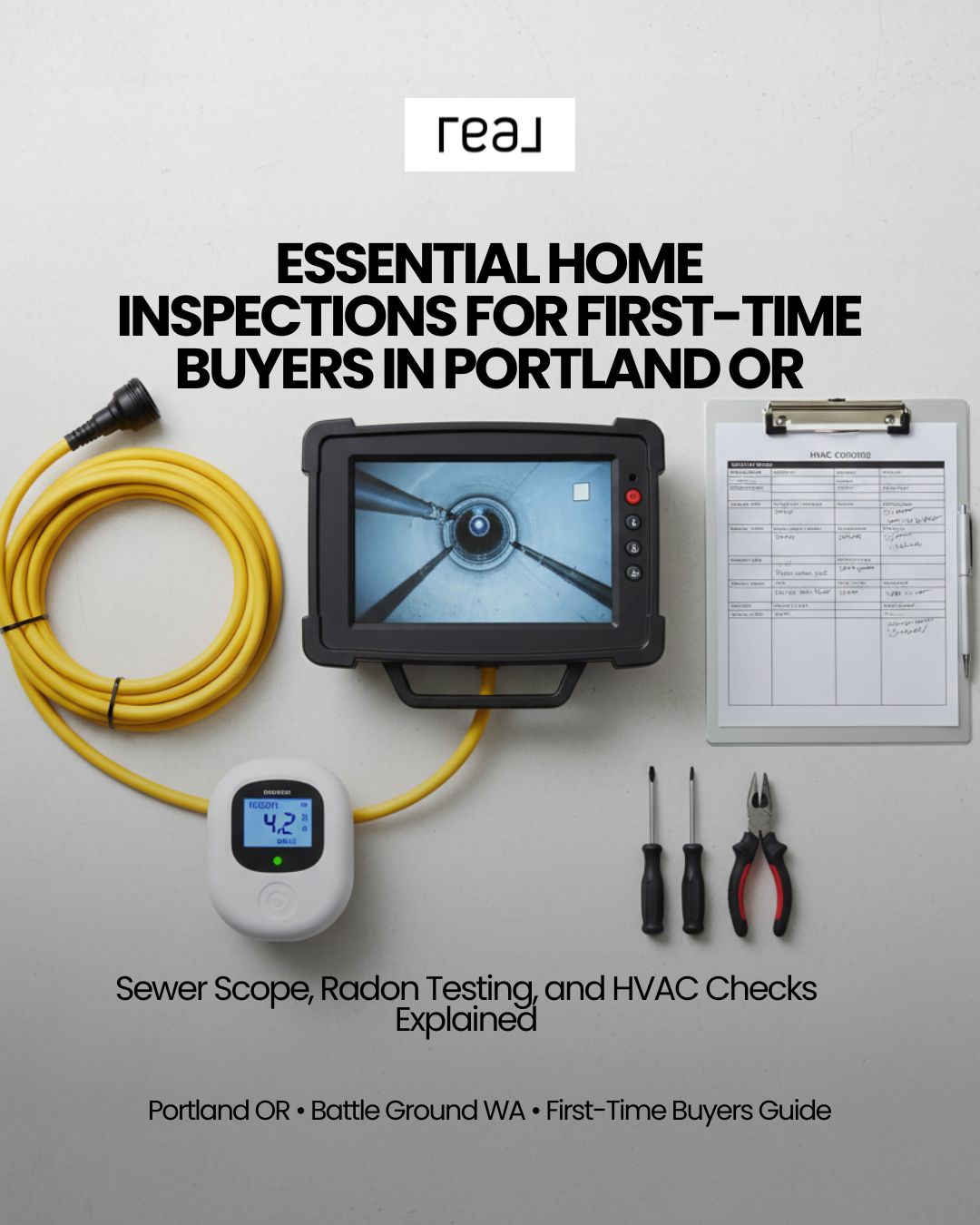
What essential inspections should you prioritize, and how do sewer scope, radon, and HVAC checks impact your purchase in Portland OR and Battle Ground WA?
Prioritize a sewer scope, a 48 hour radon test, and a licensed HVAC evaluation before you commit. These catch the costliest risks in Portland and Battle Ground and give you leverage to negotiate repairs or credits.
Why This Matters Right Now
You are buying in a competitive Portland real estate market with roughly three months of inventory, which favors sellers and compresses timelines. Prices around the Portland Metro have hovered near the mid 500s, with SW Portland trending higher and Battle Ground WA often coming in more affordable. When you buy a home in Portland Oregon, you want every dollar to work hard, so you cannot afford hidden defects that drain your budget after closing. Sewer repairs can run into five figures, radon mitigation is a health priority, and HVAC replacements can reshape your monthly cash flow. Your timing could include spring and summer competition, when Portland homes for sale move faster and inspection periods stay tight. If you understand which inspections matter most and how to use the results, you protect your investment and keep your offer strong in a market where clean, decisive deals win.
What You Need to Know Before You Schedule Inspections
You should treat inspections as risk management and negotiation tools. In older Portland neighborhoods like Laurelhurst, Irvington, Alameda, and Ladds Addition, a sewer scope is often non negotiable due to aging lines and mature trees. In Battle Ground and Brush Prairie, newer subdivisions still benefit from early detection of construction defects or improper connections.
Key takeaways:
- Sewer scope: A camera inspection identifies root intrusion, offsets, cracks, bellies, and collapsed sections. Clay, concrete, and Orangeburg lines are common in older homes. Expect $150 to $300 for the scope; spot repairs can be $2,000 to $6,000, full replacements $8,000 to $20,000 or more.
- Radon testing: The Oregon Health Authority recommends testing all homes. A 48 hour test provides an average; 4.0 pCi/L or higher typically triggers mitigation. Systems usually cost $1,200 to $2,500, and you should verify fan operation and vent routing.
- HVAC and water heater: You want documentation of age, fuel type, efficiency, and safety. A furnace typically lasts 15 to 20 years, heat pumps 12 to 15, water heaters 8 to 12. Replacement can range from $4,000 to $9,000 for a furnace, $8,000 to $15,000 for a heat pump, and $1,000 to $2,000 for a standard water heater.
- General inspection: Roof life, foundation cracks, grading and drainage, and electrical safety matter. In pre 1960 homes, ask about knob and tube wiring and panel capacity.
Older Homes and Local Risk
You will see higher sewer risk in historic corridors such as Laurelhurst, Irvington, and Ladds Addition, where large trees can invade lines. In SW Portland, hilly terrain can increase the chance of sewer bellies and drainage issues. In Battle Ground and Brush Prairie, radon levels can vary by pocket, so you should test even if a neighbor’s result was low.
How to Compare Your Options
You should compare three choices for each critical inspection: do it pre offer, do it during the inspection period, or waive it and assume the risk. In a seller’s market, you often cannot pre inspect every property, so you balance speed, cost, and risk.
Consider:
- Sewer scope timing: Pre offer scopes give you certainty and leverage, but access can be limited. During the inspection period, schedule immediately so you have time to get bids if defects appear.
- Radon strategy: Short term tests are fast and inexpensive. If results hover near action levels, you can request a mitigation system or a credit. Long term testing can be done after closing if you receive a credit and want more data.
- HVAC evaluation: If the system is past mid life or shows uneven heating and cooling, you should bring in a licensed HVAC contractor for a service check and estimated remaining life. Energy efficiency upgrades can reduce your monthly expenses.
Key factors to evaluate:
- Cost exposure: Compare potential repair costs against your total budget and the price you are paying in the Portland housing market trends you see today.
- Negotiation leverage: Strong inspection findings open the door to seller credits or targeted repairs, which help you buy a home in Portland Oregon without stretching your reserves.
- Time impact: Quick scheduling protects your inspection contingency and keeps your closing on track, which matters when multiple buyers are lined up.
Your Step-by-Step Guide
Follow a clear sequence so you do not lose momentum in a fast moving market.
1) Before you write: If the home is older or tree lined, ask for permission to complete a sewer scope prior to offer. Review seller disclosures for past sewer, radon, or HVAC notes.
2) Offer strategy: In a competitive situation, keep your inspection period tight, usually 5 to 7 business days. You can be decisive and still protect yourself.
3) Day 1 booking: Schedule the general home inspection, sewer scope, and radon test immediately. If HVAC is older than 15 years or shows poor maintenance, schedule an HVAC specialist as well.
4) On site coordination: Attend inspections so you see defects firsthand. Ask the inspector to prioritize health and safety, water intrusion, and high ticket items.
5) Rapid estimates: If defects are found, request same day or next day repair bids from licensed contractors. You need real numbers to negotiate.
6) Negotiation package: Provide the inspection summary and bids with your repair addendum. In a seller’s market, you strengthen your ask by focusing on material issues such as sewer failures, high radon, or unsafe HVAC.
7) Re inspection: If the seller agrees to repairs, schedule re inspections to verify completion and permits where required.
8) Post closing plan: If you accept a credit instead of repairs, line up contractors to complete work promptly so you control cost and scope.
What This Looks Like in Portland OR and Battle Ground WA
Your inspection priorities vary by micro market, house age, and lot conditions. In Portland proper, many pre war homes in Laurelhurst Portland, Irvington Portland, Alameda Portland, and Ladds Addition Portland have charming architecture and mature landscaping, which increases sewer and drainage risk. SW Portland’s hills can create hydrostatic pressure on foundations and settlement in older lines. East of I 205 and into East Vancouver and The Cedars, you will see more 1990s to 2010s construction, but you should still scope sewers for improper slope or construction debris.
Price context matters:
- Portland area single family median has hovered near the high 530s to mid 540s, with SW Portland often near the mid 600s.
- East Vancouver and Cedars neighborhoods often track around the high 400s to low 500s.
- Brush Prairie and Battle Ground WA can run from the low 450s to the mid 500s depending on age, size, and lot features.
Neighborhoods to consider:
- Laurelhurst: Historic homes, higher likelihood of older sewer lines, strong walkability, and price points that reward due diligence on major systems.
- Irvington: Large lots and trees, mixed updates, radon testing prudent due to basements and varied soils, strong community amenities.
- Battle Ground: Newer subdivisions with modern HVAC, yet you still benefit from sewer scopes to catch construction flaws, and radon testing remains wise due to local variability.
This is where a Portland real estate agent helps you calibrate risk by neighborhood, so you compare your options against local norms and recent repair outcomes.
What Most People Get Wrong
You might assume that new construction eliminates the need for a sewer scope. It does not. Construction debris, improper slope, or bad connections can still create expensive problems. You might also think low radon areas are safe without testing, but radon is hyper local, so your neighbor’s reading cannot predict your home. Another mistake is focusing only on flashy items like countertops, then ignoring HVAC age and safety, which can convert into a large replacement within your first year.
In a multiple offer scenario, you may feel pressure to waive inspections to be competitive. That often backfires. You can write a strong offer with a short inspection window, then focus on material health and safety items. When you compare your options, you will see that a disciplined inspection process preserves your upside and reduces the chance of budget busting surprises.
Frequently Asked Questions
Should you order a sewer scope on a newer home?
Yes, you should. Even on newer builds, improper slope, cracked fittings, or construction debris can cause backups. A scope is inexpensive compared to a line replacement. If issues appear, you can negotiate targeted repairs or a credit before closing.
How long does a radon test take and what number triggers mitigation?
A typical short term test runs about 48 hours and reports an average concentration. If your result is at or above 4.0 pCi/L, you should request mitigation. A standard active mitigation system with a fan usually costs $1,200 to $2,500 and can be installed quickly.
What HVAC red flags should you watch for?
You should look for age beyond 15 years, frequent cycling, uneven heating and cooling, rust, and a lack of service records. Gas furnaces with cracked heat exchangers, aging heat pumps with low refrigerant, and undersized returns are common issues that merit repair or replacement.
How do you negotiate inspection items in a seller’s market?
Focus on health and safety, water intrusion, and big ticket items. Provide inspection reports and written bids, then ask for credits or specific repairs rather than a long list of minor items. Tight timelines and clarity help you secure meaningful concessions without losing the deal.
Are condos different for sewer, radon, and HVAC inspections?
You still test radon and inspect HVAC, but you also review HOA documents for maintenance responsibilities. Many condos share lines, so you should ask about past sewer backups or building wide plumbing projects. Clarify what the HOA covers versus what you must repair.
The Bottom Line
You protect your purchase by making three inspections non negotiable: a sewer scope, a 48 hour radon test, and a licensed HVAC evaluation. These reveal the most expensive risks in Portland and SW Washington, and they position you to request repairs or credits without slowing your closing. In a market with limited inventory and strong demand, you win by being decisive, thorough, and focused on material issues. When you compare your options, you will see that targeted inspections deliver the best return on your time and preserve your budget long after move in.
If you’re ready to explore your options for essential inspections in Portland and SW Washington, Lisa Mehlhof Homes can walk you through the specifics for your situation.
 503-490-4888
Categories
Recent Posts











"My job is to find and attract mastery-based agents to the office, protect the culture, and make sure everyone is happy! "