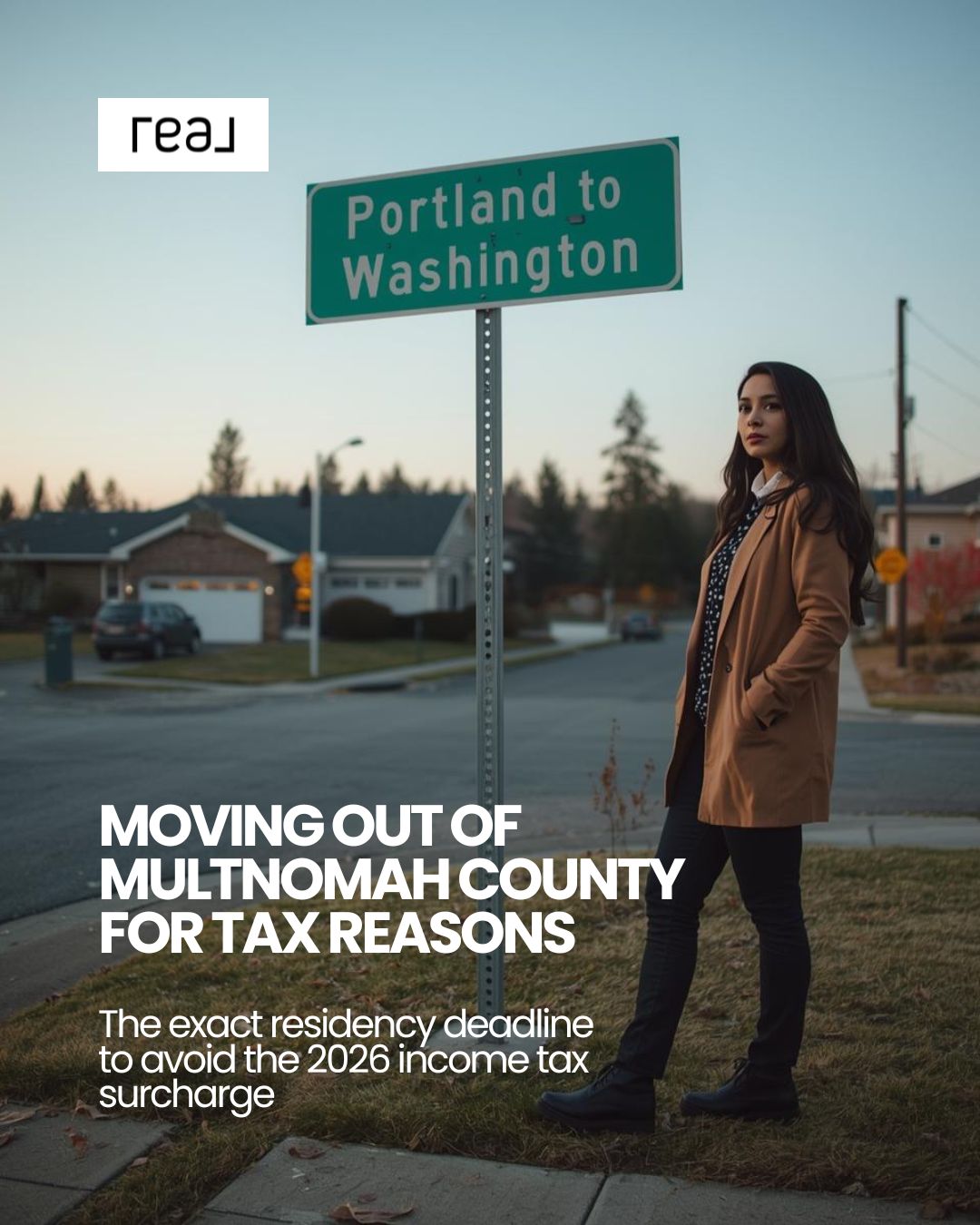
If I’m moving out of Multnomah County to avoid the income tax surcharge, what is the exact date I need to establish residency elsewhere?
TLDR
- Be a nonresident by January 1, 2026 to avoid a 2026 surcharge.
- Establish domicile elsewhere by December 31, 2025 and cut Multnomah ties.
- Document at least 90 days of physical presence in your new county or state.
- File part-year 2025 returns and update all records before year-end.
What does “establishing residency elsewhere” really mean for Multnomah County taxes?
For county and regional income-based taxes, residency follows the Oregon concept of domicile. In plain language, you must show where you truly live and intend to remain. To avoid a 2026 Multnomah County surcharge, you must begin 2026 as a nonresident of the county and keep strong, consistent documentation of your new domicile. Oregon uses a totality-of-facts test that looks at your physical presence, where your family lives, where you keep your stuff, and where your important records are maintained. See the Oregon Department of Revenue residency guidance for the factors examiners consider.
Multnomah County’s income-based programs, such as Preschool for All, rely on Oregon personal income tax concepts and require part-year or full-year returns depending on residency status Multnomah County PFA. If a new county surcharge begins January 1, 2026, aligning your move and documentation to reflect nonresidency on that date is essential.
Here is how I define it as Lisa Mehlhoff:
- Be living and sleeping in your new home before December 31, 2025.
- Shift major ties early: driver license, voter registration, vehicle, bank, healthcare.
- Keep a clear paper trail, including a signed lease or deed, utility bills, and move receipts.
How does the date rule work, and what is the exact deadline?
Income taxes are assessed on a calendar-year basis. If a Multnomah County surcharge takes effect January 1, 2026, the cleanest path to avoid it is to be a nonresident on that date. That means establishing your domicile somewhere else no later than December 31, 2025. Practically, you should be moved in and sleeping at your new address before midnight on December 31 and have key records updated. Oregon recognizes part-year residency for the year you move, which lets you split 2025 between Multnomah County and your new location using the normal Oregon part-year rules.
Because domicile is a facts-and-circumstances test, many tax professionals advise maintaining a documented pattern of physical presence in the new location. In my real estate practice, I ask clients to plan on at least 90 days of clear presence after the move along with evidence of ties, even though the state does not prescribe a hard-day count. Keep in mind that if you have Oregon-source wages after you move, nonresidents still may have filing obligations. County taxes like Preschool for All are administered alongside Oregon returns Multnomah County PFA.
What documents help prove residency?
- New driver license and voter registration at your new address
- Updated vehicle registration and insurance cards
- Lease or recorded deed, plus utility bills in your name
- Mail forwarding confirmation, employer HR address change, and school enrollment records
- Healthcare provider updates and banking statements tied to the new address
Which nearby areas make sense if I want to relocate out of Multnomah County?
You have three popular pathways: cross the river to Washington, move west into Washington County, or head south into Clackamas County. Each has its own market dynamics, taxes, and commute patterns. As a Portland Oregon real estate agent, I help clients weigh lifestyle, schools, and timelines alongside tax planning.
- East Vancouver and the Cedars
- Brush Prairie and Battle Ground
- Lake Oswego and West Linn
- Beaverton and Cedar Hills
Across the metro, the Portland region’s median sale price has stabilized around the mid 500s after a 2024 correction, with months of inventory still tight. Local MLS data shows Portland-area sales volume down roughly 12 percent year over year while Southwest Portland remains a premium submarket with many SW Portland Oregon homes for sale hovering around 650k medians. For national context, price resilience has mirrored broad trends reflected in the FHFA House Price Index.
What are the pros and cons of moving counties to avoid a surcharge?
Pros:
- Potentially avoid a 2026 Multnomah surcharge by being a nonresident on January 1.
- Washington has no state income tax, which can offset higher property taxes for some buyers Washington Department of Revenue.
- Broader choice set, from Cedars in East Vancouver to larger-lot homes in Brush Prairie and Battle Ground.
Cons:
- You may still owe Oregon tax on Oregon-source income after the move if you work in Portland Oregon Department of Revenue residency.
- Future bridge tolls could add commute cost and time for cross-river workers Interstate Bridge Program.
- Moving for taxes alone can backfire if lifestyle, schools, or commute do not fit your long-term plan.
How do I structure my timeline, budget, and market strategy to hit the date?
Start with the end in mind. To avoid a 2026 surcharge, your target is to be fully moved and domiciled elsewhere by December 31, 2025. Work backward 90 to 120 days for search, negotiations, inspections, and closing. In East Vancouver, competitive but steady conditions mean well-priced listings can still move in 2 to 3 weeks. In Lake Oswego, premium listings may go faster, but part of the inventory takes 30 to 45 days to close once under contract.
Budget for closing costs of about 2 to 3 percent of the purchase price, plus moving costs. If you are selling in Multnomah County, price realistically. Portland’s median has stabilized around 550k, with months of inventory near 1.5 to 2.0 in many close-in areas according to local MLS reporting. If you plan energy-efficiency updates after closing, Portland’s Home Energy Score framework offers a checklist of high-ROI items you can use as a guide anywhere in the metro.
One of my clients, a tech professional, chose Cedars in East Vancouver for a new build that matched fiber internet and commute priorities. We wrote in late summer, targeted a November completion, and closed mid December. They updated licenses and voter registration within a week and kept thorough proof of physical presence. Another client, a physician relocating from Hillsdale to the Lake Oswego area, needed a fast close. We negotiated repairs up front, set a 30-day escrow, and moved by December 20. In both cases, we finished address updates before year-end and planned 90 days of documented presence.
If you are a first-time buyer, explore down payment programs early. Oregon Bond loans and Washington first-time buyer programs can improve affordability for qualified borrowers.
FAQs
1) What is the exact date I need to establish residency elsewhere? To avoid a surcharge that begins on January 1, 2026, be a nonresident of Multnomah County on that date. The practical deadline is to be fully moved and domiciled elsewhere by December 31, 2025. Sleep at your new home that night and update key records. File part-year 2025 returns consistent with Oregon’s residency rules Oregon Department of Revenue residency.
2) Do I need 90 days in my new location to “prove” residency? Oregon does not mandate a fixed-day rule. Domicile is a facts-and-circumstances test. In practice, many advisors suggest documenting at least 90 days of presence along with strong ties like licenses, voter registration, and utility bills to make your case clear. Keep contemporaneous records and ensure your major life ties align with your new address Oregon Department of Revenue residency.
3) If I move to Vancouver but still work in Portland, will I owe Oregon taxes? As a Washington resident, you would not pay Oregon tax on non-Oregon income, but Oregon-source wages are still taxable to Oregon. You would file as a nonresident for Oregon on that income. County-level surcharges that rely on Oregon returns may not apply if you are not a county resident, but confirm with a CPA.
4) Will future bridge tolls change the math if I move to Washington? Possibly. Current plans contemplate tolling on the Interstate Bridge later this decade with peak pricing. Model your commute costs and time alongside mortgage and taxes. The timing and rates are still being refined, so keep an eye on official updates. I also encourage clients to test-drive routes during peak hours.
5) Can renting satisfy residency for tax purposes or do I need to buy? Renting can establish domicile if other facts support it. A signed lease, utility bills in your name, address changes for licenses and voter registration, and actual physical presence are key. Buying is not required. I have guided many renters who crossed the county line by mid December and documented ties promptly.
6) How do market timelines look for a late-year move? Local MLS data shows Portland metro inventory still relatively tight, with Southwest submarkets commanding premium pricing. East Vancouver remains active, and Lake Oswego demand stays steady. Plan 30 to 45 days to close for financed purchases, plus time for inspection and appraisal. Build a cushion for holiday schedules that can slow title, underwriting, and movers.
7) What are the first five steps I should take right after closing?
- Change your driver license and voter registration within 7 to 10 days.
- Update employer HR, payroll, and benefits addresses.
- Move vehicles and insurance policies to the new address.
- Set up utilities in your name and keep first bills.
- Forward mail and update banks, healthcare, and school records.
Conclusion
The bottom line If your goal is to avoid a Multnomah County surcharge that would begin on January 1, 2026, the operative date is December 31, 2025. Be fully moved and sleeping at your new address by that night, with as many ties as possible already switched. Then maintain clear documentation of physical presence for the following months. From Cedars in East Vancouver to Lake Oswego and Washington County, there are great options. As your Portland Oregon real estate agent, I will align your purchase plan, timing, and documentation checklist so your tax, lifestyle, and housing goals all line up.
Lisa Mehlhof Homes | License #220603251 Call or text 503-490-4888 https://lisamehlhoffhomes-
Categories
Recent Posts











"My job is to find and attract mastery-based agents to the office, protect the culture, and make sure everyone is happy! "