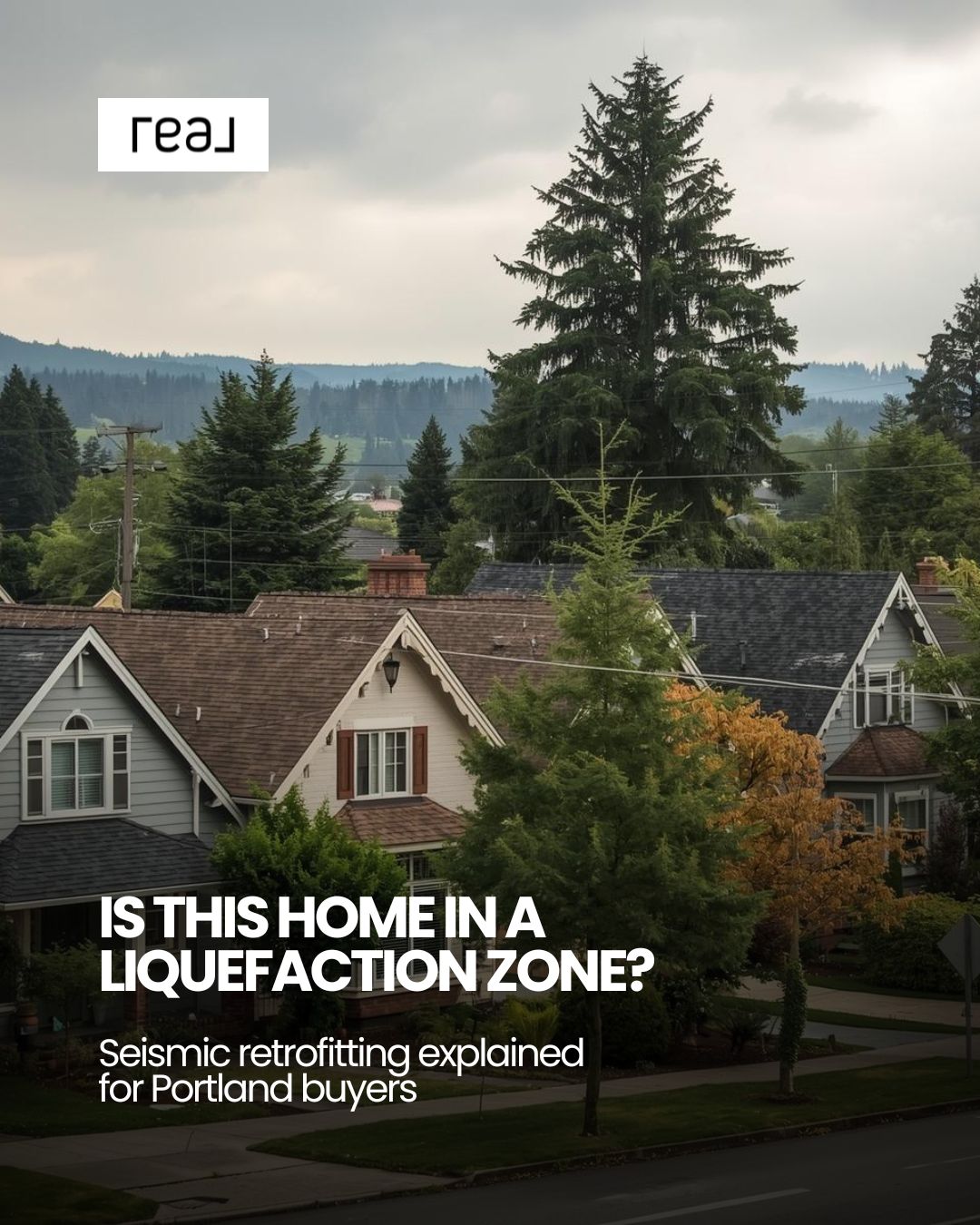
Is this home in a liquefaction zone, and does it have seismic retrofitting (bolted to foundation)?
TLDR
- Start with hazard maps and permits to confirm liquefaction risk and retrofitting status.
- SW Portland and East Vancouver show moderate to high risk on FEMA maps.
- Typical retrofit bolting and bracing costs run eight to twenty thousand dollars.
- Use inspections, contractor bids, and credits to budget safety upgrades confidently.
What does liquefaction and retrofitting really mean for Portland buyers?
Liquefaction is when saturated soils lose strength during strong shaking, which can make a structure sink or tilt. Parts of Southwest Portland and East Vancouver fall into moderate to high susceptibility areas on federal and state maps, so the question matters for nearly every buyer I advise in these neighborhoods. As a Portland Oregon real estate agent, I help clients interpret soil risk alongside market realities like pricing and competition.
Right now the Portland metro median sale price is $554,000 with 1.8 months of supply, signaling a competitive market, according to recent MLS reporting. SW Portland’s median sits around $675,000, East Vancouver is near $515,000, Brush Prairie roughly $630,000, and Battle Ground about $550,000. Low inventory means you may not walk away from a great house just because of risk, but you should factor mitigation. Typical retrofit items include foundation bolting, cripple wall bracing, and plywood shear panels. In our market I regularly see contractor bids between $8,000 and $20,000 depending on access and scope, which aligns with local guidance on seismic strengthening.
Here is how I define it as Lisa Mehlhoff:
- Liquefaction risk is a site and soil question informed by official hazard maps.
- Seismic retrofitting is a building-strengthening plan, often bolting and bracing.
- A smart offer blends risk, retrofit cost, inspection findings, and market leverage.
How do I check liquefaction risk and retrofitting status in our area?
Start with official mapping. For a first pass on regional risk, review the FEMA hazard tools, then refine with state-level maps. Oregon buyers can layer liquefaction susceptibility through DOGAMI, and Washington buyers can use the Washington Geological Survey Portal. Next, confirm whether the home is already retrofitted. Look for anchor bolts, metal plates, and ply sheathing in the crawl space, and then verify permits with local records. Portland’s property record system is helpful for older homes that may have been strengthened.
I also recommend pairing mapping with a specialized structural inspection. An experienced inspector or engineer can identify missing components, lumber conditions, and whether the sill plate and cripple wall bracing meet current best practices. If you are buying in SW Portland Oregon homes for sale where many houses are early to mid-century, this step is often the key to a confident decision and clean appraisal path.
Cite and save the data you gather. When we negotiate, I attach hazard map snapshots, contractor estimates, and permit lookups. In a tight inventory market, documented risk and cost carry real weight. Inspectors and appraisers appreciate clear, authoritative evidence.
Which tools and links should I use?
- FEMA regional hazard resources: FEMA Hazard Resources
- Oregon DOGAMI earthquake and liquefaction: DOGAMI Earthquake Hazards Viewer
- Washington Geological Survey mapping: WA Geology Portal
- Portland property and permits: Portland Maps
- Clark County property records: Clark County MapsOnline
- Seismic strengthening guidance: City of Portland BDS
- Current market stats for pricing context: RMLS Market Action and NAR Housing Data
Where are the neighborhood watchouts, and what should I expect?
Neighborhood geology changes block by block. I tailor advice to micro-areas and property age, then calibrate it against your goals. The examples below are common patterns I see weekly in my work across Portland, East Vancouver, and nearby suburbs like Lake Oswego.
- Hillsdale and Multnomah Village (SW Portland)
- South Waterfront and Johns Landing
- Lake Oswego (First Addition, Lake Grove)
- Fisher’s Landing and Pleasant Valley (East Vancouver)
- Cedars East Vancouver WA real estate
- Brush Prairie and Battle Ground
What are the pros and cons of homes in liquefaction zones?
Pros:
- Opportunity to buy in desirable areas that others overlook due to perceived risk.
- Retrofitting can be scoped, scheduled, and budgeted with clear permit pathways.
- Documented upgrades may enhance buyer confidence at resale in the Lake Oswego Oregon Real Estate Market and beyond.
Cons:
- Insurance and lender questions may add steps or documentation to your transaction.
- Retrofit costs can stress budgets for first-time buyers unless negotiated as credits.
How do I budget, schedule, and negotiate seismic safety during a purchase?
Start by sizing the work. A typical single-family retrofit in our region runs about $8,000 to $20,000 for foundation bolting and cripple wall bracing, depending on crawl space access, lumber quality, and the need for engineered drawings. The City of Portland has a clear checklist for residential seismic strengthening, and most projects can permit and complete within 2 to 6 weeks when contractors are not backlogged.
Next, plan the financing strategy. If we are in multiple offers, consider asking for a closing credit rather than insisting the seller complete the work. In a market with 1.8 months of supply, credits often land more smoothly than repair demands. If the home scores low on energy performance, remember Oregon now requires a Home Energy Score disclosure for listings. Some sellers complete minor upgrades to improve the score, which can dovetail with seismic work.
One of my clients in Multnomah Village loved a 1940s bungalow but worried about soil risk. We verified moderate susceptibility on the state map, secured a $12,500 contractor bid, and negotiated a $10,000 credit. They completed bolting and bracing within three weeks. Another client, a physician relocating to OHSU, found a townhouse near South Waterfront. The HOA had engineered records and reserve planning, so we focused on emergency preparedness rather than structural work.
For tech professionals and military families evaluating East Vancouver Washington real estate, newer builds often align with modern code, though we still verify anchor bolting and shear walls. A brief permit search in Clark County paired with a focused inspection keeps the timeline tight. If you are buying near Cedars, many homes already meet higher standards, which simplifies budgeting.
FAQs
1) How can I confirm if a house is actually bolted to the foundation? Check the crawl space or basement for anchor bolts tying the sill plate to the concrete foundation. Look for metal hardware and plywood shear panels on cripple walls. Then verify records through the local permit system. In Portland, search by address on Portland Maps. If records are absent, a structural inspector can document existing conditions and provide a retrofit scope.
2) Do newer homes still need seismic retrofitting? Homes built after the mid-1990s typically incorporate anchor bolting, hold-downs, and engineered shear walls that meet modern seismic code. Even so, it is smart to confirm details in the inspection and permits. In East Vancouver’s newer communities and Cedars, the risk tends to be lower for missing components. Maintenance still matters, especially drainage and grading that keep soils stable.
3) Will lenders or insurers care if the home is in a liquefaction zone? Some lenders and underwriters ask for more documentation if a property sits in a higher susceptibility area. This may affect available coverage or prompt recommendations for earthquake insurance. Requirements vary by company and product. I advise clients to obtain quotes early and to share any retrofit bids. The extra clarity can prevent last-minute surprises before loan documents are issued.
4) How much value does a seismic retrofit add at resale? Value varies by neighborhood and buyer pool. In lower-inventory areas, documented retrofits can increase buyer confidence and help your home compete against comparable listings. My practical rule is to treat retrofitting as a risk-reduction and marketability investment rather than a dollar-for-dollar return. Good documentation, photos, and final inspections strengthen your resale narrative.
5) What should I do if hazard maps and on-site soils seem to conflict? Maps show generalized susceptibility. Site-specific conditions can differ based on fill, drainage, and previous earthwork. If the home is a finalist, schedule a structural inspection and, when indicated, consult a geotechnical engineer. We can also review historical permits for grading or retaining walls. Ground-truthing often resolves the discrepancy and gives a clearer estimate of retrofit or maintenance needs.
6) Are condos in South Waterfront or downtown affected by liquefaction risk? Condo towers often have deep foundations and engineered systems that address local soils. Your review focuses on HOA reserves, engineering reports, and maintenance planning. Request recent reserve studies and any seismic assessments. While individual owners usually do not control structural retrofits, strong reserves and documented capital planning signal long-term resilience and help with lender approvals on condo loans.
7) How does this factor into offers in a competitive market? Use documentation to your advantage. I attach hazard map excerpts, inspection notes, and contractor bids to justify a credit or price change. When inventory is 1.8 months and SW Portland’s median is $675,000, sellers respond to data. If multiple offers are likely, I frame repairs as buyer-completed post-closing and focus on a fair credit that keeps both sides on schedule.
Conclusion
The bottom line: If you are shopping in SW Portland, Lake Oswego, or East Vancouver, liquefaction risk and seismic retrofitting are manageable with the right plan. Start with official maps, verify permits, and bring in a structural inspector when a home is a strong contender. Align the scope and timing with market facts like low inventory and neighborhood pricing. Then negotiate smartly with credits or pre-closing work, supported by clear documentation. As your local guide, I will help you balance safety, budget, and long-term value so you can move in confident and prepared.
Lisa Mehlhof Homes | License #220603251 Call or text 503-490-4888 https://lisamehlhoffhomes-
Categories
Recent Posts











"My job is to find and attract mastery-based agents to the office, protect the culture, and make sure everyone is happy! "