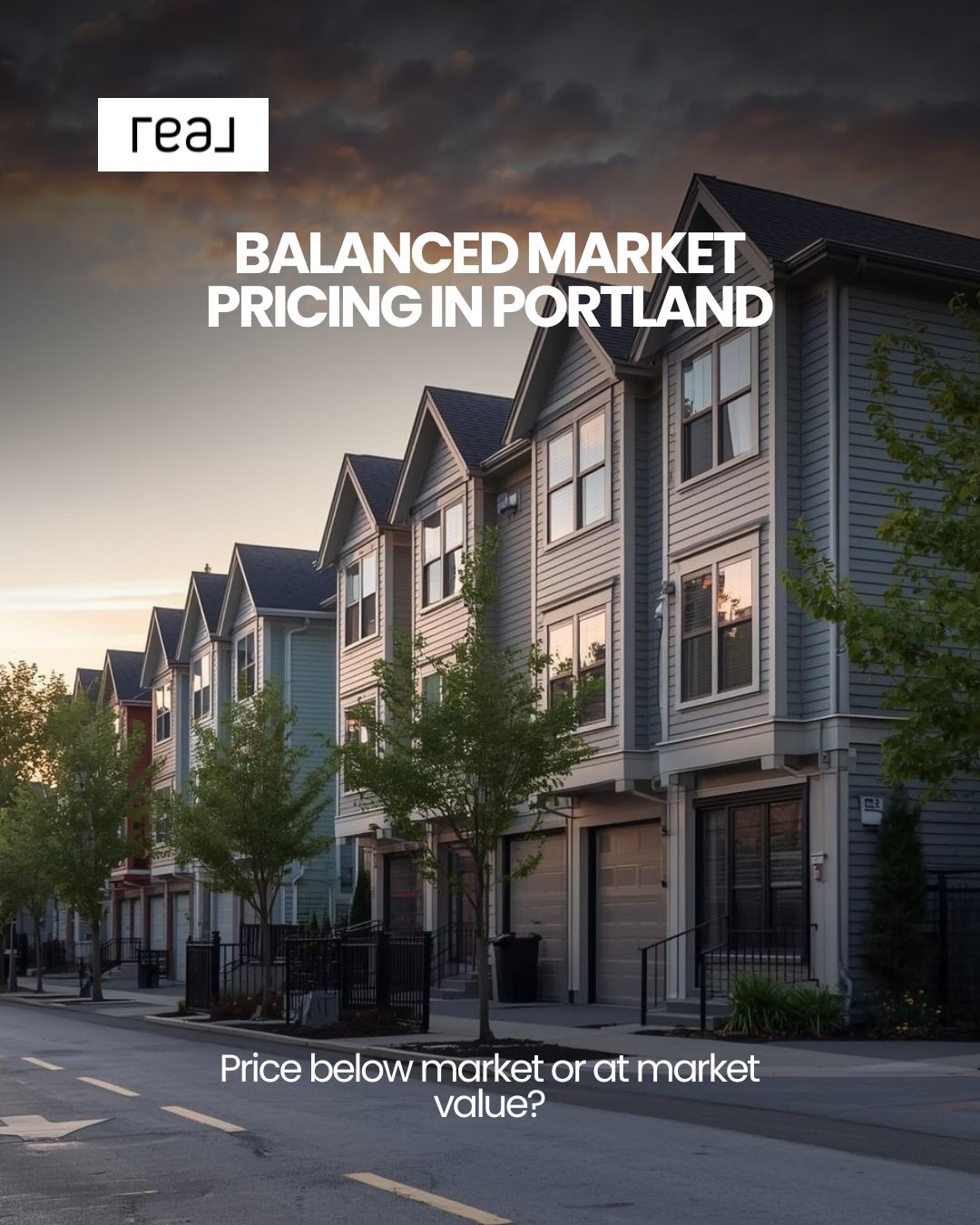
We are entering a balanced market. Should you price slightly below market to spark a bidding war, or price at market value?
TLDR
- Balanced markets reward precision. Price to today’s comps, not last spring’s headlines.
- Underpricing 1–2 percent can work for turnkey homes with unique demand drivers.
- Pricing at market value often yields 98–100 percent list-to-sale with less volatility.
- Your neighborhood’s absorption, buyer profile, and prep budget determine the smarter strategy.
What does a balanced market really mean in Portland right now?
A balanced market is when neither buyers nor sellers hold a clear advantage. In practical terms that is typically 4–6 months of inventory. Portland’s path is heading that direction. The metro sat at roughly 1.5 months of inventory in Q3 2025, a tight seller’s market, then rose toward balance with approximately 5.1 months by November 2025. Listings are still moving, but pricing must reflect precise, recent comparable sales rather than stretched expectations. Median sale price reached about 581,000 dollars in October 2025, up 6.8 percent year over year, which is healthy but not a signal to overreach.
As a Portland Oregon real estate agent, I watch neighborhood-to-neighborhood shifts closely. SW Portland trended near 560,000 dollars in October, while East Vancouver hovered around 485,000 dollars and Brush Prairie plus Battle Ground near 495,000 dollars. These differences matter. The same list price strategy can perform very differently across Multnomah Village, the Cedars in East Vancouver, or central Battle Ground.
Data notes: inventory, absorption, and price trends cited here are drawn from RMLS Market Pulse and my ongoing analysis of active, pending, and sold listings.
Here is how I define it as Lisa Mehlhoff:
- Balanced means days on market stretch and price gaps narrow, so precision wins.
- Buyers gain negotiation room, yet well-prepped listings still command attention.
- Local micro-markets can be seller-leaning or buyer-leaning even within the same month.
Should I price slightly below market or price at market value?
Pricing 1–2 percent below nearby active competition can still catalyze multiple offers in specific scenarios. When I see less than a month of supply for a product type, like fee-simple townhomes, I sometimes recommend a calibrated underlist. Recent RMLS data shows attached homes and townhomes absorbed quickly in Q3 2025, around 0.6 months of supply, while detached homes moved more moderately. In those low-supply niches, a subtle price incentive may pull in three to five offers, lifting the final to three percent or more above list.
In contrast, pricing at market value suits most balanced segments. When we peg a price to the median of the most recent three to five comparable pendings within a half mile and 90 days, we typically see 98–100 percent list-to-sale results with fewer renegotiations. This strategy reduces appraisal risk and protects momentum if your first buyer backs out. It also aligns with buyers’ behavior in a balanced environment, where they tour more homes, compare carefully, and respond fastest to clean, well-supported pricing.
Data sources: absorption and median price references come from RMLS Market Pulse. For planning around future supply, monitor Portland’s Residential Infill Project and Metro’s UGB review.
When does underpricing backfire?
- When nearby pendings already reflect price reductions and slower traffic.
- When condition or location is average and not a “top 10 percent” presentation.
- When appraisal gaps are unlikely and buyers lack cash to bridge differences.
Where do neighborhood dynamics tilt your pricing strategy?
Local context is everything. SW Portland Oregon homes for sale in Multnomah Village and the Southwest Hills draw lifestyle buyers who value walkability, schools, and quick access to Forest Park. In October, SW hovered around 560,000 dollars median, slightly below the metro. Homes with updated systems and a polished cosmetic profile can benefit from a 1–2 percent underlist if competing actives are sparse. If three similar homes are already price-adjusted, pricing at market is safer.
- SW Portland
East Vancouver Washington real estate, especially the Cedars East Vancouver WA real estate corridor, benefits from improved I-205 travel times and new BRT stops. Median pricing near 485,000 dollars broadens the buyer pool. If the submarket shows two or fewer competing listings in your micro area, a small underlist can spur urgency. With more than four comparable actives, price right at market to stay out front.
- Cedars in East Vancouver
Battle Ground and Brush Prairie WA homes for sale are seeing strong family demand and new community amenities. Median cluster around 495,000 dollars has attracted VA buyers and move-up locals. When inventory is thin in your school boundary, minor underpricing works. Where three or more new-build alternatives exist, hold to market value and lean on presentation to compete.
What are the pros and cons of each approach?
Pros:
- Underpricing slightly can compress days on market and increase offer count.
- Market-value pricing lowers appraisal and financing risk for ordinary-condition homes.
- Both approaches benefit from strong prep, data-rich comps, and staging.
Cons:
- Underpricing can train buyers to expect concessions after inspection.
- Market-value pricing may attract fewer early showings if nearby homes are discounted.
- Overcorrecting either way risks sitting or leaving money on the table.
How do I build the right pricing plan for my goals?
I start with a hyperlocal comp set, then cross check against RMLS absorption and the newest pendings, not just solds. For example, if townhomes in your pocket are turning in under 21 days and the last two went pending at full price in the first weekend, a 1–2 percent underlist may be justified. If nearby detached homes needed two price reductions before selling, we stick to market value, tighten presentation, and time the launch for buyer activity peaks.
Cost planning matters. Typical pre-list investments I manage for sellers:
- Pre-inspection: 450–700 dollars
- Light handyman and paint refresh: 1,500–3,500 dollars
- Deep clean and yard spruce: 400–900 dollars
- Staging for a 3-bed home: 1,800–3,200 dollars
- Professional media and floor plan: 350–650 dollars
One of my clients in Multnomah Village prepped for 2,800 dollars and priced right at market based on three fresh pendings. We drew two offers in week one and closed at 100.3 percent of list without appraisal drama. Another client relocating to Cedars in East Vancouver had a turnkey townhome. We underlisted by 1.5 percent, set a clear offer deadline, and secured four offers with a 3.2 percent lift, plus a short inspection timeline that preserved momentum.
For buyers and sellers navigating policy shifts, watch Middle Housing Land Division opportunities for fee-simple townhomes under Portland’s ripened rules. You can review the Residential Infill details at Portland’s RIP page. For broader supply signals, follow Metro’s UGB Review. Where financing affordability matters, first-time buyers can explore rate and down payment support at OHCS Loan Programs.
FAQs
1) How do interest rates change the pricing call in a balanced market? Rates influence monthly payment sensitivity. When rates tick up, buyers compare more rigorously and penalize overpricing faster. I favor market-value pricing with a strong value story in higher-rate periods. If rates dip and showing traffic jumps, a slight underlist can be effective for pristine homes where absorption is already tight. We’ll track lock volume and tour counts before choosing.
2) Should I set an offer deadline if I price below market? Offer deadlines can help, but only when buyer traffic is already strong. If we see 10–15 showings the first 48 hours, a 48–72 hour deadline channels interest without alienating careful buyers. If traffic is light, deadlines appear forced and may backfire. I prefer data-driven timing based on RMLS activity reports and day-by-day showing feedback.
3) How do appraisals factor into underpricing or market pricing? Underpricing can produce a final sale above list, which appraisers will scrutinize. We mitigate with robust comp packets, contractor bids for improvements, and a concise list of value drivers. Market-value pricing typically aligns better with recent pendings, lowering revision risk. Either way, I provide the appraiser with organized data and access for a smooth visit.
4) What if my home needs updates compared with nearby listings? In a balanced market, condition gaps widen. I usually recommend market-value pricing plus targeted, high-ROI refreshes like paint, lighting, and landscaping. Underpricing a tired home can still lag if buyers fear bigger repairs. We will price to reflect condition honestly, disclose proactively, and use pre-inspection to reduce renegotiations after offer.
5) Do school ratings or tax differences change the right pricing approach? Yes. Families prize school stability, so homes in top-performing boundaries often sustain stronger demand. For Portland specifics, review district report cards at the Oregon Department of Education. Tax nuances matter too. Oregon’s Measure 50 and assessed value resets at sale can change buyer perceptions. See guidance at the Oregon Department of Revenue and I will prepare a tax-impact worksheet.
6) Will future development or UGB changes affect my pricing now? Potential expansion of Portland’s urban growth boundary adds land capacity over time, but lots will not hit the market overnight. The current resale market is still driven by existing inventory and near-term new builds. Keep tabs on the process at Metro’s UGB Review. For most sellers today, pricing should reflect current comps, not theoretical future supply.
7) Are there special considerations for VA or physician loans on the buy side? Absolutely. VA buyers in Clark County and physicians using jumbo or specialty loans often have lender overlays and timing needs. I adjust timelines, appraisal expectations, and closing buffers to match. For VA clients I coordinate early with the lender and emphasize move-in readiness. For physicians, I showcase low-maintenance fee-simple options that align with busy schedules.
Conclusion
The bottom line In a balanced market, pricing is a strategy decision rooted in local absorption, condition, and buyer behavior. Underpricing by 1–2 percent can still spark competition for standout homes in tight submarkets like fee-simple townhomes or turnkey SW Portland listings. Pricing at market value suits most properties, reduces appraisal risk, and preserves leverage during inspection. I will tailor the plan to your neighborhood, budget, and timeline using current RMLS data, careful prep, and a launch that meets buyers where they are right now.
Lisa Mehlhof Homes | License #220603251 Call or text 503-490-4888 https://lisamehlhoffhomes-
Categories
Recent Posts






"My job is to find and attract mastery-based agents to the office, protect the culture, and make sure everyone is happy! "