What does a “balanced” market actually mean for me as a buyer?
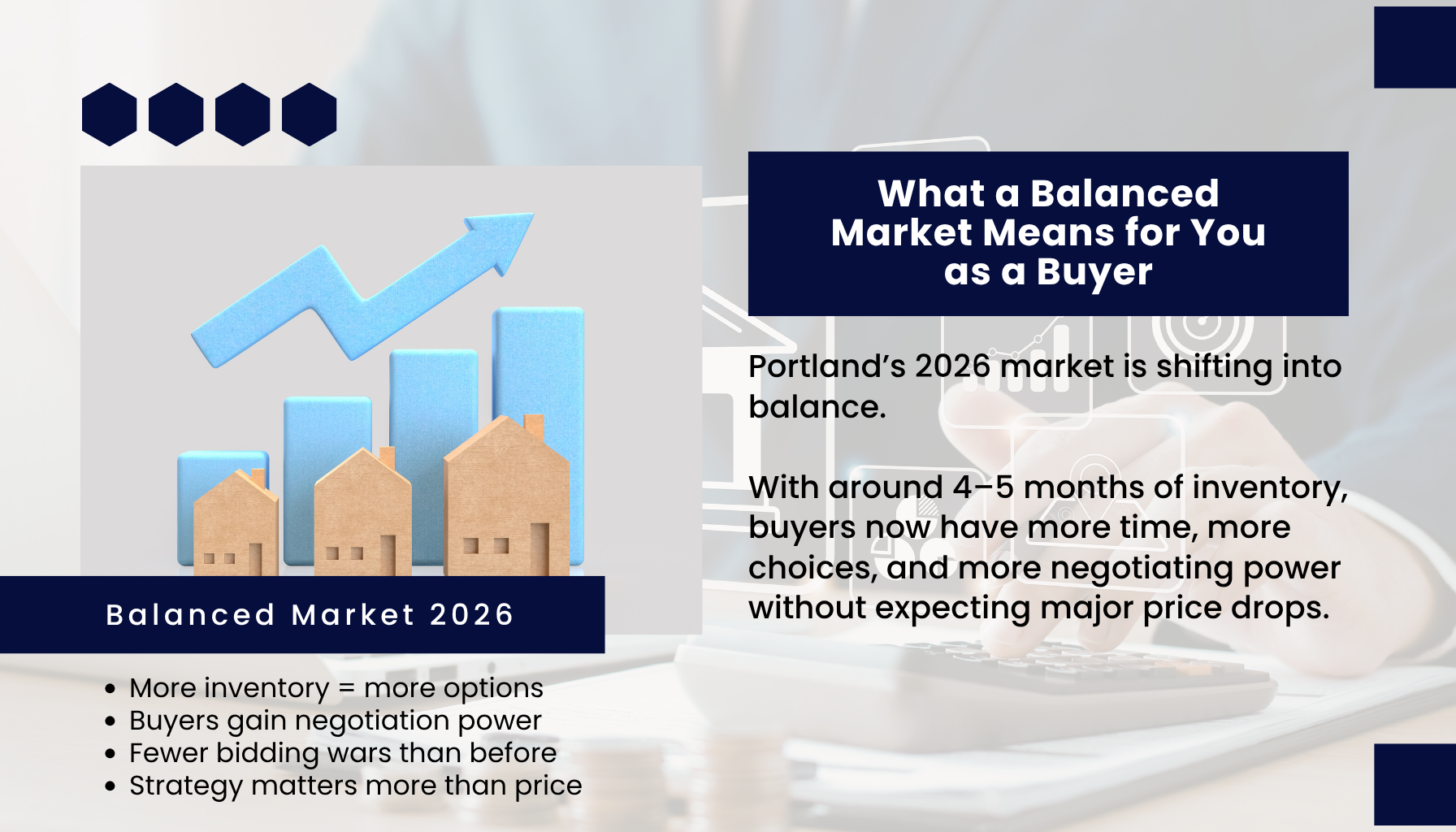
TLDR
- Four to five months of supply means buyers gain leverage without extreme discounts.
- Portland’s median price sits near $538,000 with days on market rising.
- East Vancouver offers value options as Clark County trends hold steady this spring.
- Strong pre-approval and smart terms matter more than bidding wars or huge concessions.
What does a balanced market really mean?
A balanced market is the middle ground between a hot seller’s market and a cool buyer’s market. It is commonly defined as about four to five months of housing supply, where neither side has a clear upper hand. Locally, recent RMLS data shows Portland metro inventory hovering around 4.5 months this winter with days on market stretching into the 60 to 66 day range. That puts many of my clients in a better negotiating posture without expecting steep price cuts.
Nationally, the industry uses months of supply to gauge balance. When inventory rises toward four to six months, buyers gain time to compare options and negotiate on price, credits, or repairs. When supply tightens under three months, sellers usually hold the cards. You can read more about how months of inventory works from NAR, which tracks national market conditions and definitions.
Here is how I define it as Lisa Mehlhoff:
- Buyers can ask for credits or repairs, and often get at least some.
- Sellers still receive solid offers if priced correctly and presented well.
- Price growth is modest and neighborhood-specific, not runaway or collapsing.
How does a balanced market work in Portland and Vancouver right now?
In Portland, we are seeing a median sale price near $538,000 as of February with a month-over-month uptick in March. RMLS shows pending sales improving compared to last year’s levels and days on market trending longer than a year ago. Practically, that means good homes still sell, but you have more breathing room to tour multiple properties and negotiate on repairs or rate credits. As your Portland Oregon Real Estate Agent, I am seeing list-to-sale performance around parity in many price bands when homes are priced accurately.
Across the river, East Vancouver Washington Real Estate remains attractive for budget-conscious buyers and commuters. Clark County’s median sits in the mid $500,000s while the City of Vancouver trends below that figure. Well-priced listings are moving within about a month to six weeks, but buyers are not typically escalating wildly above asking. Entry-level homes still draw attention, while move-up homes in the $600,000 to $800,000 range benefit from balanced conditions that allow for negotiations on inspection items and closing costs.
Affordability remains a key driver. The 2024 American Community Survey shows Portland’s median gross rent around $1,770, while owner costs with a mortgage are typically higher. That gap is influencing some buyers to continue renting while monitoring rates. Keep an eye on financing costs through FRED’s 30-year mortgage rate. Locally, I use RMLS data and PMAR market statistics to help you time your search and set realistic expectations.
Local nuance buyers should know
- SW Portland neighborhoods like Multnomah Village and Hillsdale still command strong interest, especially for updated homes near parks and schools.
- Lake Oswego’s upper-end segments remain steady, but buyers often win on terms, not just price. The Lake Oswego Oregon Real Estate Market values clean inspections and flexible closes.
- In East Vancouver, Cascade Park East and nearby Cedars areas offer good commuter access and relative value versus close-in Portland.
Which neighborhoods fit my goals in a balanced market?
Portland is a collection of micro-markets. Balance at the metro level does not erase neighborhood-level differences. Here are three quick snapshots I discuss with buyers each week.
- SW Portland: Multnomah Village and Hillsdale
- Lake Oswego: First Addition and Westlake
- East Vancouver: Cedars and Cascade Park East
If you are exploring SW Portland Oregon homes for sale or weighing a Clark County commute, I will align your search with your financing, school preferences, and transit needs. Medical professionals headed to OHSU or Legacy often prefer SW Hills or Dunthorpe for quick hospital access. Tech professionals heading to Intel or downtown frequently target inner Southeast or the westside for shorter commutes.
What are the pros and cons of shopping in a balanced market?
Pros:
- Negotiating room improves: inspection credits, minor price reductions, or seller-paid rate buydowns.
- More selection and time to perform thorough due diligence before committing.
- Fewer bidding wars and more predictable appraisal outcomes than peak seller cycles.
Cons:
- Well-priced homes still attract multiple offers, so strategy remains essential.
- Rates near current levels can limit buying power without creative financing.
Balanced conditions mean you should focus on value, not just price. That includes location quality, school options, commute times, HOA health, and long-term maintenance costs. My role is to help you quantify those tradeoffs so that your final decision feels confident and data-informed.
How do I make a strong offer without overpaying?
Start with fully underwritten pre-approval. I will coordinate with your lender to price scenarios at current rates and compare points versus lender credits. For reference, see the national rate trend via FRED. In our market, a clean, complete offer often beats a higher but messy one. Think organized timelines, earnest money aligned with price, and clear contingency windows.
What does a strong offer look like today:
- Pre-approval plus proof of funds for down payment and closing costs.
- A realistic inspection period of 7 to 10 days with a focus on health, safety, and major systems.
- A seller credit for rate buydown or closing costs if the home has been on the market over 30 days.
- Flexible closing or rent-back when a seller needs time to secure their next purchase.
Typical inspection costs run about $400 to $600 for a general home inspection, with $250 to $500 each for sewer scope, radon, or pest inspections. In Oregon and Washington, sellers provide property disclosures that you should review closely. I benchmark comparable sales through RMLS and incorporate local trends from PMAR and FHFA’s House Price Index to right-size your bid.
One of my clients, a tech couple relocating from California, targeted Lake Oswego at $900,000. We used a short inspection period, a pre-inspection on a favorite home, and a small seller credit toward points. They won without overbidding and trimmed their monthly payment.
Another client, an active-duty military family using a VA loan, shopped in East Vancouver near Cedars. We paired a full VA approval with a flexible close and negotiated a seller credit instead of raising price. They kept cash in reserve and still met appraisal. For VA resources, review VA Home Loans.
FAQs
1) What exactly is “months of supply” and why does 4 to 5 months matter? Months of supply measures how long it would take to sell all active listings at the current sales pace. Around four to five months is considered balanced because neither sellers nor buyers dominate. That environment usually means moderate price movement, more negotiation room, and fewer extreme bidding wars. For national definitions and context, see NAR’s research pages.
2) Should I wait for rates to drop before buying in Portland or Vancouver? It depends on your timeline and budget. In a balanced market, you can negotiate for seller credits to buy down your rate now, then refinance later if rates fall. If the right home appears and fits your payment at today’s rate, acting now can beat future price competition. Track rate trends at FRED and weigh your personal horizon.
3) How much under asking can I reasonably offer today? In balanced conditions, list-to-sale outcomes often land near 100 percent for well-priced homes. If a property has sat 30 to 45 days or needs updates, 1 to 3 percent below list, or equivalent credits, may be achievable. The strategy depends on neighborhood, condition, and competition. I analyze RMLS data and recent comps to recommend where to press and where to hold.
4) What price range fits a $3,000 monthly housing budget? A quick rule of thumb: at roughly 6 percent for a 30-year fixed, $3,000 per month for principal, interest, taxes, and insurance often supports a purchase near $500,000, assuming average taxes and premiums. Your exact number depends on down payment, HOA dues, and debt-to-income. We will model scenarios with your lender and compare rate buydown options before writing offers.
5) Are inspections still necessary if the home looks turnkey? Who pays? Yes. Even beautiful homes can hide issues. Buyers typically order and pay for inspections here. Budget about $400 to $600 for general inspection, plus $250 to $500 each for sewer scope, radon, or pest. We prioritize health and safety items during negotiations while balancing seller expectations. In Oregon and Washington, sellers must provide disclosures that we review together.
6) How can first-time buyers compete without overextending? Get fully underwritten, consider down payment assistance, and target homes a notch under your max. Oregon buyers can explore OHCS homeownership resources. Washington buyers can review WSHFC programs. In a balanced market, clean offers, flexible closing dates, and asking for strategic credits often outperform higher but riskier offers.
7) I work downtown. Which areas balance commute, schools, and value? For short commutes and strong schools, consider Multnomah Village or Hillsdale for SW Portland Oregon homes for sale. If you prefer suburban amenities and top schools, Lake Oswego’s First Addition and Westlake are excellent, with pricing to match. Value seekers who commute via I-205 often look at East Vancouver, including Cedars and Cascade Park East. Check routes with TriMet schedules.
Conclusion
The bottom line A balanced market gives buyers time to think and room to negotiate without the chaos of peak seller seasons. In Portland and across East Vancouver, inventory near 4.5 months and days on market around two months point to steady but not frantic conditions. Focus on value, not just price. Match your offer strategy to each micro-market, request targeted credits, and keep inspection timelines tight. If you need schools, use Oregon and Washington report cards. If you need rate help, leverage seller credits and revisit refinancing later. I am here to turn this balance into your advantage in the Lake Oswego Oregon Real Estate Market, Cedars East Vancouver WA Real Estate, and beyond.
Lisa Mehlhof Homes | License #220603251 Call or text 503-490-4888 https://lisamehlhoffhomes-
Categories
Recent Posts











"My job is to find and attract mastery-based agents to the office, protect the culture, and make sure everyone is happy! "