You Have a 3% Rate but Want to Move: Real Options for Portland Homeowners in 2026
TLDR
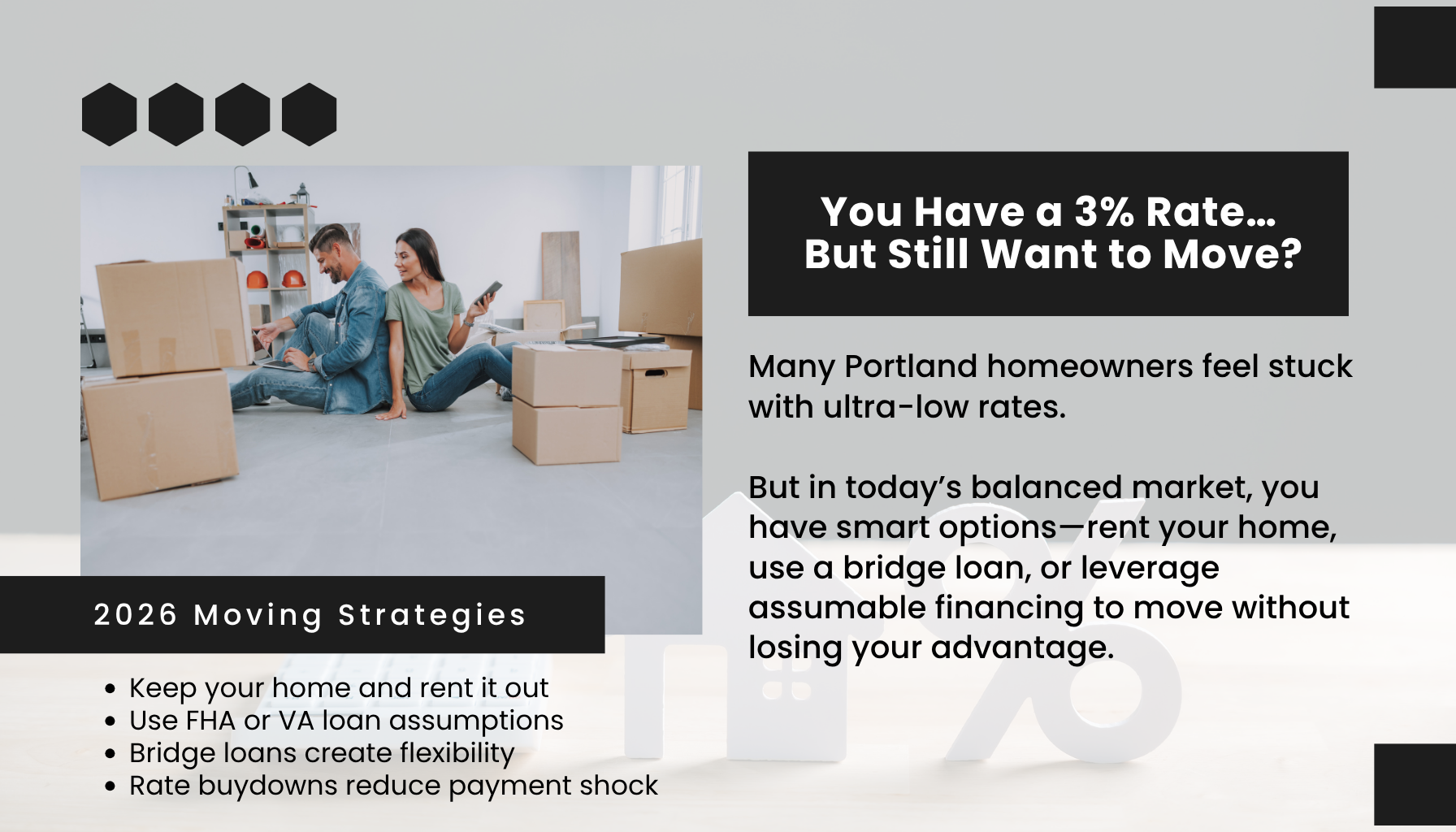
- Keep your 3% rate by renting your current home and buying strategically elsewhere.
- Consider FHA or VA loan assumptions, bridge loans, and temporary rate buydowns.
- Portland’s market is balanced, so timing, pricing, and terms matter more than speed.
- Use precise budgeting, local data, and lender programs to minimize monthly payment shock.
What does “I have a 3% rate but want to move” really mean in 2026?
In 2026, many Portland homeowners are equity rich but “rate locked.” You love your monthly payment at 3%, yet life changes, schools, commutes, and space needs are pushing you to move. With local inventory near 4 to 5 months of supply and median days on market rising to about 60 to 66, we are in a more balanced landscape than in 2021 to 2022. That means fewer bidding wars, steadier pricing, and more room to negotiate terms rather than just price. Local MLS data shows the Portland metro median around $538,000 in February 2026, with March edging higher. Clark County sits higher than the Vancouver city median, near the mid $500,000s.
Nationally, the 30-year fixed rate hovers well above your 3% note, with recent readings near the mid 6% range per FRED’s mortgage rate series. Oregon’s long-term price trajectory also remains favorable according to the FHFA House Price Index, supporting the case for strategic moves that protect your equity.
Here is how I define it as Lisa Mehlhoff:
- You are balancing equity, monthly payment, and life needs, not just “rate math.”
- Strategy selection depends on loan type, timing, equity, and neighborhood targets.
- A balanced market rewards clean offers, thoughtful contingencies, and precise pricing.
How can you move without “losing” your 3% rate entirely?
You may not be able to port a mortgage in Oregon like in some other countries, but you can capture your low rate’s value through smart structures. Start by confirming your current loan type, equity position, and whether your loan is assumable. FHA and VA loans are often assumable with lender and servicer consent. If you sell your home and a qualified buyer assumes your 3% loan, your low rate becomes a powerful marketing tool that can boost price and shorten days on market. For VA sellers, preserving your entitlement may require specific steps, so coordinate with your lender and reference the VA Home Loan program.
If you want to keep your current home and still move, consider a HELOC or a bridge loan to access equity for the next down payment. Bridge loans typically carry higher short-term rates plus points, yet they let you buy first, then sell. Temporary rate buydowns can also smooth the first years of payment on the new home. A 2-1 buydown reduces the rate by 2% year one and 1% year two, often paid by a seller credit in balanced conditions.
Core paths to compare
- Loan assumption marketing
- Keep and rent, then buy
- Sell then buy
- Buy then sell with a bridge loan
Where do the numbers pencil out in Portland, SW Washington, and Lake Oswego?
Local MLS data indicates Portland metro’s median near $538,000 in February, with months of supply around 4.5 and days on market at 60 to 66. That is balanced, so offers that include appraisal gap buffers or buydown credits can win without overpaying. Nationally, the median existing-home price has been resilient per NAR’s existing-home sales data, and rates remain elevated year to date, per FRED.
For budgeting, use Determine monthly home budget as a starting point. A $3,000 monthly PITI can often support roughly a $500,000 purchase at a 6% rate with standard taxes and insurance, though HOA fees, property taxes, and PMI can shift this range. Portland’s Housing Needs Analysis outlines ongoing affordability pressures, so pairing down payment assistance and buydowns can be decisive for first-time move-up buyers.
- Multnomah Village and Hillsdale
- Lake Oswego
- East Vancouver and The Cedars area
- Brush Prairie and Battle Ground
Census data shows the Portland metro’s median gross rent near $1,770, with owner costs for mortgaged homes around mid $2,000s, per U.S. Census Bureau ACS. These benchmarks help decide whether keeping your 3% loan as a rental offsets carrying a new 6% payment on your next home.
What are the pros and cons of each strategy?
Pros:
- Keep and rent
- Assume-and-sell marketing
- Temporary buydown on the next home
Cons:
- Keep and rent
- Assume-and-sell marketing
- Temporary buydown on the next home
How do we structure the process and timeline to reduce risk?
Mapping a precise timeline is everything in a balanced market. Start with a loan strategy review, pre-approval, and a rent-versus-sell analysis. I pull comparable sales from RMLS and match those to your equity and cash flow targets. If we pursue “keep and rent,” we model expected rent against PITI, reserves, and maintenance. If we sell, we prep improvements that maximize buyer interest at minimal cost, like paint, lighting, and exterior touch-ups.
One of my clients in Hillsdale wanted to move closer to OHSU with a new baby on the way. We listed their bungalow on a Thursday, offered a credit for a 2-1 buydown to the buyer, and secured a strong price with a 45-day close and a 30-day rent-back. Their next purchase near South Waterfront closed the week after they moved, minimizing overlap and stress.
Another client in Fisher’s Landing considered keeping their home. We used a HELOC to secure 15% down on a Lake Oswego townhome, then listed the Vancouver property after minor updates. It sold in 18 days, and we retired most of the HELOC at closing. The result trimmed their blended monthly debt and preserved flexibility to refinance when rates improve.
Key process steps:
- Pre-approval and assumptions check
- Prep, list, and negotiate terms
- Buy with confidence
- Post-close and portfolio review
Which options are best for different homeowners and movers?
As a Portland Oregon Real Estate Agent serving SW and across the river, I tailor plans to lifestyle and balance sheet. Here is how I usually align strategies.
- First-time move-up buyers
- Home buyers relocating to Portland Oregon
- Tech professionals
- Doctors relocating
- Military families
FAQs
1) Can I really market my home’s 3% loan as assumable to get a better price? Yes, if your existing mortgage is FHA or VA and your servicer approves an assumption. Buyers must qualify and may need cash to cover your equity. The assumable rate can widen the buyer pool and support a stronger price or shorter days on market. We confirm details with your lender early and coordinate timelines to protect your move.
2) Should I keep my home as a rental or sell it first? It depends on cash reserves, risk tolerance, and neighborhood rent-to-value ratios. I compare projected rent to PITI, vacancy assumptions, and maintenance. If positive cash flow is achievable and you want long-term wealth building, keeping can work well. If cash is tight or the next purchase is time sensitive, selling first can reduce stress and financing complexity.
3) What is a 2-1 buydown, and how much does it cost? A 2-1 buydown temporarily lowers the rate by 2% in year one and 1% in year two. The cost equals the present value of those interest reductions, often covered by a seller credit in a balanced market. On a $600,000 loan, costs can land in the low to mid five figures. It is a useful bridge if you expect to refinance later.
4) How long will it take to sell in SW Portland or East Vancouver? In a balanced market, plan for 30 to 75 days from list to close, depending on price point and condition. SW Portland’s Multnomah Village and Hillsdale often see solid activity with correct pricing and clean inspections. East Vancouver frequently moves faster for updated homes. Smart prep, tight disclosures, and lender-ready buyers reduce surprises and delays.
5) What timeline should I expect if I use a bridge loan to buy first? Start with underwriting and appraisal on the new purchase, then line up listing prep on your current home immediately. Many clients close the purchase in 21 to 30 days, then list within one to two weeks. Sales often wrap in 30 to 45 days. All-in, plan on 45 to 75 days of bridge exposure, though this varies by neighborhood and season.
6) How do current mortgage rates affect my budget if I move now? Rates near the mid 6% range materially change monthly payments compared to your 3% note. We model multiple price points and buydown scenarios. I also recommend reviewing historical rate context via FRED and price trends via FHFA HPI. If refinancing windows open later, we set alerts to revisit the loan.
7) Are down payment assistance programs available for move-up buyers? Yes, depending on income, location, and program rules. Oregon’s housing agency provides multiple paths that can assist with down payment and closing costs. Start at OHCS Down Payment Assistance and consult your lender for current eligibility. Some programs are designed for first-time buyers, defined as no ownership in the last three years.
Conclusion
The bottom line You do not have to choose between staying stuck with your 3% rate and overextending in a new home. In Portland’s balanced market, you can use assumable loan marketing, rent-and-hold strategies, bridge financing, and temporary buydowns to align monthly costs and lifestyle needs. With precise comps from RMLS, budgeting at realistic DTIs, and neighborhood-specific timelines, we can move deliberately and still act quickly when the right home appears. Whether your target is SW Portland Oregon homes for sale, East Vancouver, or the Lake Oswego Oregon Real Estate Market, I will help you structure the cleanest path to your next front door.
Categories
Recent Posts








"My job is to find and attract mastery-based agents to the office, protect the culture, and make sure everyone is happy! "