Is the Portland Metro Housing Market Cooling Down in 2026?
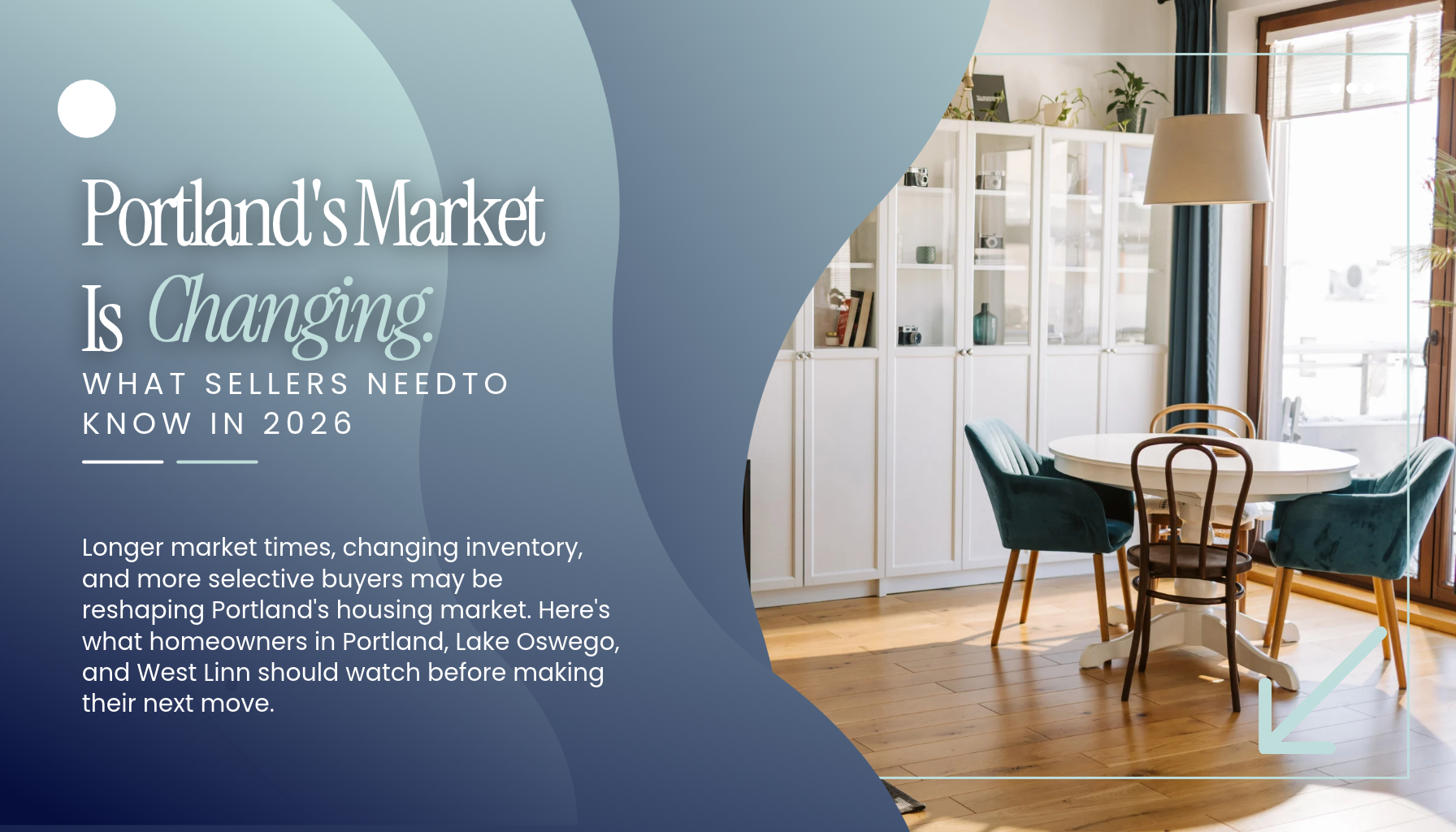
Is the Portland metro housing market actually cooling down in 2026, and how do prices and days on market compare to 2025 in Portland, Lake Oswego, and West Linn?
The Portland metro market is showing signs of a shift in 2026, with some neighborhoods potentially experiencing longer days on market and more measured price movement compared to 2025 — though verified figures from the RMLS Market Action Report should be reviewed for your specific submarket. But "cooling" does not mean the same thing everywhere, and your specific neighborhood tells a very different story than metro-wide headlines.
Why This Matters Right Now for Portland Oregon Real Estate
If you are a homeowner in your 50s, 60s, or beyond, and you have been watching the Portland Oregon real estate market with one eye on downsizing, you are probably asking yourself one core question: is the window closing, or is it opening?
That question matters more right now than it has in several years. The Portland metro entered 2026 after a transitional 2025, during which mortgage rates stayed elevated, buyer behavior was widely described as more cautious, and inventory was gradually recovering from pandemic-era lows. For sellers in neighborhoods like Laurelhurst, Irvington, Lake Oswego, and West Linn, these shifts affect how long your home sits, what buyers are willing to offer, and ultimately how much equity you walk away with.
What I tell my clients is that a cooling market is not necessarily bad news for a downsizer. In fact, it can work in your favor if you understand both sides of the equation.
What "Cooling" Actually Means in Portland, Lake Oswego, and West Linn
Before you react to a headline, you need to understand what a "cooling" market really involves. It is not a single number. It is a combination of signals that, taken together, paint a picture of shifting conditions.
Here is what to watch:
- Days on market (DOM): How long homes sit before going under contract. Rising DOM is often the earliest cooling signal.
- Median sale price trends: Are prices flat, declining, or still rising but at a slower pace?
- Active inventory levels: More listings mean more competition for sellers and more options for buyers.
- Sale-to-list price ratio: Are buyers paying asking price, or are they negotiating below?
In my experience working across Portland neighborhoods and Southwest Washington, a market can cool on one metric while holding firm on another. For example, you might see days on market stretch out in Southeast Portland while prices in Lake Oswego remain relatively steady because of limited luxury inventory. That is why metro-wide averages can be misleading for someone who lives in a specific community.
Why 2025 Is the Right Comparison Point
Comparing to 2025 is meaningful because it was already a transition year. If 2026 continues the same trajectory, that tells you something different than if conditions are reversing. The RMLS Market Action Report for Portland provides month-over-month and year-over-year data at the neighborhood level. I recommend requesting the most recent report from your agent to see exactly where your submarket stands rather than relying on general commentary.
How Northeast Portland Neighborhoods Are Performing in 2026
If you own a home in Laurelhurst, Irvington, the Alberta Arts District, or Grant Park, you are sitting in some of Portland's most sought-after real estate. These neighborhoods draw buyers who prioritize historic character, tree-lined streets, walkability to coffee shops and restaurants along Alberta Street, and proximity to parks like Laurelhurst Park.
So what does cooling look like here? For neighborhoods with strong identity and limited housing stock, the shift tends to show up in days on market before it shows up in price. Buyers searching for homes for sale in Portland Oregon in these areas may be more intentional in 2026, potentially taking longer to make offers and requesting more inspections and concessions than in prior years — your agent can confirm what the current RMLS data shows for your specific neighborhood.
What does that mean for you as a seller? It means your pricing strategy and home presentation matter more than ever. In my experience, a well-prepared listing in Irvington or Laurelhurst still attracts serious buyers, but an overpriced home will sit. And every week a home sits, your negotiating leverage decreases.
With 20 years of experience and over 165 homes sold across Portland and Southwest Washington, I can tell you that the fundamentals in Northeast Portland remain strong for sellers who price honestly and present their home well.
Lake Oswego and West Linn: What Downsizers Need to Know
Lake Oswego and West Linn consistently rank among the highest-priced submarkets in the Portland metro. If you have lived in one of these communities for 15 or 20 years, you likely have significant equity built up.
Here is the tension many of my clients in these areas face: you know your home is worth a lot, but the question is whether the market will reward patience or punish it.
Days on Market in Higher-Price Brackets
In general, higher-priced homes tend to experience longer marketing periods even in strong markets. When conditions cool, the upper end can feel shifts in days on market more acutely. For Lake Oswego and West Linn sellers, tracking DOM in your specific price range is more useful than tracking the metro average.
The Downsizer's Double Benefit
Here is something I consistently point out to downsizing sellers: if you are selling a higher-priced home and buying a smaller or less expensive one, a cooling market can actually work in your favor. You might accept a slightly lower price on your sale, but you also pay less on your next purchase. The net effect on your equity position can be positive, especially when you are moving down significantly in price.
For example, if you are selling in Lake Oswego and buying in a more affordable Portland neighborhood, in Vancouver WA, or even in Brush Prairie Washington, the savings on the buy side can more than offset any softness on the sell side.
Southwest Washington Communities: Vancouver, Brush Prairie, and Battle Ground
The Southwest Washington side of the Portland metro has its own dynamics. Vancouver WA, Brush Prairie Washington, and Battle Ground Washington have historically attracted buyers looking for more space per dollar, newer construction, and the tax advantages that come with living in Washington. There is no state income tax in Washington, which is a meaningful consideration for retirees and 55-plus sellers evaluating where to land after a downsize.
For sellers in these communities, the "cooling" question intersects with the question of whether the price gap between the Oregon and Washington sides of the metro is widening or narrowing. If more buyers are looking across the river for affordability, that dynamic is a factor worth watching when evaluating conditions on the Washington side of the metro.
As a Portland Oregon real estate agent who works both sides of the river, I can tell you that understanding these cross-metro dynamics is essential if you are deciding when and where to make your next move.
The Rate Lock Dilemma for 55-Plus Sellers in Portland
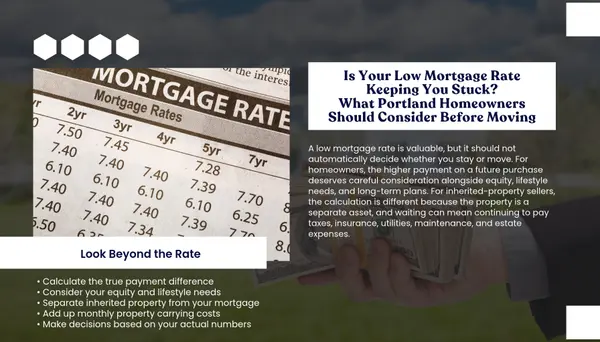
Let's address the elephant in the room. If you bought or refinanced between 2020 and 2022, you likely hold a mortgage rate in the 2-to-4 percent range. Selling means giving that up. If you need a new mortgage, you are looking at significantly higher rates in 2026.
This "rate lock" effect is widely cited as a factor in listing supply across the Portland metro, and inventory recovery has been gradual — though multiple forces shape that trend. For many would-be sellers, the math on a new mortgage can feel punishing — a tension worth working through carefully with your agent and a financial advisor.
But here is the nuance I share with my clients: if you are downsizing substantially, you may not need a large mortgage at all. A seller who nets significant equity and buys a less expensive home can put a large portion down, reducing or even eliminating the financed amount. In that scenario, the rate on a small mortgage matters far less than the rate on a large one.
This is a deeply personal calculation, and I recommend sitting down with both your real estate agent and a financial advisor to map out the numbers specific to your situation.
What to Watch Before You List Your Portland Home
If you are seriously considering listing in 2026, here is the practical checklist I walk through with sellers:
- Current DOM in your specific neighborhood or ZIP code. Metro-wide numbers are not useful here. Ask for the data from your submarket.
- Sale-to-list price ratio. This tells you whether sellers in your area are conceding price or still getting close to asking.
- Active inventory trends. Rising inventory means more competition. Fewer listings mean you have leverage.
- Seasonal timing. Portland's market historically peaks in spring and softens as fall arrives. If you are reading this in October 2026, the spring market is worth planning for.
- A current Comparative Market Analysis (CMA). Not an automated estimate, but a professional analysis from a Portland Oregon real estate agent who knows your neighborhood block by block.
My goal is to make sure you understand the data, not just receive it.
Frequently Asked Questions
Is the Portland housing market crashing in 2026?
No. A cooling market and a crash are very different things. Cooling typically means longer days on market, more buyer negotiation, and moderate price adjustments.
How do days on market in Portland compare to 2025?
Many Portland neighborhoods may be seeing homes sit longer in 2026 compared to the same period in 2025, though conditions vary by submarket — request the latest RMLS Market Action Report from your agent for your specific ZIP code to see the exact comparison. The degree varies by submarket. Request the latest RMLS Market Action Report from your agent for your specific ZIP code to see the exact comparison. Metro-wide averages will not capture your neighborhood's reality.
Is Lake Oswego still a strong seller's market in 2026?
Lake Oswego remains one of the Portland metro's premium submarkets. Limited inventory at higher price points tends to support prices. However, buyers at those levels are often more deliberate, and days on market in the luxury range can run longer. Pricing strategy is especially important here.
Should I sell my West Linn home now or wait until 2027?
That depends on your personal timeline, financial situation, and what you plan to do after the sale. If you are downsizing and buying in a lower price range, a cooling market can actually benefit your overall position. Consult with your agent and a financial advisor to map out your specific scenario.
Are homes for sale in Vancouver WA holding their value in 2026?
Southwest Washington real estate, including Vancouver, Brush Prairie, and Battle Ground, generally benefits from continued demand driven by relative affordability and Washington's lack of state income tax. However, conditions vary by neighborhood and price point. Ask for a CMA specific to your community.
How does the rate lock effect impact Portland sellers?
Many Portland homeowners hold mortgages in the 2-to-4 percent range from the pandemic era. Selling means giving up that rate, which has kept many potential sellers on the sidelines. For downsizers who can make a large down payment on a less expensive home, the rate impact is often smaller than expected.
What Portland neighborhoods are cooling fastest in 2026?
Cooling tends to show up first in neighborhoods with rising inventory and longer average days on market. Your agent can pull neighborhood-level data to show you exactly where your area stands.
Is now a good time to downsize in Portland Oregon?
For many 55-plus sellers, the combination of strong equity positions and — if conditions in your submarket are softening — a more measured buy-side market may create a favorable window. You may give up a small amount on your sale price, but you may also pay less on your purchase. The net effect can be positive if you are moving down substantially.
How do I know what my Portland home is worth in a cooling market?
Automated online estimates are not reliable in a shifting market. Request a Comparative Market Analysis from a local Portland Oregon real estate agent who understands your specific neighborhood. A CMA uses recent comparable sales and active listing data, adjusted for your home's condition and features.
What makes a Portland real estate agent right for a downsizing seller?
Look for an agent who understands both the emotional and financial dimensions of downsizing. You want someone who can provide honest pricing advice, neighborhood-level market data, and guidance on timing. With over 165 transactions closed, I bring that combination of experience and local expertise to every conversation.
The Bottom Line
The Portland metro housing market in 2026 may be shifting, but whether "cooling" applies to your specific neighborhood is a question the data — not headlines — should answer. It varies from Laurelhurst to Lake Oswego, from Woodstock to West Linn, from Sellwood to Battle Ground. For downsizers and 55-plus sellers, the most important step you can take is to understand what is happening in your specific neighborhood, not just the metro at large.
You have built significant equity. You have options. And a measured, data-informed approach to deciding when to list, how to price, and where to buy next will serve you far better than reacting to headlines.
If you are considering a move and want a clear-eyed look at what your home is worth in today's market, I would welcome that conversation. With 20 years of experience, over 165 homes sold, and a teaching-focused approach to every client relationship, I am here to help you make a confident decision.
Categories
Recent Posts



"My job is to find and attract mastery-based agents to the office, protect the culture, and make sure everyone is happy! "