Where Portland Is Quietly Booming in 2026: Neighborhoods to Watch
TLDR
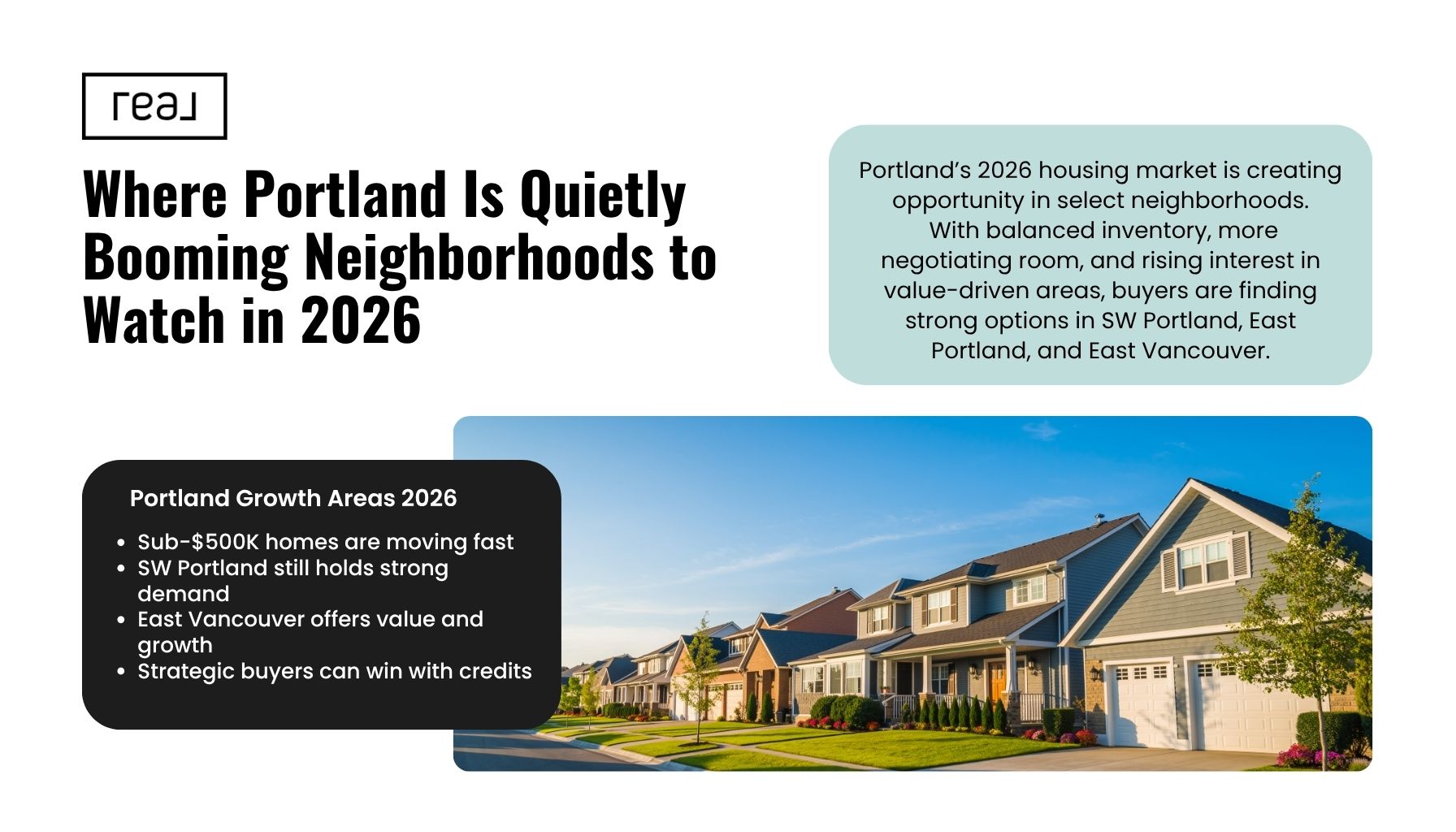
- Balanced market with 3.6 months of supply and modest prices encourages strategic buys.
- Sub-500K homes are hottest, particularly in SW Portland and East Vancouver Cedars.
- Clark County’s suburban nodes offer value, space, and growing job centers access.
- Smart credits, rate buydowns, and timing help buyers win in competitive pockets.
What does “quietly booming” really mean in Portland right now?
In 2026, the Portland metro is a balanced market with roughly 3.6 months of inventory. That means neither side holds overwhelming leverage, which is a shift from the peak seller cycles in recent years. Median metro sale prices in February came in around $498,000, about 2.5 percent lower than a year ago. Days on market are hovering near the low-to-mid 40s. Many homes still close under list price, especially outside the sub-500K hot spots. I monitor these numbers through the Regional Multiple Listing Service and local association reports, including RMLS Market Action and state dashboards.
A quiet boom is not a frenzy. It is a steady uptick in absorption, showings, and contract activity within select neighborhoods that align with today’s buyer priorities: commute efficiency, school quality, walkability, and move-in-ready value. The most consistent theme I see as a Portland Oregon Real Estate Agent is renewed buyer focus on homes under $500,000 and well-priced listings near emerging amenities.
Here is how I define it as Lisa Mehlhoff:
- Multiple showings and quick offers on homes priced to the comps, especially under $500,000
- Measurable list-to-sale improvement against last quarter within tight micro-markets
- New development, zoning, or infrastructure planning catalyzing near-term livability gains
How does demand concentrate across Portland and Vancouver in 2026?
Portland’s sub-500K segment is seeing the highest concentration of demand. First-time buyers, relocating professionals, and move-down sellers are converging around value-priced single-family homes and modern townhomes. In SW Portland, areas like Multnomah Village and Hillsdale show repeated activity on listings with strong schools and quick access to retail nodes. In early spring, I have seen competitive scenarios develop around well-staged, well-priced homes in this band.
Across the river, East Vancouver Washington Real Estate continues to attract buyers seeking newer construction, lower property taxes compared to some Oregon jurisdictions, and convenient access to I-205 and I-5. The Cedars East Vancouver WA Real Estate submarket has drawn renewed attention, with recent MLS pulls suggesting median prices in the low 400s. This is bringing first-time buyers and investors off the sidelines. Clark County overall tracks near three months of inventory with healthy population growth and ongoing logistics expansion along the Columbia corridor, as summarized in Washington’s state economic updates from OFM.
What role do jobs, transit, and planning play?
Jobs and planning are powering the quiet boom. The OHSU campus, Intel in the Westside corridor, and growth in healthcare and logistics continue to pull buyers toward convenient commutes. On the planning front, Portland’s Housing Needs Analysis outlines where growth and mixed-use infill are prioritized, guiding investor and homebuyer interest. Review the city’s adopted framework here: Portland Housing Needs Analysis. Proximity to frequent transit, bikeways, and neighborhood commercial streets consistently correlates with steadier demand.
Which neighborhoods are the top 2026 watch-list candidates?
Below are the micro-markets where I am seeing quiet but material momentum. If you are scanning SW Portland Oregon homes for sale or exploring East Vancouver Washington Real Estate, start here.
- Multnomah Village and Hillsdale, SW Portland
- Maplewood and Hayhurst, SW Portland
- Cedars and Fisher’s Landing East, East Vancouver
- Brush Prairie and Battle Ground, Clark County
- Lake Oswego’s First Addition and Lake Grove condos
- Montavilla and Foster-Powell, East Portland
What are the pros and cons of targeting “quiet boom” neighborhoods?
Pros:
- Better pricing predictability due to balanced supply and 42-day average marketing windows
- Opportunities for credits at closing, often 1 to 2 percent of the purchase price
- Strong long-term fundamentals around schools, retail corridors, and planned infill
Cons:
- Sub-500K listings can still attract multiple offers within 48 to 72 hours
- Older housing stock in SW pockets may require upfront system upgrades
- Some HOA communities restrict rentals or exterior alterations, limiting flexibility
How do I shop and win in these areas without overpaying?
Start with clear math. Mortgage rates have generally ranged in the mid 5s to around 6 percent this season for well-qualified buyers. Track weekly averages using FRED’s 30-year fixed series to time a rate lock. In a balanced market, small pricing edges can make a big difference. I often negotiate a seller credit to buy down the rate or offset closing costs. Credits between 1 and 2 percent of the price are common in today’s conditions.
I recommend a tight pre-approval and fully underwritten file ready before touring. Typical costs you should plan for:
- Inspection package: 450 to 700 dollars depending on size and add-ons
- Appraisal: 650 to 900 dollars with timelines of 7 to 14 days
- Closing costs: 2 to 3 percent of the purchase price, before any seller credits
- Immediate improvements: 1 to 2 percent of price if systems are older
One of my clients, a dual-income couple relocating for healthcare and tech roles, targeted Hillsdale after missing a Multnomah Village listing. We wrote at list price with a 1.5 percent seller credit, used it to buy down the rate, and closed in 32 days. Their monthly payment dropped by over 200 dollars compared to a straight offer.
Another client, a first-time buyer focused on Cedars East Vancouver WA Real Estate, secured a three-bedroom at a price near the low 400s after two weeks on market. We negotiated a modest roof credit and a float-down option from the lender. The float-down captured a small mid-process rate dip, trimming the payment without reopening underwriting.
FAQs
1) Are Portland home prices still falling in 2026? Prices have softened modestly year over year, with February’s metro median near 498,000, approximately 2.5 percent below last year. Inventory is around 3.6 months, which is considered balanced. Days on market hover near the low-to-mid 40s. I verify these figures each month using RMLS Market Action and local association reports, which reflect actual closed sales across the Portland metro, and refer to the FHFA Q4 2025 HPI report for comprehensive home price trends.
2) Where can first-time buyers still find value under 500,000? SW Portland pockets like Multnomah Village, Hillsdale, and Maplewood produce value when listings are priced to comps. East Vancouver’s Cedars and some Fisher’s Landing East homes and townhomes also deliver approachable entry points. In Clark County, Brush Prairie and parts of Battle Ground remain attractive for space and schools, often trading in the low to mid 500s with room to negotiate credits.
3) How competitive are offers in SW Portland below 500,000? Below 500,000, expect more showings and faster movement. Well-priced homes with updated kitchens, baths, and roofs can see multiple offers within a few days. The best strategy is pairing a clean, complete offer with a targeted credit rather than chasing price. Pre-inspections and tight timelines also help. I tailor terms to the seller’s pain points to preserve value while reducing risk.
4) Is commuting from Brush Prairie or Battle Ground realistic for Portland jobs? Yes, many of my clients manage 30 to 45 minute commutes to Vancouver or Portland during typical peak periods, depending on job location and departure times. C-TRAN coverage continues to expand, and the I-5 corridor is the primary route. When we set tours, we test the route in real commute windows so you understand true door-to-door times before making an offer.
5) Should I ask for repairs or for a closing credit after inspection? In a balanced market, a clear, capped credit often works better than requesting a long repair list. Credits of 1 to 2 percent of purchase price are common and can be applied to a rate buydown or closing costs. I structure requests around health, safety, and major system items so appraisers and underwriters are comfortable and timelines stay intact.
6) How do mortgage rate buydowns and float-downs work in 2026? A buydown uses seller or lender credits to reduce your interest rate, lowering the monthly payment. A float-down allows you to capture a better rate if market averages drop before closing. Track averages through FRED’s mortgage rate series. I coordinate with your lender to model scenarios and align credits with the best return on monthly savings.
7) What timeline should I expect from offer to keys? For financed buyers, plan on 30 to 45 days from mutual acceptance to closing. Appraisals typically return within 7 to 14 days. Inspections are often completed within 7 days of acceptance. If we secure a seller credit, I ensure lender approval early. For condos, budget extra time for HOA document review. Cash closings can compress to 10 to 20 days with clean title.
Conclusion
The bottom line Quiet booms do not splash headlines. They show up in well-priced listings drawing steady showings, healthy absorption, and smart buyer strategies that reduce monthly costs. In 2026, SW Portland Oregon homes for sale near Multnomah Village and Hillsdale, value plays in Maplewood and Hayhurst, the Cedars and Fisher’s Landing East in Vancouver, and suburban options in Brush Prairie and Battle Ground are all worth your attention. With balanced supply, modest year-over-year price softness, and seller credits back in play, you can buy well with the right plan. If you want a data-driven path to the right house at the right payment, I am here to help.
Lisa Mehlhof Homes | License #220603251 Call or text 503-490-4888 https://lisamehlhoffhomes-
Categories
Recent Posts








"My job is to find and attract mastery-based agents to the office, protect the culture, and make sure everyone is happy! "