Should You Pay Buyer Closing Costs or a Rate Buydown in Portland Oregon?
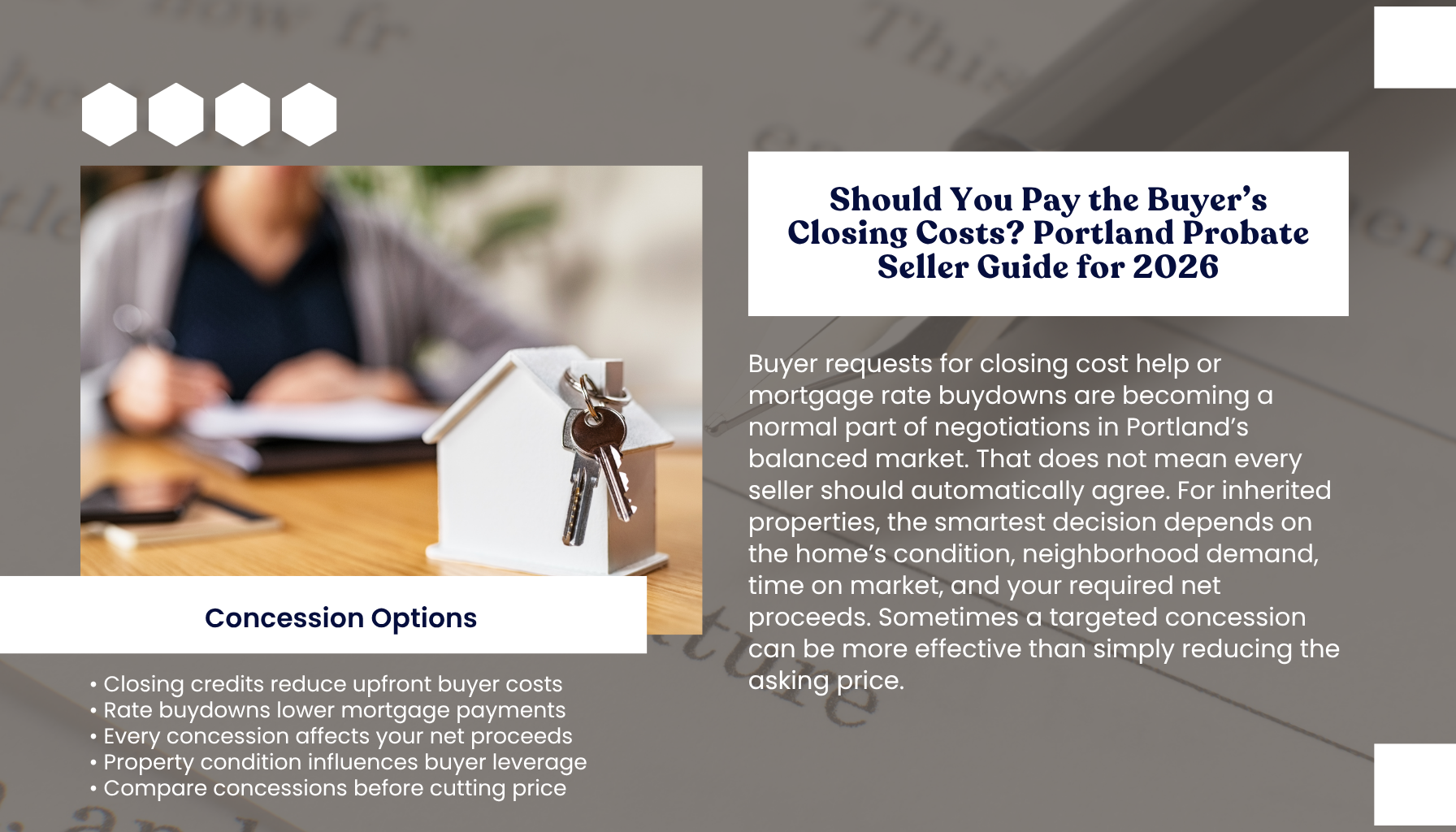
Should you expect to pay closing costs or a rate buydown for the buyer when selling an inherited or probate property in Portland, Oregon?
In Portland's current balanced market, you should expect some buyer requests for concessions, especially on inherited homes. Whether you agree, and how much you offer, depends on your property's condition, location, and pricing strategy.
Why This Matters Right Now in Portland Oregon Real Estate
If you have inherited a home in Northeast Portland, Southeast Portland, or across the river in Vancouver WA, you are stepping into a market that has changed dramatically from the frenzy of a few years ago. The Portland metro median home price sits around $545,000, and with 30-year fixed mortgage rates hovering near 6.53%, buyers are stretching harder to make their monthly numbers work. That is exactly why concession requests, whether for closing cost credits or rate buydowns, have become a routine part of negotiations.
With 20 years of experience helping sellers navigate this market and over 165 transactions closed across Portland and Southwest Washington, I can tell you this: the answer is not a blanket yes or no. It depends on your specific property, your neighborhood, and what the buyer pool looks like for your home. Understanding the difference between these concessions and when to use them strategically can mean the difference between a stalled listing and a smooth closing.
What Closing Cost Credits and Rate Buydowns Actually Mean for Portland Sellers
Before you can decide whether to offer either concession, you need to understand what you are really being asked to do.
Seller-paid closing costs means you agree to cover a portion of the buyer's settlement charges at closing. These charges include loan origination fees, appraisal fees, title insurance, prepaid taxes, and other escrow costs. The credit comes out of your proceeds, and the buyer effectively rolls those costs into the purchase price.
A rate buydown is different. You pay an upfront fee directly to the buyer's lender to temporarily or permanently reduce their mortgage interest rate. The most common structures are:
- 2-1 Buydown: The rate drops 2% in year one, 1% in year two, then returns to the full rate
- 1-0 Buydown: The rate drops 1% in year one only
- Permanent Buydown: You pay discount points (each point equals 1% of the loan amount) to permanently lower the rate
What I tell my clients is simple: both concessions reduce your net proceeds by roughly the same dollar amount. The question is which one makes the buyer more likely to close, and which one keeps you closest to your target price.
How Portland's Balanced Market Affects Concession Expectations in 2026
So, should you expect these requests? Let me put the current market in perspective.
Portland's housing inventory sits at approximately a 3.0-month supply, which puts it in balanced territory. The sale-to-list price ratio was 100.56% in March 2026, meaning well-priced homes are still commanding full asking price or slightly above. Homes are averaging 55 to 80 days on market for standard listings.
That "balanced" label, though, plays out very differently depending on your neighborhood and property type. Here is where it gets hyperlocal:
- Laurelhurst and Irvington in Northeast Portland are seeing median sale prices around $655,000, up 7.0% year over year. Updated craftsman homes on tree-lined streets near Laurelhurst Park or along NE Hancock Street are still drawing strong interest. If your inherited home in these neighborhoods is in solid condition, you have leverage to push back on concession requests.
- Alberta Arts District homes typically range from $480,000 to $700,000, offering one of the more accessible entry points into NE Portland. Buyers here tend to be more rate-sensitive, which means buydown requests are more common.
- Foster-Powell and Woodstock in Southeast Portland attract buyers drawn to the creative energy and relative affordability. Inherited homes in these areas that need work will almost certainly face concession requests.
- Vancouver WA is a competitive market with homes selling at 100.07% of asking price, but 30.8% of listings have seen a price cut. If you have inherited a home in Vancouver, expect the conversation to come up, especially since buyers on that side of the river benefit from Washington's lack of state income tax.
When Concessions Make Strategic Sense for Inherited Properties
Here is where my background in education really shows up in how I approach real estate: I want you to understand the "why" behind every number. One of the most common situations I see involves an inherited home in a neighborhood like Sellwood or Lents where the property has not been updated in decades. The heirs are often out of state, managing the probate process from a distance, and the house needs work.
One family I worked with inherited a 1940s bungalow in the Foster-Powell neighborhood. The home needed a new roof, updated electrical, and cosmetic work throughout. Rather than invest $40,000 to $50,000 in renovations and wait months for the work to finish, we listed the home at a realistic price and offered a 2-1 rate buydown as part of the marketing. That buydown cost the sellers roughly $8,500 but attracted a buyer who closed in 38 days. The sellers netted more than they would have with a deep price cut, and the estate closed on schedule.
The math often works in your favor when you frame it this way:
- A $10,000 price reduction lowers your proceeds by $10,000
- A $10,000 closing cost credit or buydown also costs $10,000, but it keeps your sale price higher on paper, which supports the appraisal
What does that actually mean for your wallet? It means offering a concession can sometimes protect your bottom line better than cutting your price.
Oregon vs. Washington: Cross-Border Considerations for Probate Sellers
If you have inherited property on both sides of the Columbia, the financial picture shifts significantly. This is something I discuss with probate and inherited-property sellers across the Portland and Southwest Washington market regularly.
Selling in Oregon:
- Oregon has a state estate tax with a $1 million exemption threshold, one of the lowest in the nation
- Sellers face state income tax up to 9.9%
- The good news: Oregon does not have a traditional transfer tax, so recording fees are relatively modest
- You benefit from the stepped-up cost basis, meaning your capital gains calculation starts from the home's fair market value at the date of death
Selling in Washington (Vancouver, Brush Prairie, Battle Ground):
- Washington has no state income tax, which can be a significant advantage
- However, Washington charges a tiered Real Estate Excise Tax (REET): 1.1% on the first $525,000, 1.28% on $525,001 to $1,525,000, and higher above that
- The state estate tax exemption is $2.193 million, more generous than Oregon's
In Brush Prairie, where median list prices reach $628,000 and above, the REET alone can run $6,500 to $8,000. Factor that into your calculation before agreeing to additional buyer concessions.
How to Negotiate Concessions Without Leaving Money on the Table
Having closed over 165 transactions and earned a 5-out-of-5-star rating from 24 past clients, I have seen every negotiation scenario play out. Here is my practical advice for probate sellers in this market:
- Price it right from day one. A well-priced home in Irvington or Laurelhurst will generate competitive interest that reduces buyer leverage. When homes sit, concession requests grow.
- Know your walkaway number. Calculate your total closing costs, including agent commissions, escrow fees, title insurance, and any applicable excise taxes. Then decide the minimum net proceeds you will accept.
- Consider the buydown over the price cut. A recent seller in the Woodstock neighborhood was hesitant about offering a buydown until we showed her that a $7,000 buydown attracted two additional offers, while a $15,000 price reduction had generated zero new interest over three weeks.
- Condition matters most. If your inherited home has deferred maintenance, staging and light cosmetic updates can reduce concession pressure more effectively than any pricing strategy alone.
Frequently Asked Questions
How much are typical closing costs for a seller in Portland Oregon?
You can expect to pay between 6% and 8% of the sale price when you factor in agent commissions (now negotiable), title insurance, escrow fees, and prorated property taxes. On a $545,000 home, that is roughly $32,700 to $43,600 out of your proceeds. Oregon does not charge a traditional transfer tax, keeping that specific cost lower than many states. For more details on what fees are involved, the Consumer Financial Protection Bureau offers a comprehensive breakdown of closing costs and who typically pays them.
What is a rate buydown and how does it work in Portland real estate?
A rate buydown is an upfront payment you make to the buyer's lender to reduce their interest rate temporarily or permanently. With current rates near 6.53%, a 2-1 buydown would give the buyer a 4.53% rate in year one and 5.53% in year two, making the monthly payment significantly more affordable during those initial years. If you want to understand more about how loan costs are structured, the CFPB's guide to learning about loan costs can help you grasp the broader picture of mortgage financing.
Are buyers in Northeast Portland asking for concessions right now?
In neighborhoods like Laurelhurst and Irvington, where the median sale price hit $655,000 (up 7.0% year over year), well-priced homes still generate strong interest. Concession requests are less common for updated homes in these areas. However, older inherited properties that need significant work will typically face requests for closing cost credits.
Should I offer a rate buydown or a closing cost credit in Vancouver WA?
Both accomplish similar goals, but the right choice depends on your buyer. First-time buyers often prefer closing cost credits because they reduce their upfront cash needs. Move-up buyers with more savings may respond better to a rate buydown that lowers their monthly payment. Your agent should guide you based on the specific offer.
Do probate properties have to offer concessions to sell?
No. There is no requirement to offer concessions. However, inherited homes frequently have deferred maintenance and outdated finishes, which gives buyers more negotiating leverage. The key is pricing accurately for the home's current condition rather than agreeing to concessions as an afterthought.
How does the stepped-up basis affect my decision on concessions?
The stepped-up cost basis resets your inherited property's value to its fair market value at the date of death. If your parent bought a Portland home for $150,000 in 1995 and it is now worth $545,000, your cost basis starts at $545,000. This can eliminate capital gains tax entirely, giving you more flexibility in how you negotiate.
Is it better to reduce the price or offer buyer concessions?
Offering a concession often protects your sale price on paper, which supports the appraisal. A $10,000 concession and a $10,000 price cut both cost you the same, but the concession keeps the contract price higher. This distinction matters during the appraisal process.
What concessions are common for inherited homes in Southeast Portland?
In neighborhoods like Foster-Powell, Woodstock, and Sellwood, concessions of 2% to 3% of the purchase price are common for inherited homes that need updating. Sellers who invest in staging and light cosmetic improvements often face smaller concession requests or none at all.
Can I refuse to pay closing costs for the buyer?
Absolutely. Every term is negotiable. If your home is priced competitively and in a desirable neighborhood near landmarks like Laurelhurst Park or Irvington's historic district, you have leverage to decline. The risk is losing that buyer, so weigh the cost of the concession against the cost of additional time on market.
How do Washington state taxes affect my proceeds if I sell in Brush Prairie?
Washington charges a tiered Real Estate Excise Tax starting at 1.1% on the first $525,000. For a Brush Prairie home listed at $628,000, the REET alone runs approximately $6,500 to $7,000. Factor this into your net proceeds before agreeing to additional buyer concessions.
The Bottom Line
You should expect the conversation about closing costs or a rate buydown to come up, especially when selling an inherited home in Portland Oregon or Southwest Washington communities like Vancouver and Brush Prairie. Whether you agree to those concessions depends on your property's condition, your neighborhood's demand level, and your bottom-line goals. The current balanced market gives both sides room to negotiate, but strategy matters more than ever.
If you are navigating a probate sale or inherited property across the Portland metro area, I would love to help you understand your options. With over 20 years of experience and 165 homes sold across Portland and Southwest Washington, I bring the honest communication and local expertise that inherited-property sellers need during what is often an emotional and complex process. Reach out to Lisa Mehlhoff at 503-490-4888 to get a clear picture of what your property is worth and what concessions, if any, make sense for your situation.
Categories
Recent Posts





"My job is to find and attract mastery-based agents to the office, protect the culture, and make sure everyone is happy! "