Condo vs House vs Townhome: Best Choice for First-Time Buyers in SW Portland and East Vancouver WA
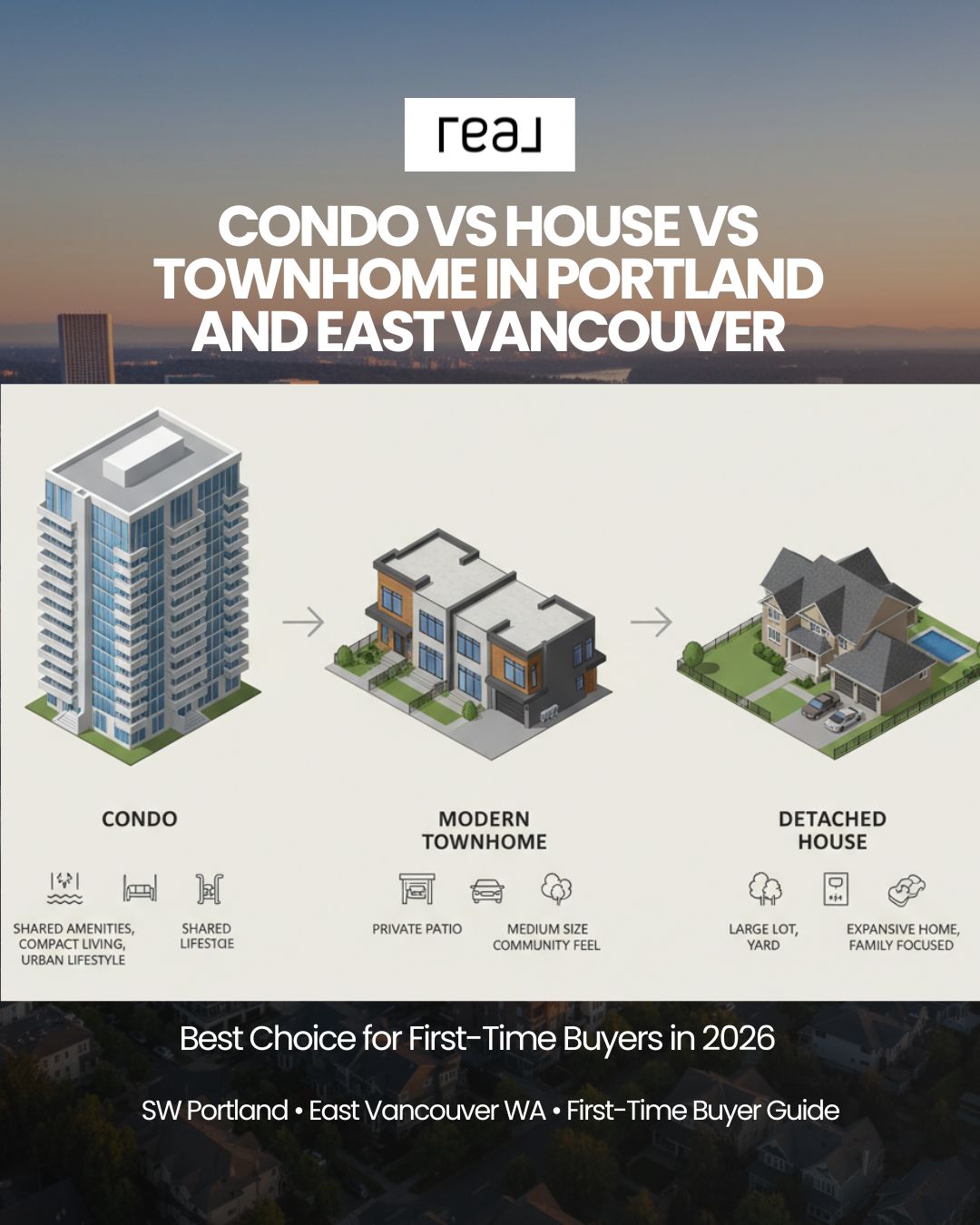
Condo vs House vs Townhome: Best Choice for First-Time Buyers in SW Portland and East Vancouver WA
SNIPPET ANSWER: For most [first-time buyers in SW Portland and East Vancouver, a townhome gives you the best mix of price, space, and low upkeep. Choose a condo for the lowest entry cost, or a house if budget and privacy are your top priorities.]
Why This Matters Right Now
You’re buying into the Portland real estate market during a low-inventory cycle, which means every decision carries more weight. Local MLS data shows about 3 months of supply, so you face competition and steady prices. Portland median home value hover near the low to mid 500s for the metro, with SW Portland trending higher and East Vancouver a bit lower. Mortgage rates around the mid 6s keep monthly affordability front and center. Your choice between condo, townhome, and house directly changes your monthly payment, maintenance time, inspection risks, and resale outlook. If you choose well, you improve your odds of winning an offer and protecting your budget. If you choose poorly, you risk overpaying, facing surprise costs, and outgrowing your home too fast.
What You Need to Know Before You Choose
You should set your decision framework before you tour homes. Start with your payment comfort zone and your lifestyle needs. In this market, you often choose between more space and more convenience.
- Budget and monthly payment: First-time budgets commonly span $400,000 to $600,000. Condos often fit $350,000 to $450,000, townhomes mid 400s, and detached houses often start near $550,000 in SW Portland and about $500,000 in East Vancouver.
- HOA fees and what they cover: Condos often run $300 to $500 per month. Townhome HOAs are usually $150 to $300. These can cover exterior maintenance, insurance on common areas, and amenities that save you time.
- Maintenance and time: A house gives you control but adds lawn, roof, and systems upkeep. Condos shift most exterior upkeep to the association. Townhomes sit in the middle with some private outdoor space and shared exterior maintenance.
- Commute and transit: SW Portland offers bus and light rail access, with new connections planned for the Southwest Corridor. East Vancouver relies on C-TRAN, Mill Plain access, and I-5. Your commute time impacts daily life more than you think.
- Inspection profile: Older Portland houses often need sewer scopes and radon testing. Townhomes and condos still need full home inspection plus HOA document review, which can reveal upcoming assessments or rules that change your costs.
- Resale time horizon: If you plan to hold 5 to 7 years, your risk from short-term swings drops. If you may move within 3 years, consider properties with broader buyer appeal and strong neighborhood demand.
Local cost snapshot
In SW Portland, the entry point for a detached home often starts around the mid to high 500s. Condos can be notably lower, especially in South Waterfront and Hillsdale-adjacent pockets. In East Vancouver and The Cedars, you often find newer townhomes in the mid to high 400s and detached homes starting near the low 500s, with Brush Prairie and Battle Ground offering semi-rural value in the mid 400s to mid 500s.
How to Compare Your Options
When you compare your options, you want the best mix of price, comfort, and risk control. In a low-inventory environment, a clear comparison helps you act decisively.
- Condos: Lowest entry price, minimal exterior maintenance, and amenities like gyms or secure parking. Higher HOA fees and limited private outdoor space. Great if you value simplicity and a lower purchase price.
- Townhomes: Balanced option. Moderate HOA, some yard or patio, and more interior space than many condos. Shared walls can affect privacy, yet ownership often includes the land beneath the home, which helps long-term value.
- Detached houses: Maximum privacy and yard, no HOA, and the strongest control over improvements. Higher upfront cost and greater responsibility for roofs, siding, sewer, and landscaping.
Use a side-by-side comparison with total monthly cost and expected upkeep. A condo with a $400 HOA can match or exceed the monthly cost of a slightly higher-priced townhome with a lower HOA. A house without an HOA can still cost more monthly if utilities, insurance, and maintenance rise. Favor properties that fit your daily life and your savings plan.
Key factors to evaluate:
- Total monthly cost: Mortgage, taxes, insurance, HOA, utilities, and a maintenance reserve.
- Inspection risk: Sewer in older Portland homes, radon in basements, roof age, and HVAC lifespan.
- Resale appeal: Location, parking, outdoor space, and noise levels that influence future buyers.
Your Step-by-Step Guide
You should follow a clear sequence to move from browsing to keys in hand. This keeps your decision grounded and your offer competitive.
1) Get pre-approved and define your ceiling. Ask your lender to show payment at your target price and at 10 percent higher. Confirm costs for FHA, conventional, VA, and state programs in Oregon or Washington.
2) Set a monthly payment limit. Include HOA, taxes, insurance, and a monthly maintenance reserve. For condos and townhomes, use the HOA’s latest budget to check for fee hikes.
3) Choose a property type for your first pass. If affordability is tight, start with condos and townhomes in neighborhoods you like. If privacy and yard are non-negotiable, focus on houses in East Vancouver, Brush Prairie, or Battle Ground for value.
4) Tour with purpose. Evaluate noise, parking, storage, natural light, and outdoor space. Check commute time during rush hour.
5) Run the inspection plan. Budget a general CFPB home inspection guide, sewer scope for older homes, and radon test. Review roof age, HVAC and water heater age, and electrical safety. For condos and townhomes, review HOA financials, reserve study, and rules.
6) Build the offer. Use recent comparable sales and discuss concessions and contingencies. In a 3 month supply market, strong terms and clean timelines help you win without overpaying.
7) Appraisal and negotiations. If the appraisal is low, consider seller concessions, price adjustments, or additional funds. Always protect your emergency savings.
8) Final review and walk-through. Confirm repairs, appliances, and any permits. Recheck HOA meeting notes for upcoming assessments.
What This Looks Like in Portland Oregon and SW Washington
Your options vary block by block. In SW Portland, you find a suburban feel with quick access to parks and city amenities. In East Vancouver and nearby communities, you see newer developments and strong value for space.
- South Waterfront and Hillsdale adjacent condos: You can target modern buildings with strong amenities and walkability. Expect HOA fees in the $300 to $500 range, with entry prices often in the high 300s to low 400s for smaller units.
- Multnomah Village, Maplewood, and West Portland Park: You can find townhomes with moderate HOAs and small private yards. Detached homes often start in the mid to high 500s, with townhomes landing in the mid to high 400s.
- East Vancouver and The Cedars: You can find newer townhome communities with efficient layouts and manageable HOAs. Detached homes often start near the low 500s, with townhomes frequently in the mid to high 400s.
- Brush Prairie and Battle Ground: You can unlock more land and newer subdivisions. Detached homes often range from the mid 400s to mid 500s, with semi-rural privacy and access to I-5 via SR 502.
- Irvington, Alameda, Laurelhurst, and Ladds Addition: You can explore historic homes that attract strong demand. Expect higher inspection diligence, including sewer and electrical. Prices often reflect premium locations and architecture.
Price growth has been steady year over year, with about 1 to 2 percent gains recently. Days on market can compress in spring and early summer, so you should prepare financing early. Planned transit improvements in SW Portland could enhance long-term value near future stations. In Vancouver and Clark County, continued development along Mill Plain and SR 500 supports amenities and employment access.
What Most People Get Wrong
You might assume a home without an HOA always costs less. In reality, the roof, siding, landscape, and sewer add real monthly costs once you budget them. Many buyers underestimate long-term maintenance on older homes in Portland’s wet climate. Another misconception is that condos do not appreciate. Appreciation depends on location, building health, and affordability at resale. Condos in walkable, amenity-rich areas with good reserves can perform well over time. Buyers also skip HOA due diligence. You should always read reserve studies, insurance coverage, and meeting minutes before you commit. Finally, you should not skip inspections. Sewer scopes in older neighborhoods and radon tests in basements are vital to avoid costly surprises.
Frequently Asked Questions
Which option gives you the most affordable monthly cost after HOA and utilities?
You often see the lowest purchase price with condos, but an HOA of $300 to $500 can lift your monthly payment. Townhomes usually balance cost and space with HOAs of $150 to $300. A detached house can avoid an HOA, yet utilities and maintenance can raise monthly outlays. Compare all costs side by side.
What inspections are essential for each property type in this area?
You should always get a general home inspection. For older Portland houses, add a sewer scope and a radon test. For all properties, check roof age and HVAC. For condos and townhomes, review HOA documents, reserves, pending assessments, and building maintenance history to catch hidden costs that affect your budget.
Will a condo appreciate slower than a house in the Portland real estate market?
You should expect houses to lead long-term appreciation due to land value and broader buyer demand. That said, condos in prime, walkable locations with strong reserves and amenities can see solid gains, especially when affordability tightens. Your hold period matters. A 5 to 7 year horizon reduces short-term volatility risk.
What first-time buyer programs can help you buy a home in Portland or East Vancouver?
You can explore FHA with 3.5 percent down, conventional loans with 5 to 10 percent down, VA if eligible, and state-backed programs through Oregon Housing and Community Services or the Washington State Housing Finance Commission. These may offer lower rates or down payment assistance. Confirm income limits, credit requirements, and class completion.
How much should you budget for closing and move-in costs?
You should plan for 2 to 3 percent of the purchase price for closing costs, plus prepaid taxes and insurance. Add inspections, appraisal, and initial maintenance or upgrades. For condos and townhomes, include move-in fees or HOA transfer charges. Keep an emergency fund after closing to handle surprises like appliance replacement or minor repairs.
The Bottom Line
Your best first home balances monthly affordability, maintenance comfort, and future resale. In SW Portland and East Vancouver, a townhome often delivers the best mix of price, space, and low upkeep. A condo minimizes entry costs and simplifies maintenance. A detached house maximizes privacy and control if your budget allows and you are ready for full maintenance. When you compare your options, run total monthly costs, check inspection risks, and select neighborhoods that fit your commute and lifestyle.
If you’re ready to explore your options for condos, townhomes, or houses in Portland Oregon and SW Washington, Lisa Mehlhoff at Lisa Mehlhof Homes can walk you through the specifics for your situation.
 503-490-4888
Categories
Recent Posts










"My job is to find and attract mastery-based agents to the office, protect the culture, and make sure everyone is happy! "