How to Sell and Buy in Portland in 2026 Without Moving Twice (or Losing Your Mind)
TLDR
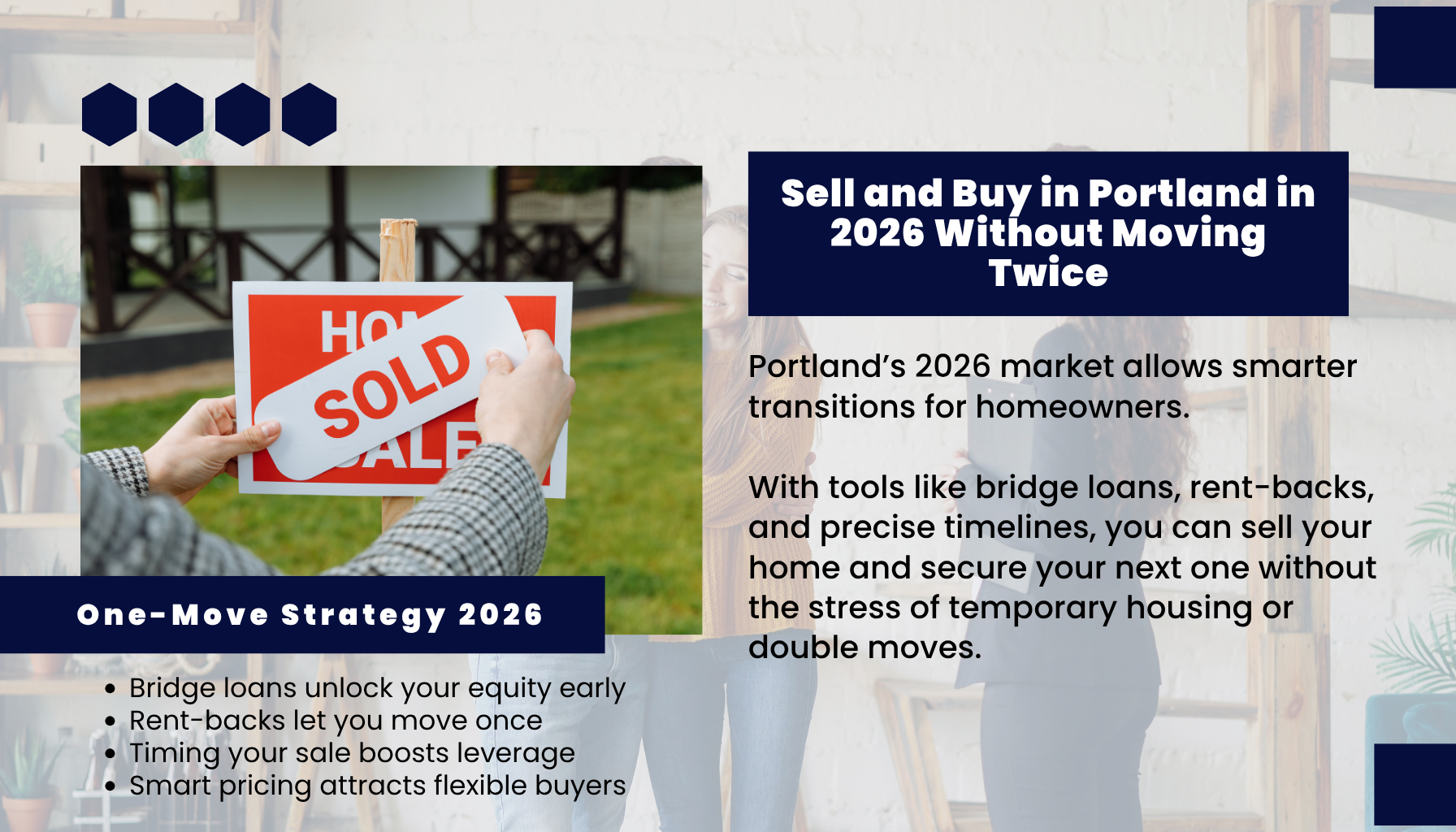
- Use bridge loans, rent-backs, and precise timelines to avoid temporary housing.
- Price realistically using recent MLS data, then buy confidently with flexible terms.
- Target submarkets by price band, days on market, and commuting needs carefully.
- Leverage local programs, transit, and new infill rules to expand your options.
What does “sell and buy without moving twice” really mean for 2026?
In plain terms, it means coordinating your sale and next purchase so you do not rent a storage unit or crash with relatives in between. In a 2026 Portland market that is cooler than the 2021 to 2022 peak but still tight by historical standards, the focus is smart sequencing, strong pre-approval, and aligning dates with contingency tools. According to local MLS reporting, the Portland metro median sale price hovered near $525,000 in January 2026, roughly 3 percent lower than a year prior, and average days on market ranged about 33 to 42. That combination creates a window where sellers still have leverage if they price right, and buyers can negotiate practical occupancy solutions.
Seasonality matters. In most years, April to June shows the largest buyer pool in the Portland area, which is ideal for maximizing attention on your listing. With more supply than 2025 but not an oversupply, well-prepared homes in price-sensitive tiers still move quickly. The key is stacking the right strategy for your niche: first-time sellers moving within the city, relocators coming into town, tech professionals targeting Westside commutes, doctors needing rapid access to OHSU, or military families balancing VA timelines.
Here is how I define it as Lisa Mehlhoff:
- Secure financing that lets you write non-contingent or limited-contingency offers.
- Negotiate rent-back or possession terms so you can close, then move once.
- Price and launch in spring while your purchase search is already underway.
How does the financing puzzle work in 2026 so you skip interim housing?
Three tools solve most timing gaps: short-term bridge loans, rent-backs, and well-structured contingencies. Many lenders offer 30 to 60 day bridge options that let you access equity before your current home sells. On a $500,000 purchase, a short bridge could cost 1 to 2 points up front plus interest for 30 to 60 days, often a few thousand dollars in total, depending on your profile. For many clients, that cost is lower than two moves, storage, and lost negotiation power on the buy side.
Rent-backs are widely used in Oregon and Washington, especially when buyers are flexible. Commonly, sellers negotiate up to 30 or 60 days of possession after closing, paying a per diem equal to the buyer’s principal, interest, taxes, and insurance. This lets you close on the sale, lock in your purchase, and then move once. In a market where MLS shows many homes still selling within about one month, a rent-back often bridges the week or two you need to close on the new place and schedule movers.
What about contingencies and competitiveness?
Contingent offers are more viable in early 2026 than at the peak. If your listing is already live and likely to sell within the 33 to 42 day average, some sellers of your next home will consider a “sale of buyer’s property” contingency. Position it well: price your listing competitively, show professional photos, provide an MLS link to your live listing, and include pre-approval. For price bands under $500,000, competition remains sharper, so bridge loans or rent-backs may outperform contingency. For $500,000 to $700,000, limited contingencies can still win with strong terms.
For compliance and planning, align your lender playbook with current best practices from NAR Research and your closing timeline with local standards. For broader price-trend context, check the FHFA HPI March 2026 for national and regional perspective while leaning on our RMLS data for micro-level decisions.
Which neighborhoods and price bands are best for smooth one-move strategies?
In 2026, success depends on matching neighborhood dynamics to your financing and lifestyle. As a Portland Oregon Real Estate Agent based in SW, I see three clear lanes. Sub-$500,000 remains the most competitive, with pockets still seeing multiple offers. The $500,000 to $650,000 tier is balanced yet active around close-in eastside and SW corridors. Over $650,000, West Hills, inner SW, and Lake Oswego offer strong school access, privacy, and upper-tier finishes where move-up buyers often negotiate rent-backs successfully.
Transit and commute also shape timing. TriMet’s frequent bus service and MAX access support inner east and SW moves, while TriMet trip planner helps plot a realistic door-to-desk schedule. For cross-river commuters, C-TRAN bus rapid transit is a solid alternative to I-5 or I-205. Infill changes under the Residential Infill Project will keep adding duplexes and townhomes in 2026. For details, see Portland Residential Infill Project.
- Hillsdale and Multnomah Village, SW Portland
- Cedars in East Vancouver, WA
Other micro-markets to consider:
- Cully and Lents for sub-$500,000 opportunities with light rail or bus access.
- Alberta Arts and Division for $500,000 to $650,000 with vibrant amenities.
- West Hills and Lake Oswego for premium schools and privacy, often above $650,000.
For broader planning around new attached options, stay current with Portland Residential Infill Project updates, which expand middle housing choices and can widen your target list.
What are the pros and cons of bridge loans, rent-backs, and contingencies?
Pros:
- Bridge loans unlock equity before you sell, so you can write stronger offers.
- Rent-backs reduce stress, letting you close, then move once on your schedule.
- Contingencies enable safer transitions for conservative budgets and first-time sellers.
Cons:
- Bridge loans add fees and short-term interest, which must be weighed against two moves.
- Rent-backs require per diem payments and clear agreements about condition and utilities.
- Contingent offers can lose in competitive price bands without compelling pricing and terms.
How do I time, price, and prepare the sale to fund the buy?
Start 45 to 60 days before listing. I recommend a pre-listing inspection tailored to older Portland homes. For pre-1930s, verify foundations and seismic updates. Always sewer-scope clay laterals. Budget $150 to $300 for sewer scopes and $180 to $250 for radon tests, especially in West Hills and SW. If you have cedar shake roofing from earlier eras, plan $15,000 to $25,000 for replacement. These proactive steps let us present your home confidently and reduce last-minute renegotiations.
Staging and presentation pay for themselves. Professional staging in our market typically runs $2,000 to $4,500 for an average-sized SW bungalow or ranch. Photography, floor plans, and a 3D tour add a few hundred dollars. Timing your launch for late April or May, then reviewing offers after the first weekend, usually optimizes both price and flexibility. When buyers want your home, they are far more open to a 30 to 60 day rent-back that buys you time to close on your next property.
One of my clients, a doctor relocating to be closer to OHSU, needed a tight commute and top-tier schools. We priced their Multnomah Village home using RMLS comps, cleaned up punch-list items, and launched in May. They accepted an offer with a 45 day rent-back at a fair per diem. That gave us time to purchase in Lake Oswego near top schools, a move aligned with the Lake Oswego Oregon Real Estate Market, and they moved once without storage.
Another client, a tech professional transferring to Hillsboro, combined a 30 day bridge loan with a short rent-back. We found a home near Raleigh Hills with fiber and EV charging. Their bridge cost around $3,200 total for fees and interest, which was less than two moves plus storage. They wrote a limited-contingency offer, closed smoothly, and avoided interim housing completely.
For cross-river buyers evaluating East Vancouver Washington Real Estate, possession flexibility and shorter inspection timelines often secure the win. If you are commuting to Portland, proximity to I-205 and potential future rail improvements discussed by WSDOT can help guide neighborhood choices. And if you are seeking SW Portland Oregon homes for sale while selling in Clark County, align your sale first, then layer a short bridge or rent-back to remove pressure.
FAQs
1) When is the best month in 2026 to list so I can also buy smoothly? April to June typically sees the deepest buyer pool in our region, which helps your sale attract multiple strong offers and opens doors for rent-backs. With more attention, you can select buyers who accept your preferred possession terms. If you need to buy first, a 30 to 60 day bridge loan in late spring lets you shop early and close in sync with peak demand on your sale.
2) Is a contingent offer realistic in Portland right now? Yes, if your listing is live, well-priced, and professionally presented. In price bands above $500,000, many sellers will consider a sale-of-buyer’s-property contingency, especially if your home is already under contract. Where sub-$500,000 remains competitive, a limited-contingency or bridge approach often performs better. Success depends on aligning pricing with current MLS data and showing proof of strong pre-approval.
3) What inspection issues derail older Portland homes, and how do I prepare? The most common are sewer lateral issues, elevated radon, and older roofing. I encourage a pre-listing sewer scope, radon test, and roof evaluation. If your home predates widespread seismic upgrades, be ready for questions about foundation bolting. Modest pre-listing investments reduce re-trade risk and help buyers accept rent-back requests since they trust the home’s condition.
4) How much does it cost to use a bridge loan versus moving twice? Bridge costs vary by lender and profile, but many clients spend a few thousand dollars for 30 to 60 days, including points and interest. Two moves plus storage can exceed that quickly, not to mention the stress and time. We will compare quotes line by line so you can decide if convenience, negotiation leverage, and a single move justify the cost.
5) Can VA, FHA, or physician loans work with rent-backs or contingencies? Yes, though the details must match loan and occupancy rules. VA and FHA can accommodate standard rent-backs if the occupancy timeline is reasonable. Physician loans often allow flexible down payments and can pair with bridge strategies. The key is precise dates and disclosures so your lender, title, and both sides’ agents are aligned well before closing.
6) How do I coordinate a cross-river move between Vancouver and Portland without moving twice? First, align your sale timeline with RMLS benchmarks for days on market in your neighborhood. Next, decide if a short bridge or rent-back is smarter based on your budget. For East Vancouver, target Cedars and corridor-adjacent neighborhoods for faster access to I-205 and C-TRAN. For SW Portland, use the TriMet trip planner to verify commute times and school drop-offs.
7) Are more townhomes and middle housing options coming that could help my timing? Yes. Portland’s Residential Infill Project continues to support more duplexes, triplexes, and townhomes in 2026, expanding choices for both sellers and buyers. That flexibility can help you identify a purchase more quickly when you need a tight timeline. Stay current through the Portland Residential Infill Project page and plan tours of new or recently built homes that lend themselves to quick occupancy.
Conclusion
The bottom line Coordinating a sale and purchase in 2026 without moving twice is absolutely achievable with the right plan. Use MLS-driven pricing, prep thoughtfully, and launch in the spring window to maximize leverage. Pair that with a short bridge loan or negotiated rent-back to keep your move to a single, calm weekend. Match your strategy to your target area, whether SW Portland Oregon homes for sale, East Vancouver Washington Real Estate, or a move-up in the Lake Oswego Oregon Real Estate Market. If you want a custom timeline and a one-move blueprint, I am here to guide every step.
Lisa Mehlhof Homes | License #220603251 Call or text 503-490-4888 https://lisamehlhoffhomes-
Categories
Recent Posts







"My job is to find and attract mastery-based agents to the office, protect the culture, and make sure everyone is happy! "