What price range should I really be looking in based on my monthly budget?
TLDR
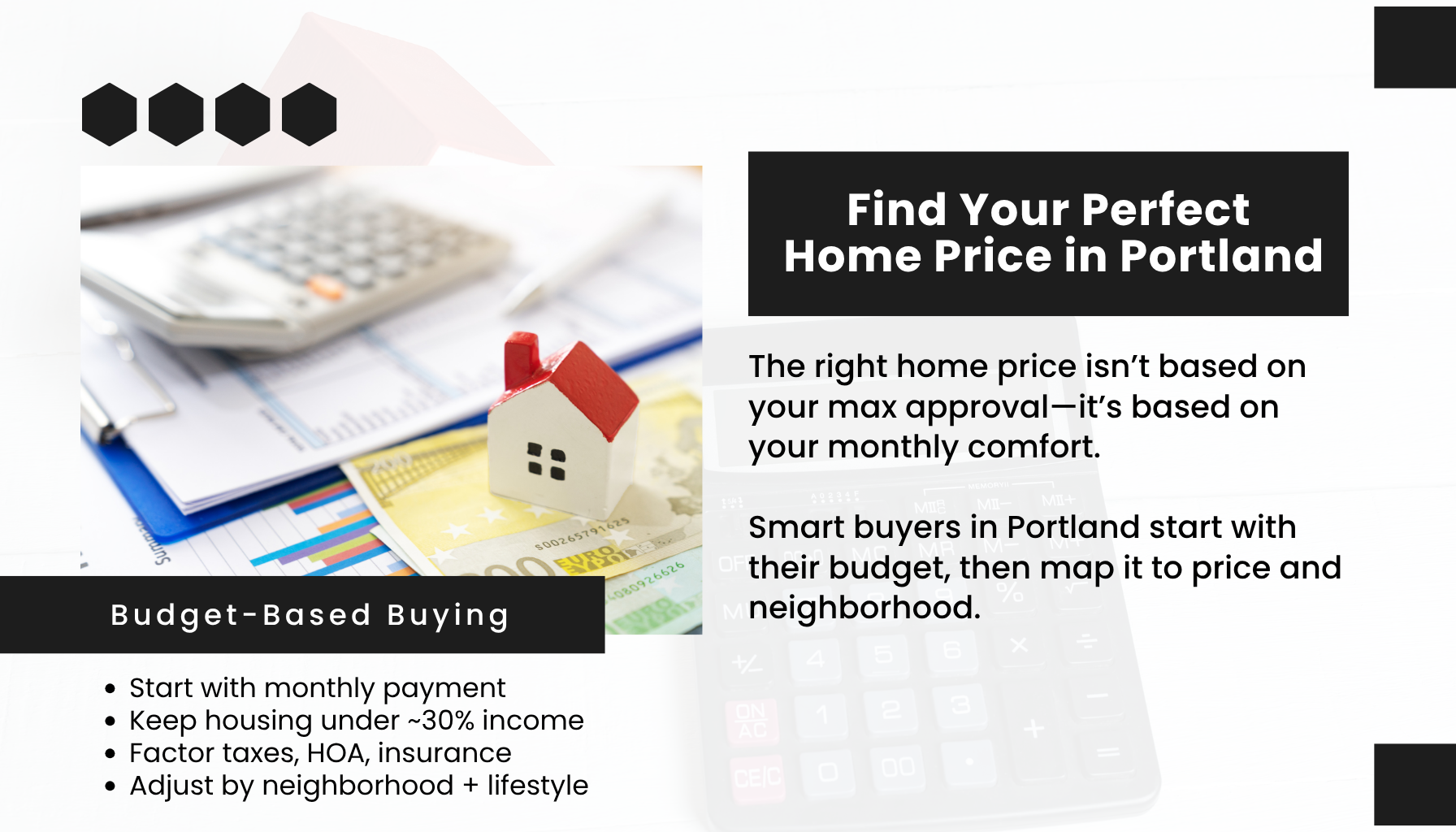
- Start with monthly payment target, then back into price using taxes and insurance.
- In Portland today, 30 percent of gross income is safe affordability yardstick.
- With 6 percent rate, $5,000 budget maps near $400k to $425k.
- Neighborhood choice shifts payment via taxes, HOA, and commute tradeoffs.
What does “budget-based price range” really mean for Portland buyers?
When clients ask what price they can afford, I start with their monthly payment comfort zone, not a preapproval ceiling. Your total monthly housing cost includes principal and interest, property taxes, homeowner’s insurance, mortgage insurance if applicable, HOA dues if any, and utilities. That all-in figure is what determines real affordability in the Portland real estate market and across Vancouver, Brush Prairie, and Battle Ground.
A common rule of thumb is to keep housing at or below 30 percent of gross monthly income. According to NAR's affordability guidance and typical underwriting, this target supports sustainable ownership while allowing room for savings and lifestyle. Local taxes, condo dues, and insurance vary by neighborhood, so two homes with the same list price can create very different payments.
In early 2026, our market is mildly seller-leaning but more balanced than in 2022. Portland’s median sale price is about $564,000 with roughly 1.7 months of supply and typical days on market around 27, based on local MLS data for February 2026. Those conditions matter because they influence your negotiation leverage, closing timelines, and concessions.
Here is how I define it, as Lisa Mehlhoff:
- Start with a monthly payment you can sustain for 5 to 7 years.
- Back into price by layering taxes, insurance, HOA, and any mortgage insurance.
- Adjust by location, loan type, interest rate, and expected maintenance.
How does this calculation work in Portland right now?
Let’s translate the numbers using current Portland housing market trends. With rates hovering near recent norms, the research example at 6 percent is a practical baseline. If your monthly budget is $5,000, that typically supports around a $350,000 to $425,000 price, depending on down payment, taxes, HOA, and whether you carry mortgage insurance. The research example shows about $2,100 PITI around a $350,000 loan at 6 percent, and with taxes and insurance, you can often reach $400,000 to $425,000.
At a $7,500 monthly budget, you may target roughly a $600,000 loan amount, which often aligns with $650,000 to $700,000 homes. In the city, that can open up Alberta Arts in the $500,000 to $700,000 band or certain townhomes in Northwest, while in Vancouver, you might also consider Fisher’s Landing or Salmon Creek, where the median sale price sits near $510,000 with about 2.0 months of inventory and roughly 23 days on market.
According to the FHFA House Price Index, national prices continued year-over-year growth through late 2025, which aligns with our local pattern of moderating appreciation. Locally, Portland is seeing roughly 3 to 5 percent annual price growth with inventory up about 15 percent from last spring, based on regional MLS reports. That gives buyers a little breathing room to balance budget and lifestyle.
Translating your monthly budget to a price
- $3,200 monthly target: FHA with 3.5 percent down can point to low $400,000s condos or $375,000 to $425,000 single-family options in parts of East Portland or entry points in Vancouver.
- $5,000 monthly target: Often $400,000 to $425,000 purchase with 5 to 10 percent down, or higher with strong credit and lower taxes.
- $7,500 monthly target: Typically $650,000 to $700,000 purchase, opening Alberta Arts, select Northwest townhomes, or Fisher’s Landing single-family.
Always refine with live quotes from your lender because rate, credit score, and loan type can change the math quickly.
Which neighborhoods fit different budgets and lifestyles near Northwest Portland?
Directly around my office in the Northwest District, Slabtown, and the Pearl District, you will find walkable streets, great dining, and quick access to Streetcar and MAX. Price points vary widely, and the monthly payment depends on taxes and HOA dues as much as price. Here are budget-to-neighborhood fits that I often review with clients.
- Pearl District
- Northwest District and Nob Hill (Alphabet District)
- Alberta Arts District
- East Portland (Woodlawn, Parkrose)
If you look north across the river for payment efficiency, Vancouver offers a $510,000 median price and shorter days on market. Fisher’s Landing runs about $550,000 to $750,000 with strong schools. Salmon Creek provides options around $480,000 to $620,000 and newer townhomes. For acreage and quiet, Brush Prairie shows a median near $585,000, with Battle Ground around $525,000 and typically brisk 20-day market times.
What are the pros and cons of pushing your price versus staying conservative?
Pros:
- Reaching closer-in neighborhoods reduces commute time and long-term transportation costs.
- Larger or newer homes can lower maintenance surprises and protect resale value.
- Slightly higher purchase can capture appreciation in tight submarkets over time.
Cons:
- Stretching the monthly payment reduces flexibility for savings, travel, and emergencies.
- Higher taxes, dues, or mortgage insurance can outpace future income growth.
- Changes in job, family needs, or rates may make an aggressive payment feel stressful.
How do I align financing, negotiation, and timelines with my monthly target?
Smart financing can keep you on budget even in a mild seller’s market. In this region, balanced inventory is considered 4 to 6 months, and we are sitting closer to 1.5 to 2.5 months, so plan on a competitive but not frantic pace. Make your offer strong without overreaching: 1 to 2 percent earnest money, a 7 to 10 day inspection period, and a 30-day closing are common. Consider a modest appraisal gap of up to $5,000 where data supports value.
Expect inspections to cost $400 to $650 for a standard home, plus optional sewer scope, radon, or pest as needed. This relates to the home inspection payment responsibility. If a condo makes sense for your monthly budget, weigh dues against maintenance savings. For first-time buyers, FHA at 3.5 percent down or USDA with zero down outside the urban growth boundary can bridge a gap. Military families can use VA with zero down up to county conforming limits. Washington State Housing Finance Commission and Oregon Housing and Community Services both offer down payment programs that can add $10,000 to $25,000 in assistance for qualified buyers.
One of my clients, a software engineer relocating from Seattle, targeted a $7,000 payment. We balanced HOA dues against walkability and landed a townhome in the Northwest with manageable dues and a 30-day close. Another client, a resident physician starting at OHSU, wanted under $4,500 monthly and a short commute. We chose Goose Hollow for easy transit, used seller credits toward a rate buydown, and stayed within budget.
FAQs
1) How do Oregon and Washington taxes affect my monthly payment? Property taxes differ block to block. Oregon has property tax compression under Measure 5, which can moderate effective rates in certain areas, while Washington’s structure is different by county. The result is that two similarly priced homes can produce very different tax bills. I pull actual tax records from local county data during budgeting so your payment reflects reality, not estimates.
2) Are FHA, VA, or USDA loans realistic in Portland and Vancouver? Yes. FHA with 3.5 percent down is common in East Portland, parts of Vancouver, and some townhome communities. VA works well throughout Clark County for military families up to conforming limits. USDA can be viable just outside the urban growth boundary, particularly around Battle Ground or select Clark County pockets. These programs change your mortgage insurance, rate, and upfront costs, which can expand your price ceiling.
3) How much cash beyond my down payment should I plan for? Budget 2 to 3 percent of the purchase price for closing costs, including lender fees, title and escrow, prepaid taxes, and insurance. Inspections typically run $400 to $650, with optional tests adding a few hundred. Earnest money is often 1 to 2 percent, and it applies to your total due at closing. We can sometimes negotiate seller credits to offset closing costs in today’s mildly competitive climate.
4) Should I plan to refinance later, and does that change my target price now? Refinancing can improve your payment if rates fall, but you should be comfortable with the payment today without relying on a future refinance. If a refinance is likely, consider a conservative adjustable-rate mortgage structure that fits your timeline. I still recommend budgeting for your initial fixed period without straining, then treating any future refinance as a bonus rather than a necessity.
5) Is an appraisal gap waiver risky in this market? Limited appraisal gap coverage can be strategic when data supports value. A small gap, like up to $5,000, helps compete without taking on outsized risk. I analyze recent comparable sales and active listings to gauge the likelihood of an appraisal shortfall. With 1.5 to 2.5 months of inventory and moderating appreciation, we can often avoid large gaps while still winning.
6) How do condos compare to single-family homes for monthly cost? Condos can offer lower purchase prices and shared maintenance, which helps first-time buyers. However, HOA dues can be meaningful, especially in elevator buildings or amenity-rich communities like the Pearl District. Single-family homes carry higher maintenance and insurance variability, but no monthly HOA in many cases. I will model both scenarios so you can compare payment, out-of-pocket maintenance, and resale trajectory.
7) How long will it take to find a home within my budget? With days on market around 20 to 27 across the region, most motivated buyers secure a home within 4 to 8 weeks once preapproved, then close in about 30 days. If you are targeting high-demand pockets in the Northwest District or Pearl, add a few weeks for selectivity. In East Portland or parts of Vancouver, options tend to move faster, but selection is broader.
Conclusion
The bottom line: Your budget is the keystone for every decision, from neighborhood to loan type to negotiation strategy. In early 2026, the Portland homes for sale landscape offers opportunity across price points, with Portland housing market trends showing mild appreciation and more balanced conditions than the 2022 peak. Start with a monthly number that feels comfortable for several years, then translate that into price by layering taxes, insurance, HOA, and mortgage insurance. I will help you compare neighborhoods like the Pearl, Northwest District, Alberta Arts, East Portland, and Vancouver submarkets, and craft an offer that wins without straining your financial life.
Lisa Mehlhof Homes | License #220603251 Call or text 503-490-4888 https://lisamehlhoffhomes-
Categories
Recent Posts






"My job is to find and attract mastery-based agents to the office, protect the culture, and make sure everyone is happy! "