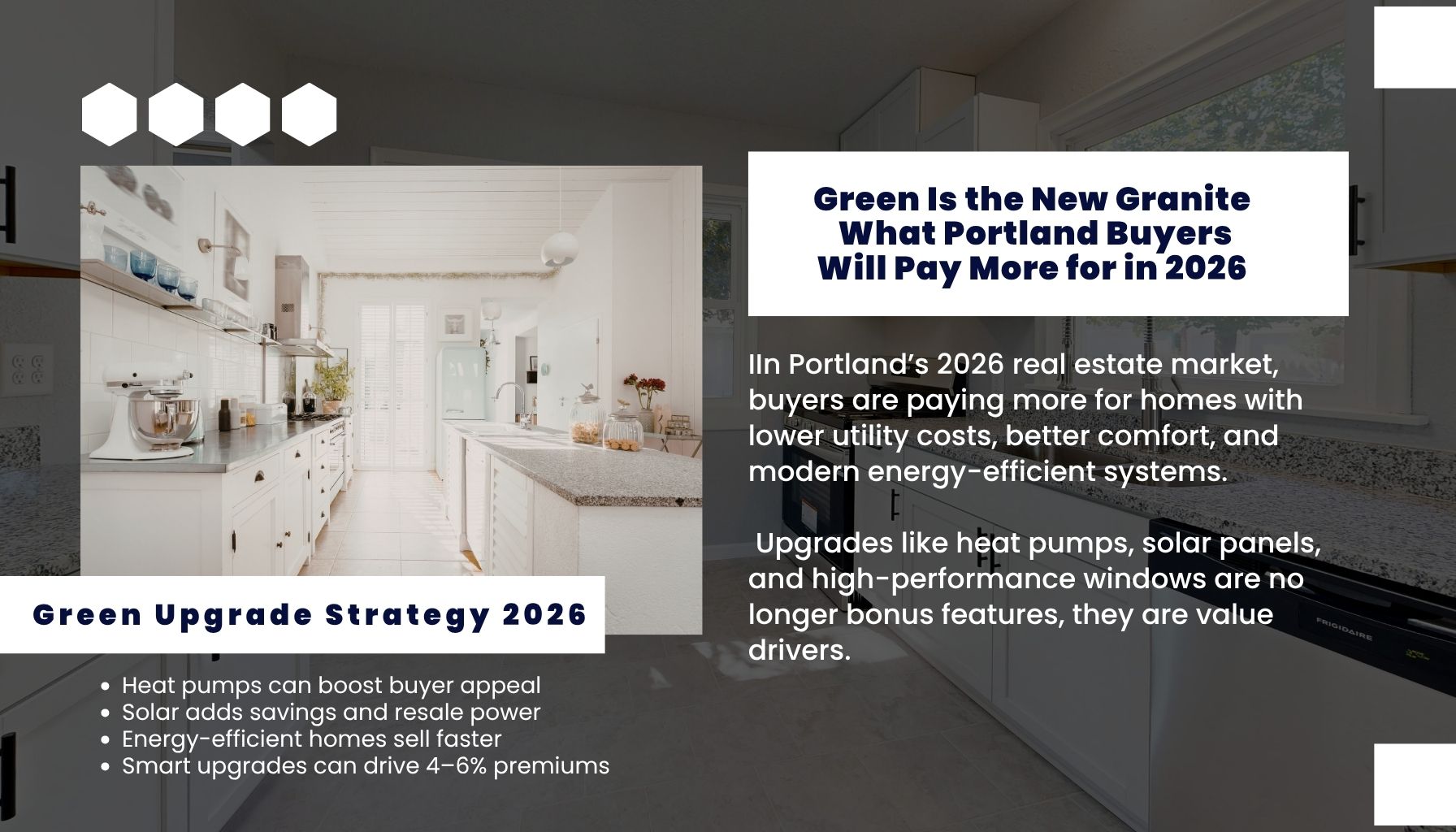
Green Is the New Granite: Energy‑Efficient Upgrades Portland Buyers Will Pay More For in 2026
TLDR
- Heat pumps, solar, windows, insulation drive 4–6% premiums and faster sales.
- Rebates, credits, and smart sequencing cut costs and improve appraisal support.
- Neighborhood context matters; SW Portland buyers, Lake Oswego, and Cedars value efficiency.
- I guide upgrades, contractors, financing, and timing for strong 2026 results.
What does “green is the new granite” really mean in Portland?
In 2026, sustainability is not a niche add-on. It is a price-driving feature, especially with Portland’s tight inventory near 1.8 months and median days on market hovering around 13 days in the city and 15 to 18 days across East Vancouver, Brush Prairie, and Battle Ground. Buyers want comfort, lower utility bills, and modern systems that minimize maintenance. Those needs translate directly into higher offers and stronger negotiating power for efficient homes.
From what I see in the Portland Regional MLS and on the ground with clients, homes featuring heat pump HVAC, rooftop solar, triple-pane windows, and proven air sealing strategies often command a 4 to 6 percent premium over comparable properties lacking those upgrades. In 2025, Portland’s median sale price reached $572,000 citywide, with premium SW neighborhoods such as Multnomah Village and Hillsdale around $710,000. A 4 percent premium on a $700,000 home is meaningful ROI if you plan the work well and leverage incentives.
Here is how I define it as Lisa Mehlhoff:
- Green upgrades that reduce energy use and ownership costs are top-tier features.
- Buyers compare utility estimates like they compare finishes and walkability.
- The best results come from data-backed upgrades, not from guesswork or trends.
Which energy‑efficient upgrades are Portland buyers paying more for in 2026?
Top-of-list in Portland and nearby suburbs are heat pump HVAC systems. They provide efficient heating and cooling in one package and are a perfect fit for our climate. Typical installed costs run $8,000 to $15,000 depending on home size and ducting. Next, rooftop solar remains compelling thanks to the 30 percent federal tax credit. After credits and local incentives, many homeowners net $12,000 to $25,000 for a 5 to 7 kW system. Buyers love seeing predictable energy bills and appraisers can often reflect contributory value when production data is available.
Triple-pane or high-performance windows plus targeted air sealing and attic insulation are close behind. Windows commonly run $15,000 to $30,000 for a standard Portland bungalow, with immediate comfort benefits and noise reduction that tech professionals and medical staff on odd hours appreciate. Strategic insulation and air sealing often deliver the best bang for the buck at $2,000 to $6,000. Energy Trust of Oregon provides prescriptive rebates that stack with federal incentives, helping sellers keep out-of-pocket costs in check. See current programs at Energy Trust of Oregon. For broader consumer sentiment, the National Association of REALTORS points to rising buyer interest in sustainability features across markets, reflecting a nationwide shift in expectations. Explore resources from NAR at NAR Sustainability.
In Clark County and East Vancouver, EV charging readiness is becoming a must-have. A 240-volt circuit and Level 2 charger installation can be as low as $900 to $1,500 depending on panel capacity. Pair that with heat pump water heaters and smart thermostats and your listing aligns with the way many buyers live today. To ground these choices in current market context, you can review local pricing trends at the Portland Regional MLS and area valuation references via the Clark County Assessor.
What about condos?
Condos in South Waterfront, Goose Hollow, and the Pearl often have centralized systems or HOA-run boilers. When private upgrades are limited, look to high-impact interior changes such as induction cooking, efficient lighting, smart thermostats, and certified low-VOC materials. Monthly HOA dues may already cover some building-scale sustainability work, so be sure to highlight that in your listing copy and show utility history to support buyer confidence.
How do neighborhood dynamics shape the payoff for green upgrades?
Neighborhood context matters because buyer profiles and building stock vary. In SW Portland, buyers in Multnomah Village and Hillsdale often value comfort, quiet, and lower operating costs more than cosmetic updates alone. In East Vancouver and the Cedars, many homes are newer and already efficient, so the best differentiators can be solar, EV charging, and heat pump water heaters. In Lake Oswego, where buyers tend to expect high-end finishes, pairing energy performance with design-forward materials bridges lifestyle and value. Brush Prairie and Battle Ground see larger lots that can accommodate solar arrays and rainwater harvesting, which helps with both sustainability and landscape maintenance.
- Multnomah Village and Hillsdale, SW Portland
- Cedars and East Vancouver
I also guide many homeowners in Lake Oswego, where the Lake Oswego Oregon Real Estate Market often rewards comprehensive packages that combine aesthetics and performance. Think triple-pane windows matched with custom casings, heat pump HVAC with discrete registers, and whisper-quiet ventilation for indoor air quality. In Brush Prairie and Battle Ground, buyers frequently look for energy savings on larger footprints. A mid-size solar array and a heat pump water heater can turn a sprawling home into a low-cost operator, which broadens the buyer pool and supports pricing strength.
What are the pros and cons of doing energy upgrades before listing?
Pros:
- Higher offers and wider buyer pool due to modern systems and lower bills.
- 4 to 6 percent premium potential when packages are planned and documented.
- Faster marketing momentum in low-inventory segments with clear feature advantages.
Cons:
- Upfront costs and lead times can slow your listing timeline if poorly sequenced.
- Not all upgrades appraise equally without utility data or third-party documentation.
- Complex electrical or roofing conditions can trigger scope creep and extra permits.
How do I plan, finance, and sequence upgrades for maximum ROI?
Start with a simple energy audit or walkthrough to identify the 3 to 5 upgrades with the highest value density. My typical sequence is air sealing and attic insulation first, windows only where performance or condition demands, then heat pump HVAC, EV readiness, and finally solar if roof age and electrical service make sense. This path stacks immediate comfort improvements with the visual and financial proof buyers want.
Financing can be straightforward. Many clients use a small HELOC or savings, then recapture the cost at closing. Rebates and credits can defray thousands. Review local incentives at Energy Trust of Oregon, federal credits via the FHFA resources page as a starting point for housing market context, and homeowner assistance programs at the Portland Housing Bureau and the Washington State Housing Finance Commission if you intend to hold the home longer. For market trajectory comparisons, the Portland Regional MLS provides inventory and price data. Investor share trends in our region have also been tracked by CoreLogic, reinforcing competitive dynamics that reward standout listings (CoreLogic).
One of my clients in Hillsdale replaced an aging furnace with a variable-speed heat pump, added R-49 attic insulation, and installed a 240-volt EV circuit. We listed two weeks later and received three offers, all above list, with the buyer citing comfort and EV readiness as tie-breakers. Another client in the Cedars of East Vancouver installed a 6 kW solar array after verifying the roof had 18 years of life left. The array plus a heat pump water heater reduced their annual utility projections by over $1,000, and the home appraised comfortably at contract price.
For first-time buyers and relocating professionals considering SW Portland Oregon homes for sale or Cedars East Vancouver WA Real Estate, I often craft an immediate post-close upgrade roadmap. In 60 to 90 days, we can capture most of the comfort and savings benefits while setting you up for stronger resale down the line.
FAQs
1) Which single upgrade gives the best ROI right now in Portland? If you can only pick one, a high-efficiency heat pump usually wins. It delivers comfort year-round, it is visible in marketing, and it meaningfully lowers bills. That combination resonates with tech professionals, medical staff on varied shifts, and families watching monthly costs. Pair it with a smart thermostat and you will see daily benefits while also strengthening your resale position within our low-inventory market.
2) Will appraisers fully credit my solar system value? Appraisers look for production data, age, and ownership status. Owned systems with documented generation and transferable warranties perform best. I prepare a package that includes utility history, inverter screenshots, installer documents, and roof condition details. While valuation treatment varies, thorough documentation improves contributory value recognition and buyer confidence, especially in premium neighborhoods like Multnomah Village, Lake Oswego, and portions of East Vancouver.
3) How do condos handle energy upgrades and resale value? Focus on upgrades inside your control like induction cooking, efficient lighting, smart thermostats, and low-VOC finishes. Check with the HOA for any building-scale efficiency improvements that may already reduce operating costs. In South Waterfront and Goose Hollow, highlighting lower utility usage plus quiet, insulated windows can differentiate your condo from similar units, which is key in a segment where finishes often look comparable.
4) Are rebates and credits changing in 2026? Federal incentives remain robust, including the 30 percent solar tax credit. Energy Trust of Oregon updates rebate menus periodically, so it is smart to verify amounts before starting work. I coordinate contractor bids with current incentives to lock in savings where possible. For Washington buyers and sellers, I also monitor utility promotions and state-level programs so we can time upgrades effectively.
5) How long should I wait after upgrades before listing? Aim for a two to four week buffer after major work. You want clean photos, verified operation, and any inspections or permit sign-offs completed. For solar, consider generating at least a few weeks of production data to include in your listing package. Even short data windows, combined with estimates, help buyers and appraisers understand value and operating cost reductions.
6) Do green upgrades matter as much in Lake Oswego? Yes, but they need to align with the Lake Oswego Oregon Real Estate Market’s design expectations. Buyers at higher price points appreciate quiet comfort and low bills, yet they also scrutinize aesthetics. Triple-pane windows with architectural detail, discrete supply grills for heat pumps, and integrated smart-home controls deliver performance without compromising style. That balance supports top-tier pricing in competitive segments.
7) How do military families and relocating doctors benefit from efficiency features? Predictable utilities and low-maintenance systems simplify life during demanding schedules and potential relocations. Proximity to OHSU or Legacy Emanuel pairs well with quiet, well-insulated homes that reduce stress and support better sleep. For military families moving along the I-5 corridor, EV readiness and durable, efficient systems reduce surprises. I help tailor upgrade plans to timing constraints and available benefits so transitions stay smooth.
Conclusion
The bottom line Energy-efficient upgrades have moved from nice-to-have to must-have across our region. With inventory near 1.8 months in Portland and days on market in the low teens, buyers are rewarding homes that deliver comfort, quiet, and lower bills. Heat pumps, solar, high-performance windows, and targeted air sealing are leading the pack and can produce a 4 to 6 percent premium when documented and marketed well. Neighborhood context shapes priorities, whether you are in Multnomah Village, the Cedars, Lake Oswego, or Brush Prairie. As your Portland Oregon Real Estate Agent, I will help you choose smart upgrades, stack incentives, and time your listing to capture 2026 demand across Portland and East Vancouver Washington Real Estate.
Lisa Mehlhof Homes | License #220603251 Call or text 503-490-4888 https://lisamehlhoffhomes-
Categories
Recent Posts







"My job is to find and attract mastery-based agents to the office, protect the culture, and make sure everyone is happy! "