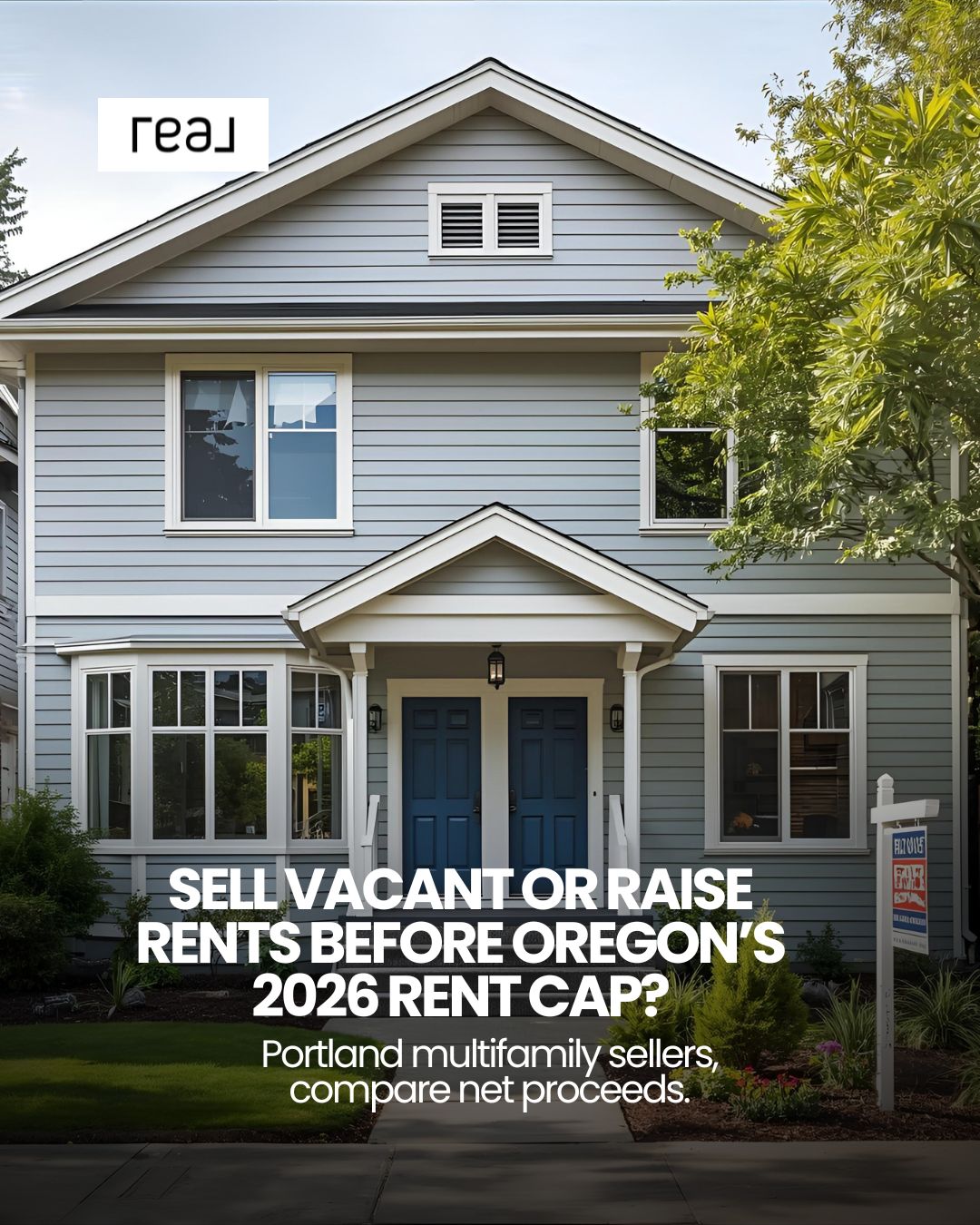
With the 2026 rent cap set at 9.5%, should I raise rents before selling my multi-family unit, or sell it vacant for a higher premium?
TLDR
- Raising rents can stabilize income, but may reduce appeal to owner-occupant buyers.
- Vacant units often command a premium, especially in low-inventory spring markets.
- Portland inventory is tight and Clark County demand is high, improving vacant-sale odds.
- Your best move depends on buyer pool, unit condition, timeline, and cost of turnover.
What does the 9.5% rent cap really mean for owners planning to sell?
Oregon’s 2026 rent cap at 9.5% sets an upper limit on annual increases for most units. If you sell with tenants in place, your buyer inherits that cap, which can restrict near-term income growth. If you sell vacant, buyers can reposition rents to market faster, which often increases the pool of bidders. In a tight market like Portland, that can translate to a sale premium if your units are rent-restricted compared to nearby comps.
Portland’s single-family benchmark sits at a median of $564,000 as of Q3 2025, up 4.2% year over year, with 1.8 months of inventory and 42 days on market on average. This low supply environment still benefits sellers even as days on market tick higher, because well-prepared properties outcompete stale listings. I watch this closely through MLS reporting, including RMLS Market Action, and I calibrate pricing against actual absorption in each neighborhood.
Here is how I define it as Lisa Mehlhoff:
- A rent increase helps valuation if your rents are materially below market.
- A vacant sale helps when your likely buyer is an owner-occupant or re-position investor.
- The right choice depends on tenant profile, seasonality, and make-ready costs.
How does this decision play out in Portland and Clark County right now?
Local context matters. In Portland, median prices are higher and inventory is tighter, while certain zip codes saw mild softening tied to recent regional tax dynamics. Meanwhile, Clark County submarkets like Brush Prairie and Battle Ground saw Q2 2025 medians around $585,000 and $550,000, with inventory between 1.2 and 1.4 months, signaling strong absorption for well-priced product. Those conditions favor listings that appeal to the broadest buyer pool, which often means clean, vacant, and ready.
Rates also shape buyer math. The July 2025 average 30-year fixed was about 6.75 percent, based on the Freddie Mac PMMS. When rates sit in that range, buyers scrutinize net operating income, cap rates, and immediate upside. If your current rents sit well below market, buyers will price in the 9.5% limit, which may suppress your valuation unless they can quickly turn units.
I counsel sellers to align with seasonal demand. Portland’s early spring historically delivers more buyers in circulation per MLS seasonality, even as specific weekly flows vary year to year. Pair that with neighborhood-level vitality and civic improvements. For example, ongoing urban investments tracked by the Portland Bureau of Development Services and park system enhancements documented by Portland Parks & Recreation can attract owner-occupants who prefer vacant or partially vacant buildings for faster move-in.
A quick math break: side-by-side scenarios
- Fourplex at $1,800 per unit. A 9.5% cap supports an increase to $1,971, or +$171 per unit per month. Building impact is +$684 per month, about $8,208 annually.
- If a vacant sale adds a 2.5% premium on an $800,000 list, that is $20,000. Turnover costs could be $2,000 per unit for paint, flooring, and deep clean plus one month of lost rent, roughly $1,800 per unit. Total make-ready and vacancy might be $15,200, netting about $4,800.
- If rents are far below market, a vacant sale can outperform because buyers can reset quickly, especially in neighborhoods with tight supply.
Which local neighborhoods and buyer pools respond best to vacant versus rented sales?
In my experience as a Portland Oregon Real Estate Agent, the choice hinges on who will buy your building. In SW Portland neighborhoods like Hillsdale and Multnomah Village, small plexes attract owner-occupants and move-up buyers relocating within the metro. Many prefer a vacant or partially vacant setup to occupy a unit on day one. In inner southeast areas such as Sellwood-Moreland, duplexes and triplexes near transit and parks pull in tech professionals and first-time investors who value immediate control of unit finishes and new leases.
Across the river, East Vancouver Washington Real Estate benefits from rapid household formation and ease of access via I-205 and C-TRAN routes. Proximity to medical hubs like OHSU and PeaceHealth Southwest supports demand from doctors relocating and retirees downsizing who often prefer vacant options. Communities near Cedars East have growing family appeal, and while Cedars East Vancouver WA Real Estate is largely newer single-family, the investor draw spills into adjacent pockets where duplexes and small multifamily trade competitively.
- Neighborhood 1
- Neighborhood 2
For investors targeting Brush Prairie and Battle Ground WA Homes, low months of supply support competitive pricing for vacant or lightly occupied assets, especially near planned corridor improvements monitored by WSDOT. Clark County’s expected population growth around 8 percent by 2030, per the Clark County Comprehensive Plan, further supports long-term rental fundamentals.
What are the pros and cons of raising rents versus selling vacant?
Pros:
- Raising rents can bolster your trailing twelve months income and justify a higher cap rate.
- Tenants in place can reduce buyer risk for pure investors who want day-one cash flow.
- If you hold through winter, increases can offset seasonally slower list periods.
Cons:
- A vacant sale often attracts owner-occupants and 1031 buyers seeking speed and control.
- Turnover work costs and one month of lost rent may still be net positive if premiums are strong.
- Rent caps can limit immediate upside for buyers, which sometimes reduces offers on occupied assets.
How do I build a 30-day game plan to decide and execute?
Start with your buyer pool. In SW Portland Oregon Homes for Sale around Hillsdale and Arnold Creek, I often position duplexes for owner-occupants who want to occupy a unit quickly. In that case, I recommend a targeted make-ready plan and a partial vacancy if cash flow allows. In inner NE and SE, I tailor the strategy to the most likely buyer profile based on MLS comps, days on market, and showings-to-offer ratios from recent quarters.
Consider your carrying costs and taxes. Portland’s Measure 26-260 Parks Levy begins in 2026 and adds about $0.22 per $1,000 of assessed value in Multnomah County and $0.15 in Washington County. You can verify levy details through the Multnomah County Assessor and Washington County A&T. In Washington, assessed values are updated annually rather than resetting at sale, as outlined by the Clark County Assessor. These items modestly affect buyer underwriting and should be factored into net proceeds timing.
One of my clients in Sellwood-Moreland owned a triplex with below-market rents. We completed a 12-day refresh, listed two units vacant, and attracted five offers. The buyer planned immediate repositioning, which justified a modest premium over occupied comps. Another client in Battle Ground maintained stable tenancies and implemented a small increase aligned with the 9.5 percent framework. An investor purchased at list after reviewing clear rent rolls and a pre-inspection package, prioritizing certainty over vacancy.
To round out your plan, confirm financing dynamics and buyer incentives. VA buyers and military families commuting to JBLM rely on zero-down options governed by VA loan limits. First-time buyers may stack assistance through Oregon Housing and Community Services or the Washington State Housing Finance Commission Home Advantage, which can broaden your pool if a unit is vacant and owner-occupiable.
FAQs
1) How much premium can a vacant sale really command? In our market, I commonly see a 2 to 3 percent premium for clean, vacant multi-family when comparable occupied buildings have constrained rents. On an $800,000 asset, that can be $16,000 to $24,000 before make-ready and vacancy costs. Neighborhood, condition, and season matter. Tight inventory, as reflected in recent MLS data, tends to amplify the premium for turnkey listings.
2) Should I raise rents now or wait until closer to listing? If your rents are far below market, a measured increase can help valuation, especially if you plan to sell to an investor. However, if you expect the highest and best use to be owner-occupancy, a vacant or partially vacant setup tends to win. Timing increases to avoid surprise or conflict before showings is critical. I tailor the plan to tenant relations and your ideal sale window.
3) How do current rates affect selling with tenants in place? With average 30-year rates near 6.75 percent in mid-2025 per the Freddie Mac PMMS, buyers are meticulous about net operating income. If your tenants are below market and constrained by the 9.5 percent cap, some investors will discount for limited upside. Conversely, vacant or quickly vacating units allow a buyer to re-lease faster, which can offset rate pressure in underwriting.
4) Are there downsides to delivering a building fully vacant? Yes. You face turnover costs, a potential month of lost rent per unit, and the risk of longer time on market if you miss the seasonal window. That said, in neighborhoods with low inventory and high walkability, vacant listings often photograph and show better. I recommend a pre-inspection, targeted upgrades, and strategic pricing informed by RMLS Market Action.
5) Do local taxes or levies impact my decision to sell now or later? They can. Multnomah and Washington counties have scheduled levy impacts that modestly influence monthly carrying costs starting in 2026, which buyers factor into budgets. Check the Multnomah County Assessor and Washington County A&T for details. In Clark County, valuation is updated annually, not reset at sale, per the Clark County Assessor, which also shapes investor expectations.
Conclusion
The bottom line: If your rents are close to market and your buyer is likely an income-focused investor, a modest increase under the 9.5 percent cap can support pricing without losing momentum. If your most probable buyers are owner-occupants or reposition investors targeting SW Portland Oregon Homes for Sale, inner southeast opportunities, or growth corridors tied to East Vancouver Washington Real Estate, then selling vacant or partially vacant often wins. I analyze each property’s rents, turnover costs, buyer pool, and timing against current MLS absorption and rate trends to recommend a clear path. If you own small multi-family near Cedars East Vancouver WA Real Estate or are weighing options in Brush Prairie and Battle Ground WA Homes, let’s model both outcomes and pick the one that nets you more.
Lisa Mehlhof Homes | License #220603251 Call or text 503-490-4888 https://lisamehlhoffhomes-
Categories
Recent Posts








"My job is to find and attract mastery-based agents to the office, protect the culture, and make sure everyone is happy! "