How Do Inspections Work and Who Pays for Inspections?
TLDR
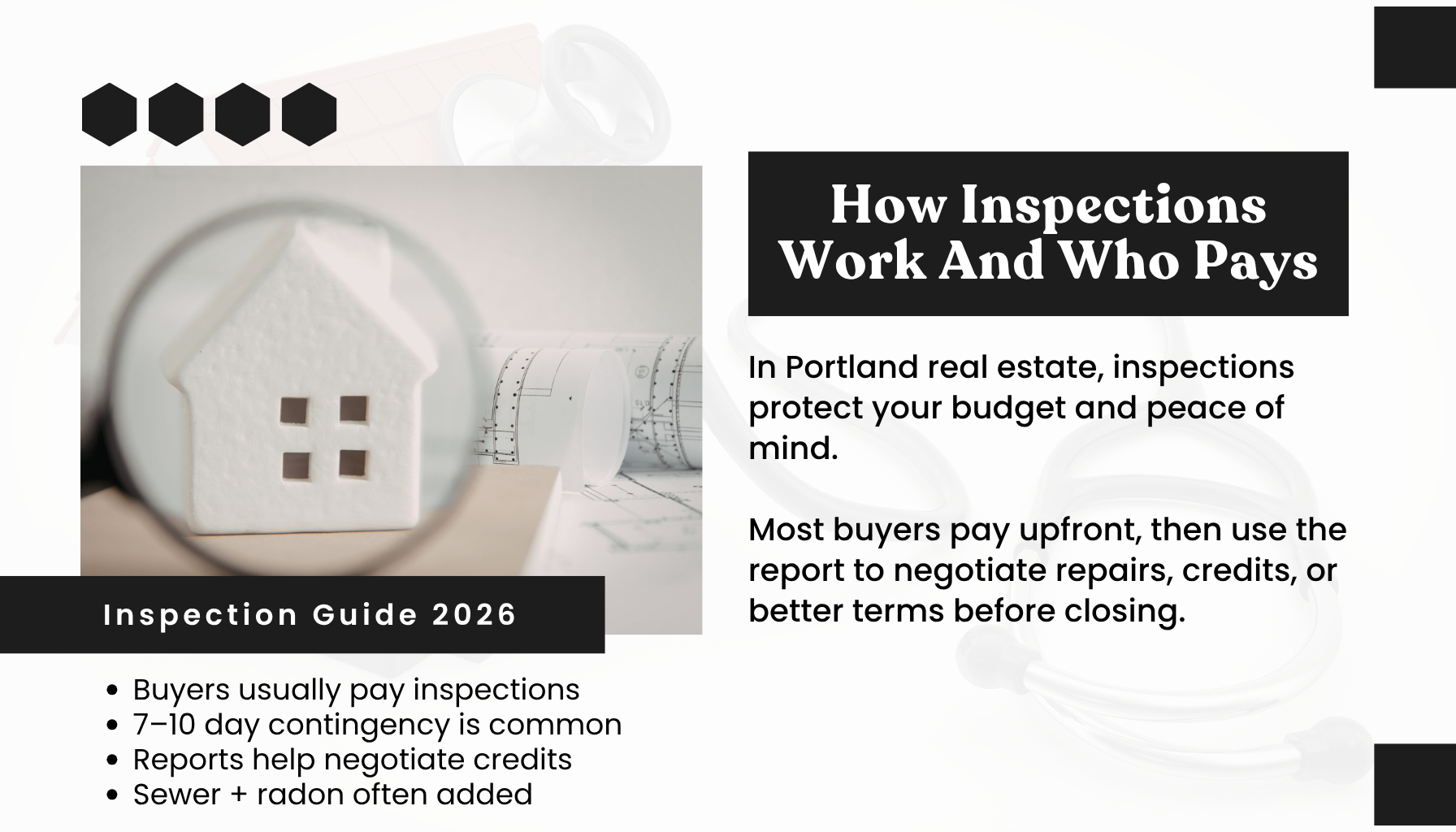
- Most buyers order inspections during a 7 to 10 day contingency period.
- Buyers typically pay for general, sewer, radon, and specialty inspections upfront.
- In today’s mild seller-leaning market, inspections remain negotiable for repairs or credits.
- Oregon and Washington customs differ slightly, so strategy depends on location and property.
What does a home inspection really mean?
A home inspection is a professional, independent evaluation of a property’s visible systems and structure. It is not a pass or fail exam. It is a detailed snapshot of condition that helps you decide whether to proceed, negotiate, or walk away. In practical terms, it protects your budget and your sanity. In the current Portland real estate market, where median prices are around $564,000 and days on market average about 27, that peace of mind is invaluable.
According to regional MLS data for February 2026, our area is operating with 1.5 to 2.2 months of inventory, depending on jurisdiction. That is still a mild seller’s market, even as conditions are more balanced than 2022. In this environment, strong offers often include inspections but keep timelines tight. NAR consistently reports that inspections remain one of the most common and important contingencies nationally.
Here is how I define it as Lisa Mehlhoff:
- A clear-eyed, third-party assessment of safety, lifespan, and maintenance priorities.
- A negotiation tool to request repairs or closing credits based on documented findings.
- Your roadmap for future ownership costs over the next 1 to 10 years.
How do inspections work in Portland OR and nearby Washington?
Once we are under contract, the inspection clock starts. In greater Portland, most buyers choose a 7 to 10 day inspection contingency for a single-family home. You schedule and pay the inspector, and they deliver a written report that covers structure, roof, electrical, plumbing, HVAC, attic, crawlspace, and more. Typical general inspection fees run about $400 to $650 for a standard home and 3 to 4 hours onsite. Larger or older homes can cost more and take longer.
Specialty inspections are common here. In Portland, we often add a sewer scope, typically $150 to $250, because many neighborhoods have older laterals. Radon testing is another frequent add-on, about $150 to $200 for a 48-hour test. Oil tank scans, pest and dry rot evaluations, and roof certifications are frequent in older neighborhoods. In Clark County, Washington, acreage properties might need well and septic inspections that can run $300 to $700 each, sometimes plus pumping fees. According to home inspection payment responsibility, buyers usually initiate and pay for these inspections, then decide whether to ask for repairs, credits, or to proceed as is.
Oregon vs Washington timing and customs
Oregon forms typically use an inspection contingency with a defined period and a buyer’s right to cancel if unsatisfied. Washington’s standard forms are similar but use different timelines and notice procedures. In Vancouver and Brush Prairie, we commonly see 7 to 10 days as well. The key difference is the exact form language and how responses are delivered. I will align your timelines to the contract and coordinate access so you do not miss critical deadlines.
Which neighborhoods and property types change the inspection game?
Older housing stock, condo buildings, and acreage properties can all shape your inspection plan. Near my office in Northwest Portland, the Alphabet District and Slabtown have charming vintage homes and some new construction that require different due diligence. The Pearl District’s mid-rise and high-rise condos introduce HOA reviews alongside unit inspections. Across the river, Salmon Creek and Fisher’s Landing in Vancouver offer newer homes with different priorities, while Brush Prairie acreage prompts well, septic, and outbuilding evaluations.
- Northwest District - Alphabet District
- Pearl District
What are the pros and cons of different inspection strategies?
Pros:
- Full inspection contingency protects earnest money and reduces future surprise costs.
- Specialty inspections uncover hidden issues like sewer failures or radon levels.
- Inspection reports provide leverage for targeted repairs or closing credits.
Cons:
- Short timelines can feel rushed and add stress to busy relocation schedules.
- Upfront costs can add up, especially with multiple specialty inspections.
- In competitive scenarios, overly broad demands risk alienating the seller.
How do I budget, schedule, and negotiate inspections for my goals?
Plan to spend $600 to $1,200 on inspections for a standard Portland home, depending on size and add-ons. Typical line items include general inspection $400 to $650, sewer scope $150 to $250, radon $150 to $200, roof certification $0 to $200, and pest or dry rot $125 to $200. In Brush Prairie or Battle Ground, add potential well and septic inspections that could push the total higher. I book trusted inspectors quickly and coordinate access right after mutual acceptance so we stay within a 7 to 10 day window.
Negotiation strategies vary by market conditions. With 1.5 to 2.2 months of inventory and days on market around 20 to 27, buyers can reasonably ask for health and safety repairs or seek modest closing credits. For first-time buyers and relocators juggling timelines, a credit can simplify things and let licensed contractors complete work after closing. VA and FHA buyers often prioritize repairs tied to safety or lender requirements. Tech professionals sometimes prefer credits to customize systems for remote work setups. Physicians working near OHSU or Providence value quick, professional remediation to meet move-in windows. Military families using VA loans usually schedule efficiently to meet PCS dates.
One of my clients in Slabtown discovered an aging sewer line on a 1920s bungalow. We requested a $6,500 closing credit, and the seller agreed after comparing estimates. This preserved the buyer’s cash reserves and avoided a delayed close. Another client purchasing a Pearl District condo flagged a pending HOA roof project. We leveraged the inspection period and HOA documents to negotiate a small price reduction, keeping the monthly budget in line with expectations.
FAQs
1) Who pays for the home inspection? In our region, the buyer almost always pays for inspections. That includes the general inspection and any specialty inspections like sewer scope or radon. Payment is due at the time of service or shortly after. The cost is not usually refundable, but the information can save you from costly surprises and provide leverage for repairs or credits before closing.
2) What is included in a standard home inspection? A standard inspection covers the structure, roof, foundation, exterior, electrical, plumbing, HVAC, windows, doors, attic, crawlspace, and interior. Inspectors note safety issues, estimate remaining life of major systems, and identify deferred maintenance. It is a visual, non-invasive evaluation, so they will not open walls. If concerns arise, we can add specialists, such as an engineer, roofer, or sewer contractor, for deeper diagnostics.
3) How long is the inspection period in the Portland area? Most offers include a 7 to 10 day inspection contingency. We schedule the inspection within the first few days of mutual acceptance to allow time for the report, follow-up evaluations, and negotiation. In faster-moving segments of the Portland real estate market, a 7 day window is common. For complex properties, we may request a longer period during offer negotiations.
4) Can I waive the inspection to be more competitive? You can, but I rarely recommend it. In a mild seller’s market, buyers still succeed with inspections by tightening timelines and focusing on health and safety. If you must be highly competitive, we can use a pre-inspection before offering or narrow the request to an “informational only” approach. Your risk tolerance, budget, and property age should guide this decision.
5) Are inspections different for condos and townhomes? Yes. You still inspect the unit, but HOA documents and building maintenance history matter just as much. We review budgets, reserves, meeting minutes, and any pending special assessments. In the Pearl District and Goose Hollow, for example, building age, window systems, and facade maintenance cycles are common considerations. I help align unit inspection findings with the HOA’s long-term plan.
6) Do VA, FHA, or USDA loans change the inspection process? The buyer still orders and pays for inspections. However, VA and FHA appraisals include property condition standards that can flag safety or habitability items. Addressing these early helps avoid loan delays. For USDA-eligible areas around the edge of the metro, well and septic certifications can be required. We tailor the inspection plan to your loan program and lender requirements.
7) What happens if the seller refuses to make repairs? We can counter with a reasonable credit request, narrow the scope to essential items, or, if allowed by the contract and within timelines, cancel and recover earnest money. According to NAR and local forms, buyers usually retain strong rights during the inspection period. Strategy depends on the property, competition, and your goals. I will help you weigh each option.
Conclusion
The bottom line Inspections are a critical checkpoint for any buyer exploring Portland homes for sale. In a market with 1.5 to 2.2 months of inventory and 20 to 27 days on market, you should balance competitiveness with prudent due diligence. A clear inspection plan protects your budget, aligns with lender requirements, and gives you strategic options to request repairs or credits. From the Northwest District and Slabtown to the Pearl District, Vancouver, and Brush Prairie, I tailor timelines, specialists, and negotiations to each property type. If you are a first-time buyer, relocating professional, physician on a tight schedule, tech worker setting up a home office, or a military family managing a PCS, I will guide you every step.
Lisa Mehlhof Homes | License #220603251 Call or text 503-490-4888 https://lisamehlhoffhomes-
Categories
Recent Posts







"My job is to find and attract mastery-based agents to the office, protect the culture, and make sure everyone is happy! "