How much under list price can I realistically offer right now?
TLDR
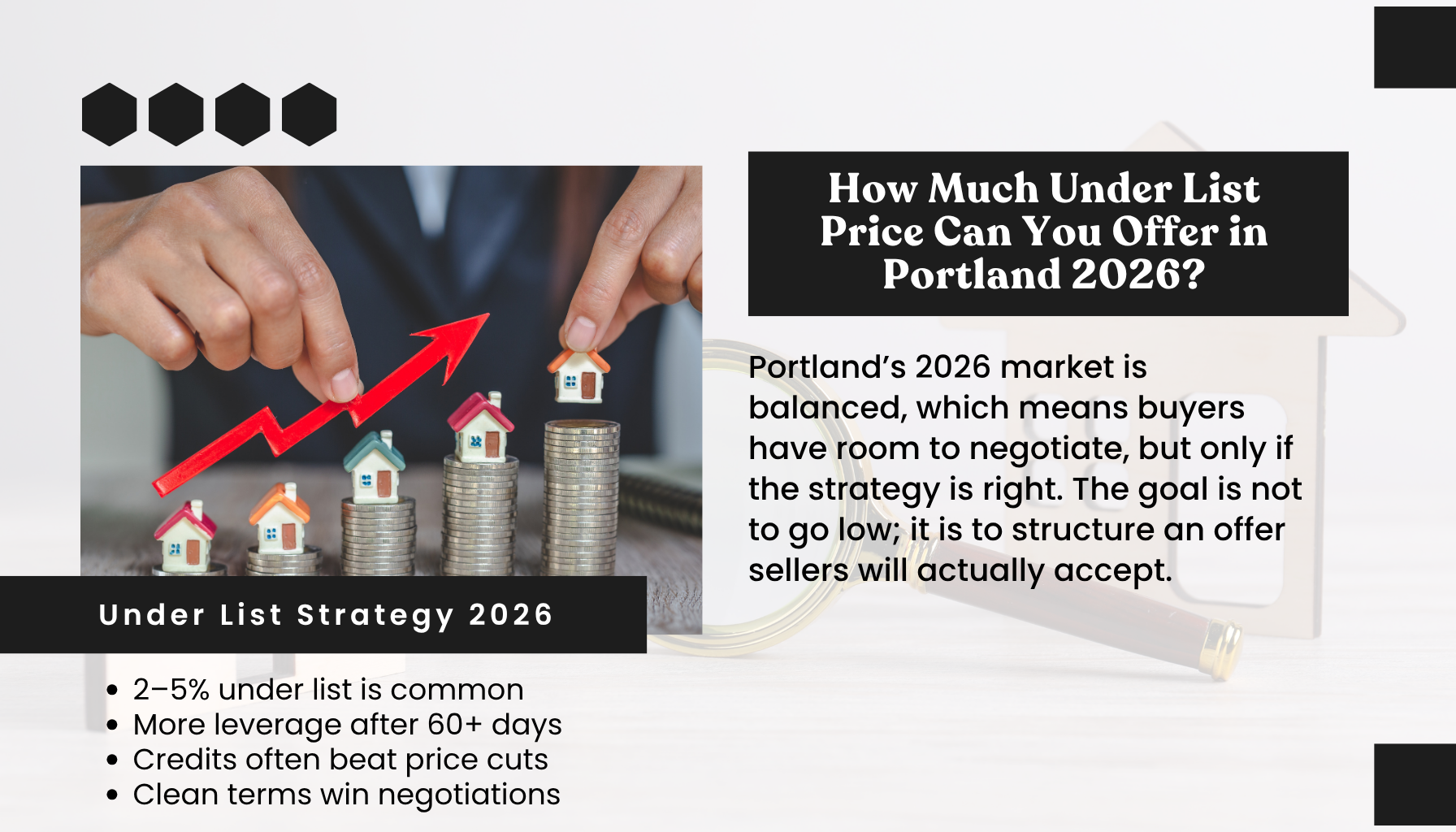
- In today’s balanced market, many buyers succeed offering 2–5 percent under list.
- Bigger discounts are possible on homes 60–75 days on market with price cuts.
- Use inspection credits, rate buydowns, and closing-cost help to boost value.
- Strategy varies by neighborhood, price point, and your financing type and timeline.
What does offering under list price really mean in Portland right now?
In a balanced Portland real estate market, offering under list is a negotiation starting point, not a lowball. The current backdrop is constructive for buyers. Local MLS data for March 2026 shows a median sale price around 524,000 with roughly 4.5 months of inventory and a median days on market near 60. That level of supply typically indicates a market where buyers and sellers have relatively equal footing.
When inventory edges higher and days on market stretch, sellers who overshoot on price often sit longer. Many of those homes reach 75 days on market and begin to accept more negotiation. Local MLS snapshots from early 2026 show roughly one in five active listings taking a price reduction. That is a clear signal that thoughtful under-list offers can work, especially if you bring strong terms and realistic timelines.
Here is how I define it as Lisa Mehlhoff:
- A smart under-list offer is usually 2–5 percent below list with supportive data.
- Your leverage increases when a home is over 60 days on market or has price cuts.
- Values improve most through credits and rate buydowns that lower monthly costs.
How does the current market shape your offer in Portland OR?
The Portland housing market trends point to steadier conditions than the frenzied years. RMLS reports a March 2026 median sale price near 524,000, up about 4.8 percent year over year, paired with approximately 4.5 months of supply. Nationally, NAR considers 4 to 6 months of inventory a balanced environment. In balanced conditions, aggressive waivers are less common, and buyers often keep inspection and financing contingencies while seeking seller-paid credits or modest price reductions.
Rates are still a real factor in affordability. FRED tracking of average 30-year mortgage rates places April 2026 in the roughly 6.25 to 6.5 percent range, with common 5-year ARM starts a bit lower. When payments are tight, negotiating a seller credit to buy down your interest rate can be more valuable than pushing for a deeper price cut. A single point, about 1 percent of the loan amount, often reduces a fixed rate by roughly 0.375 percent for the first two years with certain buydown programs.
What about supply and future builds?
The City of Portland’s 2023–2045 Housing Needs Analysis anticipates about 80,000 additional housing units by 2035. While that is a long runway, steady infill and mixed-use activity in inner neighborhoods can help keep the market from overheating. For your offer, that means you can focus on value, not panic. In many cases, a clean 2–4 percent under-list offer, paired with reasonable timelines and credits for closing costs or rate buydowns, is getting traction.
Where can you negotiate most, and how much near NW Portland?
I work daily around the Northwest District where my office sits near Slabtown and the Alphabet District, and I watch patterns neighborhood by neighborhood. Strategy is hyper-local. Here are two examples close to 2175 NW Raleigh St that show how I guide buyers:
- Northwest District (Nob Hill and Alphabet District)
- Slabtown and the Pearl District
If we step just over the West Hills into Hillside and Arlington Heights, detached homes with longer market times can allow 2–4 percent under list and inspection credits for roof, furnace, or window updates. For commuters eyeing Beaverton and Hillsboro near tech hubs, certain pockets with new-build competition may support 2–3 percent under list or meaningful closing-cost help to compete with builder incentives.
What are the pros and cons of offering under list?
Pros:
- Potential 2–5 percent savings against list, often larger on 60–75 DOM homes.
- Seller credits of 1–3 percent can reduce your rate or cover closing costs.
- More leverage to keep inspection and financing contingencies intact.
Cons:
- Too steep a discount risks alienating sellers and stalling talks.
- In-demand homes under 30 days on market may reject under-list offers outright.
- Appraisals and HOA rules can limit credits or require careful structuring.
How do you structure an offer 2–5 percent under list for best results?
The difference between acceptance and rejection is often structure and tone. I tailor each offer to the seller’s priorities and the data. Start with a realistic range. On homes listed more than 60 days or recently reduced, a 2–5 percent under-list price is viable. On fresh listings in prime blocks of the Northwest District or Pearl, think closer to 0–2 percent under list, then use a 1–3 percent seller credit to achieve a better effective outcome.
Show strength with your financing. A fully underwritten pre-approval carries weight. FHA buyers can compete well at or just under list with solid terms, especially since the FHA loan limit in Multnomah County is 524,225. VA buyers gain leverage with zero down and can request credits for funding fee or rate buydowns, which often helps sellers reconcile a modest under-list price with a win-win net.
One of my clients, a first-time buyer, targeted a Slabtown condo that had been active for 68 days. We opened at 3 percent under list and requested a 2 percent credit for closing costs and a temporary rate buydown. The seller accepted our price and split the credit, and my client’s monthly payment dropped enough to stay within budget.
Another client relocating to Portland to work near OHSU focused on the Alphabet District. The home was 27 days on market with steady showings. We offered 1 percent under list but negotiated a 1.5 percent credit after inspection findings on the furnace and older windows. The seller appreciated the balanced approach and closed on our timeline.
Costs to plan for:
- Inspection: 500 to 700 depending on size and add-ons like sewer scope.
- Appraisal: 700 to 900 for most loan types.
- Closing costs: often 2 to 3 percent of the purchase price.
- HOA fees in condo buildings: commonly 300 to 700 monthly, higher in amenity-rich towers.
- Rate buydown: about 1 percent of loan amount per discount point, often reducing rate around 0.375 percent for certain buydown structures.
FAQs
1) How much under list can I offer without offending the seller? In today’s balanced Portland real estate market, 2–5 percent under list is typically seen as reasonable on homes with 45–75 days on market or recent price reductions. For newly listed, well-priced homes under 30 days, start closer to 0–2 percent under list. Pair a fair price with clean terms, a strong pre-approval, and specific credits that help your monthly payment instead of just chasing a deeper discount.
2) Is a price cut or a seller credit better for my bottom line? A credit often delivers greater real-world savings because it can fund a rate buydown or cover closing costs. With average 30-year rates around the mid-6s, lowering your rate can outweigh a slightly deeper price reduction. Still, every property and loan scenario differs. I will model both paths so you can see payment and cash-to-close impacts before deciding how to structure your ask.
3) Should I waive contingencies to get an under-list deal accepted? In a balanced environment, you rarely need to waive key protections. Keep financing and inspection contingencies. Focus on clean timelines, reasonable repair thresholds, and a thoughtful credit request. Sellers appreciate certainty. If a home has been listed for more than 60 days, they often prefer a sure path to closing over squeezing out the last dollar, especially if you present verified funds and lender underwriting.
4) How long should I wait before going in lower on price? Timing matters. Once a listing crosses 45–60 days on market, your leverage typically improves, especially if the seller has already completed a price reduction. I monitor listing histories, showing activity, and any failed negotiations to guide your entry point. If you love a home at day 10, we adjust tactics and use credits or flexible closing to bridge the gap without overpaying.
5) How do current mortgage rates change the best offer strategy? With rates around 6.25 to 6.5 percent, payment sensitivity is high. A 1–2 percent seller credit can often reduce your rate with a buydown, creating a bigger monthly savings than a comparable price cut. We will also explore 5-year ARM options if your time horizon is shorter. I align financing tools with your plan so the final payment fits, even if the list price is firm.
6) Can VA or FHA buyers win while offering under list? Yes. VA and FHA buyers are winning when they present strong pre-approvals and clean terms. FHA buyers leveraging the 524,225 limit in Multnomah County can negotiate modestly under list or capture credits to offset cash to close. VA buyers often secure seller-paid costs or a buydown because zero down is not a weakness here. Clear communication and certainty of closing are what matter most to sellers.
Conclusion
The bottom line Today’s Portland housing market trends favor thoughtful negotiation, not bidding wars. Most buyers succeed by offering 2–5 percent under list on homes with 45–75 days on market or recent price cuts, while newer, well-priced listings call for closer-to-list offers with smart credits. Pair your price with strong financing, realistic timelines, and data from RMLS so sellers see your offer as the fastest path to a sure closing. If you are evaluating Portland homes for sale near the Northwest District, Slabtown, or the Pearl, I will tailor a strategy that protects your budget and wins the home.
Lisa Mehlhof Homes | License #220603251 Call or text 503-490-4888 https://lisamehlhoffhomes-
Categories
Recent Posts








"My job is to find and attract mastery-based agents to the office, protect the culture, and make sure everyone is happy! "