Should You Keep It as a Rental or Sell It? A 2026 Guide for Portland Owners
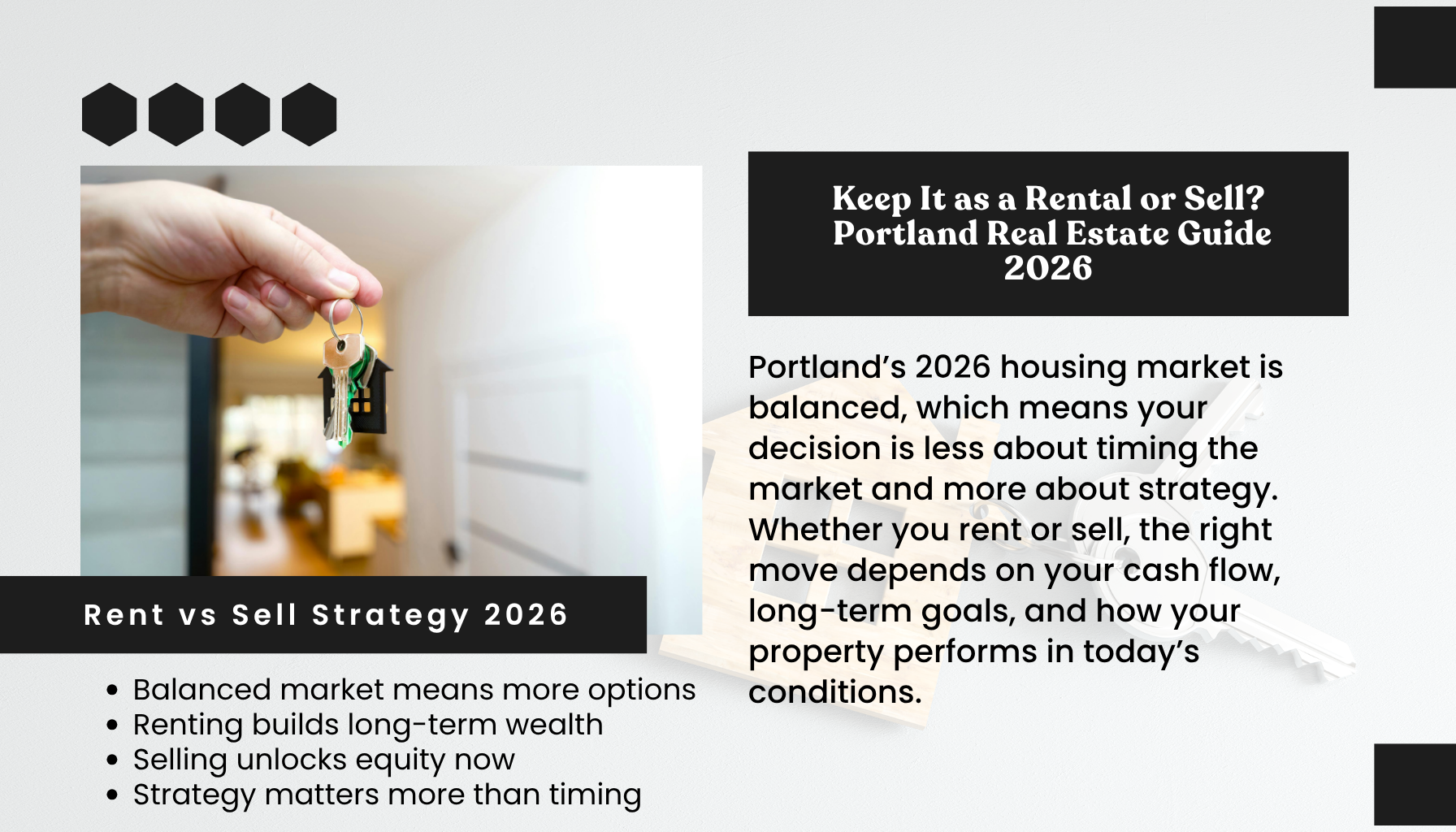
TLDR
- Portland’s balanced market favors strategy, not guesswork, for renting or selling today.
- Median sale price near $524K with ~4.5 months supply supports realistic pricing.
- If cash flow is thin, credits or a 1031 exchange may beat a hold.
- Neighborhood, timeline, and tax strategy often matter more than headline price.
What does “keep it as a rental or sell it” really mean?
You are choosing between two investment paths with different timelines, risks, and returns. Selling can maximize today’s equity, simplify your life, and reset your portfolio. Keeping a home as a rental can build long-term wealth through appreciation, debt paydown, and tax advantages, even if cash flow is modest at first.
In the current Portland real estate market, conditions are balanced. Recent RMLS Market Action reports show a median sale price around $524,000 in March 2026, inventory at roughly 4.5 months of supply, and a median days on market near 60. That means pricing, presentation, and negotiation strategy carry more weight than in ultra-competitive years. Buyers are asking for credits and, on slower or overpriced listings, negotiating aggressively. Owners who keep properties as rentals are seeing relatively stable tenant demand, yet make-ready costs and management expenses must be planned up front.
Here is how I define it as Lisa Mehlhoff:
- Selling is best when net proceeds, speed, or lifestyle simplicity outweigh potential future gains.
- Renting is best when long-term return, tax strategy, and tenant demand offset short-term cash flow.
- A hybrid can work: rent for a set horizon, then sell via a strategic refresh and targeted timeline.
How does today’s market shape the decision for Portland owners?
Portland housing market trends reflect a true equilibrium. Based on recent RMLS data, inventory has eased from prior tight years to about 4.5 months, and the median days on market hovers near 60. Well-priced homes can still move within 30 to 45 days, while listings that overshoot the market see 70-plus days and face increased buyer leverage. About one in five sellers are using price reductions or credits, which is consistent with a market that rewards precise pricing and negotiation.
Nationally, the FHFA House Price Index and S&P CoreLogic Case-Shiller continue to show steady, mid-single-digit appreciation across many metros. Portland is tracking in line with that broader backdrop, though micro-markets vary by neighborhood and condition. The City of Portland’s 2023–2045 Housing Needs Analysis also anticipates continued infill and mixed-use development, with plans indicating tens of thousands of additional units by 2035. More supply over time tends to moderate price spikes, so a hold strategy should assume a long horizon and disciplined operations, not a quick cash-flow windfall.
What do the numbers look like side by side?
Consider a hypothetical Portland home worth $524,000. If you sell, your net depends on mortgage payoff, 5–7% total selling costs, and any credits. If you rent for $2,000 per month, plan for:
- Vacancy and repairs: 10% combined
- Property management: 8–10% if outsourced
- Property tax and insurance: commonly $5,000–$7,000 annually, home dependent
- Mortgage at 6.25–6.5% for a new investor loan, if refinanced or leveraged
Many owners see thin near-term cash flow but benefit from principal paydown, depreciation, and potential appreciation. A detailed pro forma is essential.
Which neighborhoods near NW Portland make the most sense to rent or sell?
Near my office at 2175 NW Raleigh St, owners often weigh different strategies by neighborhood profile and tenant demand. The Northwest District and Nob Hill offer classic Portland charm, strong walkability, and consistent interest from relocating professionals who want close-in amenities. The Pearl District attracts tech professionals and medical staff who want modern spaces near streetcar lines and OHSU connections. Goose Hollow appeals to commuters who value MAX access and proximity to downtown while keeping a more residential vibe.
- Northwest District and Nob Hill
- Pearl District
I also keep eyes on Slabtown, which combines newer multifamily options with neighborhood character, and Hillside or Forest Park for owners considering longer leases in quieter settings. Commutes via MAX and streetcar help broaden the renter pool across these close-in neighborhoods.
What are the pros and cons of renting versus selling in 2026?
Pros:
- Renting: Long-term appreciation, principal paydown, depreciation benefits, and inflation hedge.
- Selling: Immediate liquidity, simplified finances, and ability to redeploy capital or 1031 exchange.
- Market-fit: Balanced conditions mean you can negotiate credits as a seller or lock a quality tenant.
Cons:
- Renting: Thin early cash flow, turnover costs, regulatory compliance, and maintenance uncertainty.
- Selling: Potential capital gains or depreciation recapture, cost of sale, and loss of future upside.
How do I build a step-by-step plan, and what costs should I expect?
Start by quantifying net proceeds if you sell versus a 5-year rental pro forma. If you are considering keeping it, gather make-ready bids and confirm landlord requirements. Portland requires rental registration and business licensing, and Oregon’s landlord-tenant law governs rent-increase notices and lease terms. Your CPA should model capital gains exposure, depreciation recapture at up to 25%, and whether a 1031 exchange or capital gains exclusion applies. If you lived in the home two out of the last five years, the federal exclusion can shield up to $250,000 for single filers or $500,000 for married filing jointly, subject to IRS rules.
Common local cost ranges:
- Paint and light cosmetic refresh: $3,000 to $6,000
- Flooring replacement: $4 to $7 per square foot
- Deep cleaning and landscaping: $300 to $1,200
- Appliance package: $1,500 to $3,500
- Property management: 8% to 10% monthly, plus possible lease-up fee
- Selling prep for market: $2,000 to $8,000 for targeted updates and staging
One of my clients in Goose Hollow had a condo with dated lighting and scuffed floors. A $4,200 refresh and professional marketing drew multiple qualified renters in three weeks. The first-year cash flow was slim, but with depreciation and low turnover risk, they expect a 6–7% total return including paydown and projected appreciation.
One of my clients near Slabtown planned to rent but pivoted after we priced out updates and HOA impacts. We listed strategically at market, offered a 2% seller credit to buy down the buyer’s rate, and secured a solid offer within 35 days. Their net proceeds allowed a larger down payment on a Westside home and reduced monthly costs, which aligned better with their family goals.
FAQs
1) How do Portland housing market trends affect my rent-versus-sell math? Balanced conditions, about 4.5 months of supply and median 60 days on market per recent RMLS reporting, mean you can time and price thoughtfully. As a seller, strong presentation plus credits can move the needle. As a landlord, tenant demand is steady near transit and job centers. Your rent-versus-sell decision should reflect this middle-ground environment, not extremes from earlier boom years.
2) What cap rate should I target for a close-in Portland rental? For well-located properties near NW Portland, cap rates are often modest compared to suburban assets. A 4–5% cap rate on stabilized numbers can be acceptable when paired with long-term appreciation and low vacancy risk. If you need 6% or higher, you may look at townhomes or small multis further east or north. Model several scenarios, including HOA, management, and realistic vacancy.
3) Are seller credits and buydowns still common in 2026? Yes. With a median days on market near 60, buyers often request 1–3% credits. A temporary buydown or rate-costing credit can expand your buyer pool and shorten time to close. This is especially helpful for listings above $600,000 or those that have been on market more than 45 days. Work with your lender partner to price options that maximize buyer affordability without overspending.
4) Should I sell vacant or tenant-occupied? If the tenant’s lease is near expiration, vacant can simplify showings and improve presentation. If the tenant is cooperative and the home shows well, keeping them can preserve cash flow during marketing. Portland has tenant protection rules and notice requirements, so coordinate timing carefully. In many cases, listing just after move-out and a two-week refresh produces the best price and fastest sale.
5) How do taxes differ if I sell versus rent? Selling may trigger capital gains at federal and state levels, unless you qualify for the primary residence exclusion. Renting lets you use depreciation to reduce taxable income, but depreciation is typically recaptured upon sale, often at up to 25%. A 1031 exchange can defer taxes if you reinvest in like-kind property. Work closely with a CPA who understands Oregon tax considerations and federal rules.
6) Can I rent for a year, then move back in and claim the full exclusion later? Potentially, but it depends on time lived in the home and your recent use. The IRS primary residence exclusion typically requires you to own and occupy the home as a primary residence for two of the last five years before sale. Partial exclusions can apply in limited circumstances. If you convert to a rental, track use periods carefully, and confirm with your CPA before making assumptions.
7) How do interest rates factor into my decision in 2026? Average 30-year fixed rates have hovered around the mid-6% range this spring. As a seller, this environment supports offering credits to improve buyer affordability. As a landlord, higher rates can reduce cash flow on new loans, so many owners keep existing financing or delay cash-out refinances. If you expect rates to moderate, a short rental hold followed by a sale or 1031 can be strategic.
Conclusion
The bottom line Whether you keep your Portland property as a rental or sell it in 2026 comes down to numbers, timing, and life goals. The Portland real estate market is balanced, with measured appreciation and steady tenant demand in close-in neighborhoods like the Northwest District, Slabtown, Goose Hollow, and the Pearl. If your pro forma delivers thin cash flow, targeted updates plus a strategic sale may maximize today’s equity. If your horizon is longer and your operations are dialed in, a rental can build meaningful wealth over time. I can help you model both paths and choose confidently.
Lisa Mehlhof Homes | License #220603251 Call or text 503-490-4888 https://lisamehlhoffhomes-
Categories
Recent Posts






"My job is to find and attract mastery-based agents to the office, protect the culture, and make sure everyone is happy! "