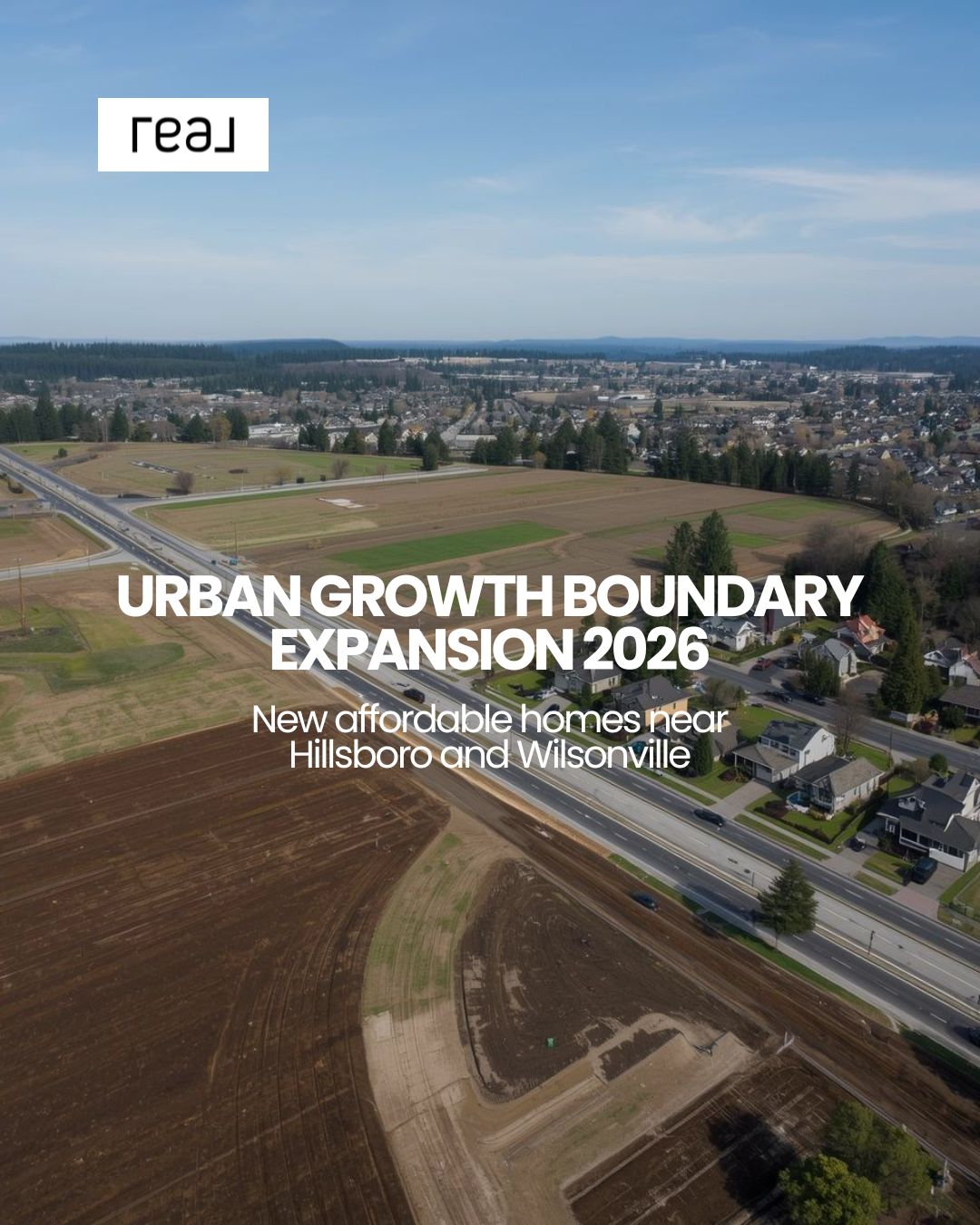
Is the Urban Growth Boundary expanding in 2026, and will that open up any new affordable inventory in areas like Hillsboro or Wilsonville?
TLDR
- Metro is reviewing a 2026 Urban Growth Boundary expansion that adds 5,500 acres.
- Early homes could deliver by 2027–2029, with starter pricing targeted sub 450k.
- Hillsboro and Wilsonville edges are prime candidates for new fee‑simple lots.
- Buyers should prepare financing and incentives now to capture first-release phases.
What does the Urban Growth Boundary really mean?
The Urban Growth Boundary, or UGB, is the line that determines where the Portland region can grow with urban services like sewers, roads, schools, and parks. Metro, our regional government, maintains and periodically reviews this boundary to ensure a 20‑year supply of buildable land for housing and jobs. When the UGB expands, it typically allows cities and service districts to extend infrastructure, then developers can entitle sites, create lots, and build homes.
The 2025–2026 review is important because our region’s supply has been tight. According to recent RMLS market data, the Portland metro posted 1.5 months of inventory in Q3 2025, then moved toward balance, hitting roughly 5.1 months by late fall, while the median sale price hovered near 581,000 as of October 2025. Those figures confirm demand remains strong, and affordability is still top of mind for first‑time buyers and relocators alike.
Here is how I define it as Lisa Mehlhoff:
- A planning tool that times growth with infrastructure, not a switch that creates instant homes.
- A policy lever to add capacity near jobs, transit, and schools, which influences pricing.
- A framework buyers can use to target emerging neighborhoods before wider demand arrives.
How does the 2026 UGB review work, and what is actually proposed?
Metro’s staff and Council evaluate population forecasts, housing needs by type, employment land supply, and infrastructure readiness. The working concept under discussion proposes adding about 5,500 acres, concentrated along the southern edge of Hillsboro and selected areas around Wilsonville. If adopted in early 2026, the region anticipates approximately 1,800 new lots by 2028, with an initial mix of 1,200 single‑family and 600 multifamily or attached opportunities. Target entry pricing discussed for some Hillsboro and Wilsonville subareas is 350,000 to 450,000 where infrastructure and land costs support it. Buyers should treat those numbers as directional, not guarantees, since fees and construction inputs vary (Metro urban growth boundary info).
On the city side, Portland has already broadened what can be built on existing lots through its Residential Infill Project. Phase II, effective in 2025, allows up to four fee‑simple rowhouses on many R2.5 lots using the Middle Housing Land Division guide, which can deliver lower‑maintenance homes without HOA fees in some cases. This complements the UGB strategy by supplying more types of homes near jobs and transit, right now inside the boundary.
What does this mean for affordability in practice?
Affordability hinges on three pieces. First, land supply. An expanded UGB adds sites that can be engineered into lots, which tempers land price pressure. Second, infrastructure timing. The sooner roads and utilities are funded, the sooner builders can deliver at scale. Third, product mix. Allowing small‑lot detached, fee‑simple townhomes, and cottage clusters brings more price points. In my daily work as a Portland Oregon real estate agent, I see entry pricing stabilize fastest where all three align.
Which neighborhoods near Hillsboro and Wilsonville are likely to benefit first?
The west‑side focus near Hillsboro and the south‑side focus around Wilsonville are the two most immediate beneficiaries, based on Metro’s preliminary direction. Each subarea has different infrastructure realities, which affects timing and achievable price points.
- South Hillsboro fringe, including Reedville and Witch Hazel
- Wilsonville’s Frog Pond area, extending toward Villebois edges
While this article centers on Hillsboro and Wilsonville, I also advise clients who compare these new‑build options with SW Portland Oregon homes for sale in places like Multnomah Village and Hillsdale, or with East Vancouver Washington real estate, where commute times via I‑205 have improved after recent corridor work by ODOT.
What are the pros and cons of expanding the UGB for buyers?
Pros:
- More buildable land that can translate into lower land costs per lot, improving entry pricing.
- Greater product variety, including fee‑simple townhomes and cottage clusters that reduce HOA dependence.
- Opportunities to buy early phases with incentives, rate buydowns, and closing cost credits.
Cons:
- Delivery lags. Even with approval in 2026, many first homes arrive 2027–2029.
- Upfront fees and infrastructure costs can limit how low prices go in the earliest releases.
- New areas may lack mature tree canopy, full transit service, or neighborhood retail in phase one.
How do I position myself to capture the first wave of new, more affordable inventory?
Start with data, lender readiness, and an eyes‑wide‑open plan for timelines. Recent RMLS statistics show our region climbed to about 5.1 months of supply in late 2025, a more balanced backdrop that often yields measured pricing and builder incentives. Meanwhile, the Portland‑Vancouver median hovered near 581,000 as of October. If UGB additions unlock 350,000 to 450,000 options in select subareas of Hillsboro and Wilsonville, they will be competitive out of the gate.
For financing, first‑time buyers should explore the Oregon Bond Residential Loan Program for below‑market rates and down payment assistance, subject to income and purchase limits. Military families purchasing near Clark County or commuting to the west side can consider VA loans with zero down where eligibility applies. Doctors relocating with jumbo needs will find special programs with reduced reserves or student‑loan flexibility. I help align these tools with actual release timelines so your approvals stay fresh.
One of my clients, a software engineer moving from Austin, compared a townhome inside SW Portland with a not‑yet‑released phase in South Hillsboro. We mapped financing against a 9‑month build window and secured a long‑lock with a float‑down. The builder later offered a closing credit plus a 2‑1 buydown, which we stacked with the lender’s incentive. Another client, a nurse practitioner relocating to work near Wilsonville, targeted Frog Pond. We built in a 10,000 allowance for window coverings, fencing, and washer‑dryer, negotiated as closing credits so her cash at closing stayed manageable.
If you are considering East Vancouver or north Clark County as a comparison, I regularly advise on Cedars East Vancouver WA real estate, and Battle Ground and Brush Prairie WA homes for sale. Some buyers prefer existing neighborhoods there while they wait for new UGB‑area opportunities to open on the Oregon side. Clark County’s development office maintains clear permit timelines and fee schedules that help with budgeting across the river (Clark County Community Development).
FAQs
1) When will the 2026 UGB decision translate into actual homes I can buy? After Metro adopts boundary changes, cities must annex, zone, and extend infrastructure. Developers then entitle and finish lots before vertical construction begins. In strong pipeline areas like south Hillsboro and Frog Pond, first closings could occur between late 2027 and 2029. Timelines vary with utility extensions, school capacity, and market conditions, so plan for 18–36 months from final approval to move‑in.
2) Will homes priced 350,000 to 450,000 really be available? Target price bands discussed for specific subareas depend on land costs, infrastructure fees, and product type. Fee‑simple townhomes and small‑lot detached have the best shot at those numbers. Expect limited counts in initial releases, with more availability as infrastructure amortizes across later phases. Incentives like rate buydowns and closing credits can also improve effective affordability even if the base price is higher.
3) How do national trends affect local affordability in 2026–2027? Nationally, home prices have continued to appreciate, though at moderating rates per the FHFA House Price Index. Builders are using incentives to maintain absorption as rates fluctuate. Locally, our shift toward a more balanced 5‑month supply gives buyers leverage. If the UGB expands, the additional land pipeline could help stabilize west‑side pricing over the next several years.
4) What if I prefer SW Portland Oregon homes for sale over new‑build suburbs? You can pursue fee‑simple rowhouses or cottage clusters enabled by Portland’s Residential Infill rules. These often deliver sooner than greenfield sites and keep you close to established amenities in neighborhoods like Multnomah Village and Hillsdale. Expect prices to reflect proximity and character, but smaller footprints and energy efficiency can offset monthly costs. I regularly evaluate both paths side by side.
5) How do property taxes work on new construction compared to older homes? Oregon reassesses property upon sale or completion, then limits annual assessed value growth. New homes in expansion areas will receive a fresh assessment based on market value, which can differ from a neighbor’s long‑held home. I prepare a five‑year tax projection with your lender so your payment planning is conservative. Check local assessor guidelines for roll‑in timing of improvements and supplemental bills.
6) Will infrastructure keep pace with growth, especially for commuting? Infrastructure is a gating factor and a top priority. Metro requires planning for roads, utilities, schools, and parks as part of UGB decisions. ODOT continues corridor work that has shortened some commute segments, and local cities coordinate school capacity. Early phases may experience construction traffic and incremental transit service. I advise clients to model commute times by time of day and to verify planned improvements with each city.
7) I am relocating with a tech or medical job. What is the best approach? For tech professionals, validate fiber availability and home‑office space standards. For physicians, explore jumbo programs with favorable terms for high‑income earners, plus neighborhoods that offer quiet streets and quick hospital access. I coordinate virtual tours, inspection oversight, and remote closings, which is common for relocations. We also compare Oregon new‑build options with East Vancouver Washington real estate to balance commute, schools, and timeline.
Conclusion
The bottom line The 2026 Urban Growth Boundary review is poised to add about 5,500 acres, with Hillsboro and Wilsonville at the forefront. That expansion, paired with Portland’s infill tools, should deliver more variety and potentially more affordable price points, particularly fee‑simple townhomes and compact detached homes. Expect earliest closings in 2027–2029, and be ready to act quickly on first releases that target 350,000 to 450,000. If you want a head start, we can align financing, incentives, and neighborhood scouting now, and compare against immediate options in SW Portland, Cedars, Brush Prairie, and Battle Ground so you can move with confidence when phases open.
Lisa Mehlhof Homes | License #220603251 Call or text 503-490-4888 https://lisamehlhoffhomes-
Categories
Recent Posts








"My job is to find and attract mastery-based agents to the office, protect the culture, and make sure everyone is happy! "