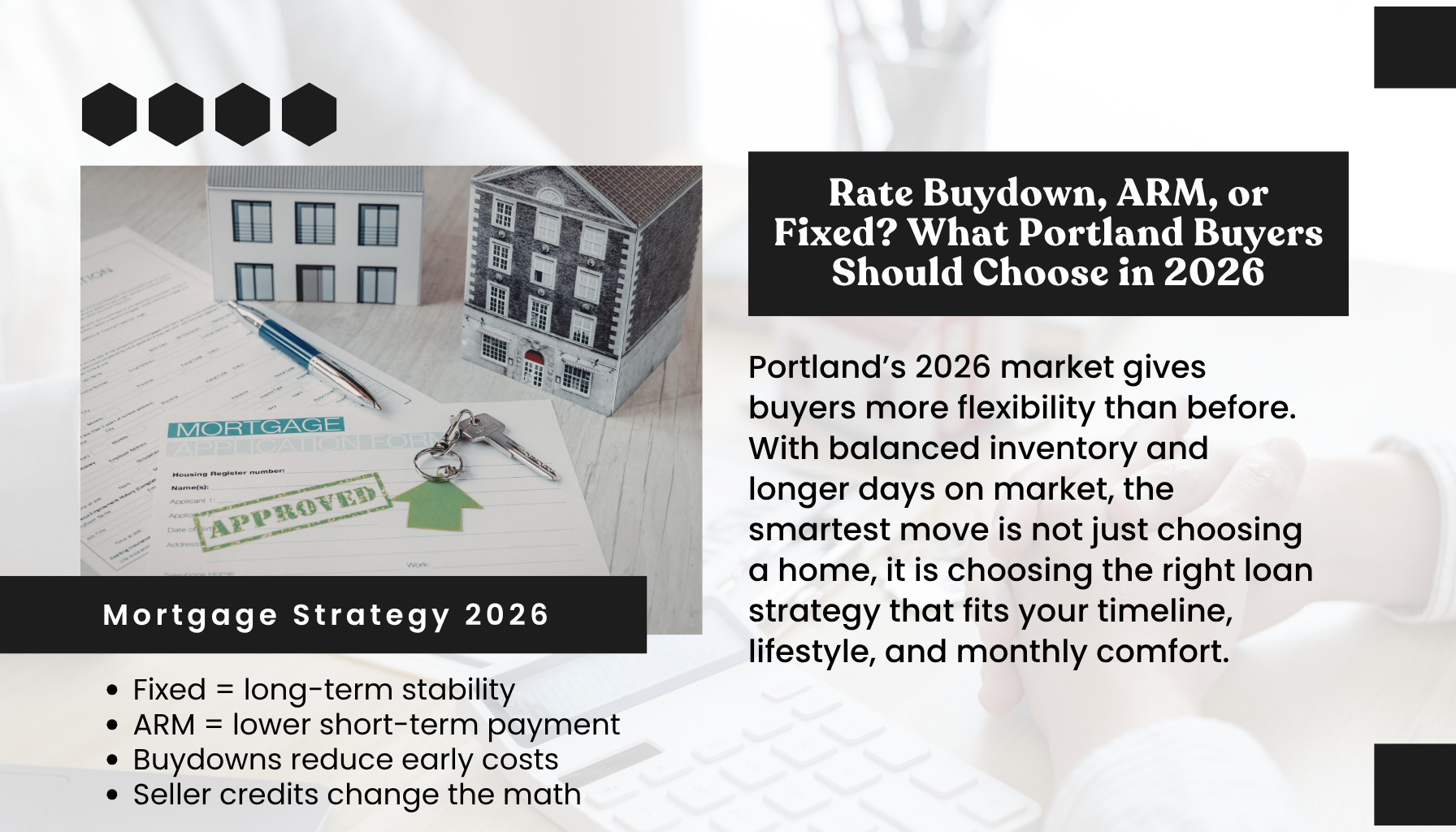
Should I use a rate buydown, adjustable‑rate mortgage, or just stick with a 30‑year fixed?
TLDR
- Fixed loans win for stability if you plan to own seven years or longer.
- ARMs fit shorter horizons or future relocations, but test worst‑case adjustments.
- Rate buydowns shine when funded by seller credits in today’s balanced market.
- Portland housing market trends support negotiating credits with 4.5 months’ supply.
What do these options really mean for Portland buyers?
In a balanced Portland real estate market, your mortgage choice can save or cost thousands over the next few years. RMLS data for March 2026 shows a metro median sale price near $524,000, up about 4.8% year over year, with roughly 4.5 months of supply and a median 60 days on market. That added breathing room means more room to negotiate price, repairs, or credits that can fund a rate buydown.
A 30‑year fixed gives a predictable principal and interest payment for the full term. A 5/1 ARM typically fixes for five years, then adjusts annually based on an index plus a margin. A rate buydown reduces your rate in one of two ways. A permanent buydown trades points paid upfront for a smaller, lasting rate drop. A temporary buydown, like a 2‑1 or 1‑0, lowers your payment for one to two years, then steps up to the full rate. In April 2026, average 30‑year fixed rates are hovering around 6.25% to 6.5% according to Freddie Mac PMMS. Local lender sheets often show 5/1 ARMs with lower initial rates.
Here is how I define it as Lisa Mehlhoff:
- Fixed rate: choose this if stability and easy budgeting outweigh small near‑term savings.
- ARM: best when your ownership horizon is shorter than the fixed period.
- Rate buydown: ideal when a seller credit funds the points in today’s balanced conditions.
How do today’s rates and payments compare in the Portland real estate market?
Let’s compare payments using a common Portland purchase scenario. Assume a $600,000 condo or townhome near NW District with 10% down and a $540,000 loan. At 6.5% on a 30‑year fixed, principal and interest are about $3,410 per month. A 5/1 ARM starting at 5.75% would be near $3,155, a savings around $255 per month during the fixed period. If a permanent buydown lowers the fixed rate from 6.5% to roughly 6.125% by paying one point, payment drops to about $3,340, saving around $70 per month.
Now layer in Portland housing market trends. With about 4.5 months of supply and 60 to 75 days on market for many listings, buyers often secure credits rather than paying list price. In my recent transactions, seller credits of 1% to 3% have been common. That can fund temporary buydowns or cover closing costs without increasing your cash outlay. When sellers price aggressively or homes linger, credits are easier to win. According to local MLS and Portland Metro Association of Realtors updates, price reductions have become more frequent early in 2026, reinforcing this strategy.
What about points and seller credits?
One discount point generally costs 1% of the loan amount. A permanent buydown can reduce your rate by about 0.25% per point, although pricing varies daily. A temporary 2‑1 buydown cuts the rate by 2% in year one and 1% in year two, then reverts to the full rate. If a seller funds the buydown via credit, you preserve cash and enjoy near‑term savings while you watch rates for a possible refinance. If you pay points yourself, compare the breakeven months against your likely time in the home.
Which option is best for your lifestyle and neighborhood near NW Portland?
If you are searching for Portland homes for sale near my office at 2175 NW Raleigh St, your daily rhythm matters. Tech professionals commuting to the Pearl or to Hillsboro might value lower ARM payments today if they plan to upsize in three to five years. Doctors relocating to OHSU or Legacy often prefer fixed rates for predictability, especially when moving into school‑oriented neighborhoods. First‑time buyers watching every dollar might pair a seller credit with a temporary buydown while leaning on down‑payment help from Oregon Housing and Community Services. For VA‑eligible military families, a VA loan plus a seller‑funded buydown can be a powerful combo.
- Northwest District and Slabtown
- Pearl District
Across these neighborhoods, a balanced market gives you leverage. RMLS March 2026 figures align with a more negotiable environment. City of Portland’s Housing Needs Analysis also anticipates significant new housing over the next decade, which supports more options and could moderate price pressure over time.
What are the pros and cons of fixed, ARM, and rate buydown?
Pros:
- 30‑year fixed: Predictable payments, easier budgeting, protects against future rate increases.
- 5/1 ARM: Lower initial rate and payment, useful for short ownership horizons.
- Rate buydown: Meaningful early payment relief if funded by seller credit in a balanced market.
Cons:
- 30‑year fixed: Higher initial payment compared to ARM, fewer near‑term savings.
- 5/1 ARM: Adjustment risk after year five, payment can rise if rates are higher.
- Rate buydown: If buyer pays points, breakeven may take years, limited benefit if you sell early.
How do you decide and execute in Portland OR?
Start with your timeline. If you plan to keep the home seven to ten years, a 30‑year fixed is usually the safest call. If you expect a job transfer or plan to upsize within five years, a 5/1 ARM can free cash flow for renovations or daycare. In today’s Portland housing market trends, I often negotiate seller credits that cover a temporary buydown or closing costs, which protects your savings and eases the first years of ownership.
Budget your closing costs. Typical buyer closing costs run 2% to 3% of the purchase price. That can include lender origination of 0.5% to 1%, appraisal near $700 to $900, underwriting and processing, title insurance, escrow, prepaid taxes and insurance, and HOA move‑in fees for condos. If you use points, add 1% per point. For FHA borrowers, note the 2026 FHA loan limit in Multnomah County is about $524,225 according to HUD. Oregon Housing and Community Services programs can assist with down payment and sometimes closing costs.
One of my clients, a software engineer buying in Slabtown, chose a 5/1 ARM at 5.75% with a seller‑funded 1‑0 buydown that shaved the first‑year payment further. He plans to transfer to a Seattle office in four years, so the lower payment fit perfectly. Another client, a physician joining OHSU, selected a physician loan with a 30‑year fixed near 6.25%. The predictability mattered more than the short‑term savings because her family plans to stay in the Northwest District long term.
Typical timeline from accepted offer to closing is 30 to 45 days. If you are highly organized with underwriting documents, 21 to 28 days is possible. Pre‑approval before home shopping is essential, especially for condos in the Pearl or Goose Hollow where HOA documentation review can add a week. I coordinate lender, HOA, and escrow milestones so your rate lock and credits are secured on time.
FAQs
1) Are ARMs risky in Portland if I buy now and refinance later? ARMs carry adjustment risk, so you must plan for the worst‑case cap. If you choose a 5/1 ARM, ensure your budget can handle the maximum allowed increase after year five. Refinancing is not guaranteed. If rates fall, great. If they do not, your payment could rise. Pick an ARM only if your expected move or refinance timeline is shorter than the fixed period.
2) Are seller‑paid 2‑1 buydowns still common in 2026? Yes, especially for listings that sit 45 to 75 days. In a balanced market, I often secure 1% to 3% in seller credits that can fund a temporary buydown. This is attractive for first‑time buyers and relocators who want breathing room the first two years. Always verify that the lender and loan type permit temporary buydowns and confirm the exact payment schedule.
3) How do I compare paying points versus asking for a price reduction? Run the numbers two ways. Points reduce payments but require upfront cash. A price reduction lowers your loan amount, which reduces payment and interest for the life of the loan. If the seller is willing to credit funds, a temporary buydown can ease year one and two while you watch rates. I calculate breakeven months and long‑term interest savings for each option before we write the offer.
4) What is best for doctors or tech professionals who might move in five years? If your horizon is around five years, a 5/1 ARM often makes sense. You enjoy a lower payment while your income grows, then sell or refinance before adjustment. If you want certainty, a 30‑year fixed remains a solid choice. Some physician and professional programs offer reduced down payments and flexible underwriting, which can keep fixed rates competitive.
5) What should first‑time buyers know about FHA, VA, and buydowns? FHA helps with lower down payments and flexible credit. In Multnomah County, the 2026 FHA limit is about $524,225 according to HUD. VA loans offer zero down for eligible military families and often have favorable rates and fees. Combine these with seller‑funded temporary buydowns to lower early payments. Always confirm that the condo or attached home is approved for FHA or VA if buying in the Pearl or Goose Hollow.
Conclusion
The bottom line Your best mortgage choice depends on your time horizon, cash on hand, and the leverage we can create in negotiations. In today’s Portland real estate market, with about 4.5 months of supply and a median 60 days on market, I often secure seller credits that make temporary buydowns very attractive. If you plan to own seven to ten years or longer, a 30‑year fixed usually wins. If your horizon is under five years, a well‑structured ARM can optimize cash flow. I will model each path using current rate sheets, RMLS data, and your goals so you buy confidently.
Lisa Mehlhof Homes | License #220603251 Call or text 503-490-4888 https://lisamehlhoffhomes-
Categories
Recent Posts








"My job is to find and attract mastery-based agents to the office, protect the culture, and make sure everyone is happy! "