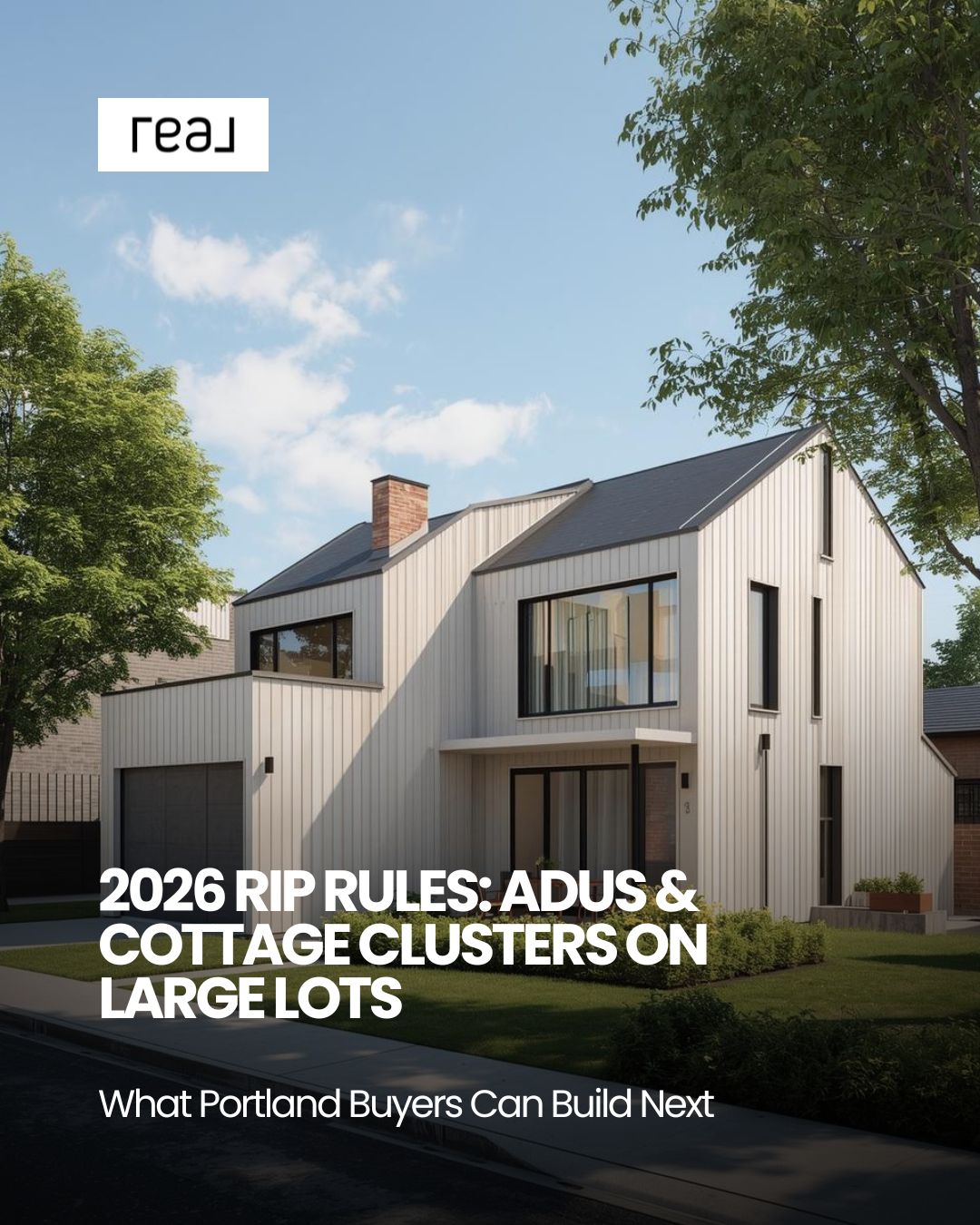
If I buy a home with a large lot, what are the new 2026 possibilities for adding a detached ADU or cottage cluster under the Residential Infill Project (RIP) rules?
TLDR
- RIP 2026 allows up to four homes by-right, six with affordable units.
- Detached ADUs up to 800 square feet fit many SW Portland lot patterns.
- Cottage clusters unlock gentle density, often two to four compact homes.
- Permits, utilities, and trees drive timelines and costs; plan early.
What do the 2026 RIP rules really allow on large lots?
Portland’s Residential Infill Project aims to create more homes within existing neighborhoods while keeping neighborhood scale in mind. The 2026 Title 33 amendments expand what you can build on most residential lots. If you buy a home on a large lot in places like Multnomah Village, Hillsdale, or Arnold Creek, you can often add a detached ADU or even plan a small cottage cluster with multiple homes.
By-right, most standard residential lots can host up to four homes total. Where at least half the homes are income-restricted below market, the cap can rise to six. Detached ADUs remain allowed and, under the 2026 update, are typically limited to up to 800 square feet with height, setback, and design standards tailored to neighborhood context. On qualifying sites, a cottage cluster can place a handful of small detached homes around shared open space.
For official rule text and updates, review the city’s RIP hub at the Portland Bureau of Planning and Sustainability and the Zoning Code Title 33.
Here is how I define it as Lisa Mehlhoff:
- Think in “homes per lot,” not just “one house plus a studio.”
- Detached ADU works for rental, aging parents, or a flex office suite.
- Cottage clusters deliver two to four modest homes with shared green.
How will permitting, zoning, and utilities work in Portland?
Every site starts with zoning and overlays. In SW Portland, environmental and tree overlays commonly apply, particularly in Arnold Creek, Ashcreek, and Far Southwest. Those overlays shape where a detached ADU or cottages can sit and how you manage tree preservation. Early conversations with a designer and the city’s planners will save months.
Permitting steps include a site plan, utility review, and sometimes a middle housing land division if you plan to separately own cottages. Detached ADUs often go through standard residential permits. Cottage clusters typically require land use review, civil engineering for shared services, and recorded access and maintenance agreements. Expect 8 to 16 weeks for straightforward ADU permits and 4 to 8 months for cluster entitlements, depending on overlays and utilities. Start with the city’s Bureau of Development Services ADU guide and explore middle housing materials via the RIP page.
System development charges, sewer capacity, and water meters matter. Some projects need a new lateral or upsized service. Review SDC information through the city’s system development charges resources. Tree rules can shape your building footprint and driveway placement; see Urban Forestry guidance.
What about financing and today’s market conditions?
As a Portland Oregon real estate agent, I am guiding buyers through a market with stable pricing and moderate inventory. Recent MLS summaries show a Portland median sale price around $511,000, roughly flat year over year, with homes averaging about 27 days on market and about two offers per home. Months of supply has hovered near the mid twos, which is neither a deep buyer’s market nor a runaway seller’s market.
Buyers are still negotiating concessions. In my recent transactions, concession money has averaged about 1 to 2 percent of purchase price, often applied to closing costs or a temporary 2-1 interest rate buydown to offset mortgage rates. You can compare and negotiate offers to make informed decisions. When rates dip, construction bids tend to tighten and timelines can compress, so locking a contractor early is wise.
Where do detached ADUs and cottage clusters make sense near my office?
I focus on SW Portland Oregon homes for sale, where lots can be larger and topography varies. I also help buyers across the river evaluate East Vancouver Washington real estate, and I track nearby markets because costs and rents inform feasibility.
- Details - Larger lots, winding streets, and a suburban feel create strong ADU privacy. - Watchouts - Environmental zones, steep slopes, and tree preservation can reshape layouts. - Typical timeline - ADU: 12 to 16 months door-to-door; cluster: 18 to 30 months depending on overlays.
- Arnold Creek and Far Southwest
- Details - Walkable 15-minute neighborhoods with strong rental demand and great schools. - Watchouts - Alley access is limited; parking and design compatibility drive approvals. - Entry-level path - Start with a detached ADU at 650 to 800 square feet before pursuing a cluster split.
- Multnomah Village and Hillsdale
- Details - Mix of county pockets and city parcels with mid-block deep lots. - Watchouts - Utility mapping can be tricky; plan early for new water meters and sewer laterals. - Typical timeline - ADU: 10 to 14 months with clean utilities; cluster: 16 to 24 months.
- Garden Home and Maplewood
- Details - While Portland’s RIP rules do not apply in Washington, large-lot patterns are similar. - Watchouts - Different zoning and utility standards; confirm with Clark County and City of Vancouver. - Entry-level path - Focus on site planning and accessory dwelling rules. I track Cedars East Vancouver WA real estate to compare rents and costs.
- Cedars area in East Vancouver, WA
For clients eyeing Battle Ground and Brush Prairie WA homes for sale, the development toolbox differs from Portland’s RIP, but the design logic is the same. You will plan around utilities, access, and trees. I use Clark County assessor records and school district inputs to model rents and resale for East Vancouver Washington real estate, Brush Prairie, and Battle Ground.
What are the pros and cons of building a detached ADU or cottage cluster?
Pros:
- Adds flexible living space for multigenerational needs or a home office suite.
- Creates a rental income stream that can offset mortgage and tax costs.
- Increases property versatility and long-term resale appeal in walkable pockets.
Cons:
- Upfront costs, including design, permits, utilities, and construction, are significant.
- Site constraints, overlays, and tree rules add time and design complexity.
- Managing tenants, HOA-like agreements, or maintenance plans requires planning.
How do I budget, phase, and execute a 2026 ADU or cottage cluster?
Begin with feasibility. I walk clients through a three-part review: zoning allowances, site constraints, and utility capacity. We overlay setbacks, trees, and slopes on a concept plan and coordinate with a designer to test detached ADU footprints from 600 to 800 square feet. For cottage clusters, we draft two to four small homes around a shared green with pedestrian pathways and bicycle parking.
Typical hard costs for a detached ADU range from roughly $250 to $350 per square foot in Portland, depending on finishes, utilities, and site grading. Soft costs can add 15 to 20 percent for design, engineering, and permits. Cottage clusters vary widely, but a conservative planning estimate is $240 to $330 per square foot per home plus sitework, utilities, and shared space improvements. System development charges, if applicable, can meaningfully affect budgets, so we verify them early via city resources.
Financing options include home equity lines, renovation loans, and portfolio products. First-time buyers can pair a smaller primary home with an ADU build plan, using state programs where eligible. Review resources at Oregon Housing and Community Services. For military families, VA financing may apply to the purchase phase, while construction may require separate draws or a refinance after completion.
One of my clients in Hillsdale purchased a home on a deep lot and negotiated a 1.5 percent seller credit through the MLS listing terms. We applied it to closing costs, then designed a 750 square foot detached ADU with a vaulted living room and compact kitchen. Permit review took 12 weeks. Construction took 8 months. The ADU now rents long-term to a medical resident who appreciates proximity to OHSU.
Another client in Brush Prairie purchased a corner lot with intent to create a small cottage layout consistent with local code. We phased it as house first, site utilities second, and two cottages third. While not under Portland’s RIP rules, the Portland planning framework helped us price trades and sequence the work. From concept to move-in for the first cottage took 20 months.
FAQs
1) What is the maximum size for a detached ADU under the 2026 RIP update? Most detached ADUs are capped around 800 square feet, with additional requirements for height, lot coverage, setbacks, and design. On lots with overlays or unique shapes, practical size may be less. Always confirm the exact limit and dimensional standards through the city’s zoning code and pre-application guidance. Start with the BDS ADU guide and the RIP page.
2) Can I create a cottage cluster and sell each home separately? Often yes, but it requires careful subdivision or a middle housing land division, plus access and utility easements. You will record common maintenance agreements and may form an HOA. Expect more surveying, engineering, and legal work than a single ADU. Timelines can run many months before building permits. Review policy updates through the Zoning Code Title 33.
3) How much should I budget for a detached ADU in SW Portland? Plan a total project budget in the range of $220,000 to $320,000 for a 600 to 800 square foot detached ADU, depending on finishes, grading, and utilities. Include design and engineering, permit fees, potential SDCs, and a 10 percent contingency. Sloped sites, tree protection, and new sewer laterals can add cost. Get contractor bids early and verify SDCs with the city.
4) What if my lot has a protected tree or a steep slope? Tree preservation is a key part of site design. Significant trees can restrict building footprints and driveway placement. Steep lots may require retaining walls, drainage plans, or alternative foundations. Engage an arborist and civil engineer during concept design, and coordinate with Urban Forestry and BDS to avoid surprises. See Urban Forestry guidance.
5) Are short-term rentals allowed in a detached ADU? Short-term rental rules change, and permits may be required. Some neighborhoods limit whole-home short-term rentals, and your financing may restrict them. Many clients choose 12-month leases to simplify compliance and financing. Confirm current rules with the city and your lender before finalizing a strategy. As your Portland Oregon real estate agent, I will help you check local requirements.
6) How do today’s rates and seller concessions affect feasibility? In our market, I frequently see seller credits between 1 and 2 percent of price, often used to buy down rates or cover closing costs. That frees your cash for design and permits. Mortgage rates move with national trends tracked by FRED and demand patterns highlighted by NAR Research. I structure offers to align your ADU or cluster budget with market conditions.
7) Do Portland’s tenant purchase-right rules apply if I buy a rental to redevelop? If you acquire an occupied rental, you may face tenant notice and relocation requirements. In some cases, tenants must receive specific notices or have purchase-related opportunities before significant changes. Requirements evolve, so consult the city’s housing and development resources and your attorney. I coordinate timelines to respect legal obligations while keeping your ADU or cluster plan on track.
Conclusion
The bottom line If you buy a large lot in SW Portland, the 2026 Residential Infill Project opens practical paths to a detached ADU or a small cottage cluster. By-right allowances up to four homes, and up to six with affordability, create flexible ways to live, rent, and build wealth. The keys are site feasibility, tree and utility planning, a clear budget, and a realistic schedule. I help clients compare SW Portland Oregon homes for sale with East Vancouver Washington real estate options and model outcomes for Cedars East Vancouver WA real estate and for Battle Ground and Brush Prairie WA homes for sale. Ready to explore your lot’s potential and pair it with today’s market?
Lisa Mehlhof Homes | License #220603251 Call or text 503-490-4888 https://lisamehlhoffhomes-
portlandrealtor.com/
Categories
Recent Posts








"My job is to find and attract mastery-based agents to the office, protect the culture, and make sure everyone is happy! "